Meme illustration of a trader proudly pointing at one sticky note labeled "Entry" on a massive empty whiteboard, while two other sections labeled "Position Management" and "Manage Yourself" sit completely blank and dusty behind him, representing the Strategy Development Trifecta concept.

Why Most Traders Only Work on Half of What Actually Matters

Trading is risky! Past performance does not guarantee future results. Click here to read our full Disclaimer

There is a common belief in trading that goes something like this: if the results are not there, something must be wrong with the indicators. Or the entries. Or the exits. Fix the chart, fix the trader.

That belief is only part of the picture. And in most cases, it is not even the most important part.

This session happened to be a no-trade day. The broker increased margin requirements ahead of an FOMC afternoon, and the rule is simple: when margin goes up, trading stops. No exceptions, no second-guessing, no trying to find a workaround because the morning session looked fine. The rule exists so those decisions do not have to be made in real time under pressure.

But what a no-trade day creates, if it is used well, is something most active trading sessions cannot provide: uninterrupted time to think, research, and work on the parts of the business that usually get pushed aside. This particular session turned into one of the more productive conversations around strategy development in a while. Specifically, a framework started to take shape that I’m calling the Strategy Development Trifecta (a cousin to The Perfect Strategy Trifecta).

The No-Trade Day as a Hidden Tool

The instinct when trading stops is to feel like a day is being lost. There are no actions to take. The market is moving and participation is on the sideline.

That feeling is worth examining, because it is usually not accurate.

No-trade days, when your rules create them, are not wasted days. They are investment days. Research gets done. Ideas get tested. The task list that never gets touched during active sessions finally gets some attention. All of that happens without the mental load of managing open positions.

One thing to be careful about, though: observations made during a no-trade day should not automatically be used to adjust an active strategy. If there is no plan to trade those specific conditions going forward, then what happens during a no-trade day is interesting data, not actionable data. Keeping that distinction clear matters.

The Strategy Development Trifecta

Most traders build one-third of a trading system and call it complete.

They have a setup. They know what to look for. They have studied their entries and their exits. That is real work and it counts. But it is only one piece of what a fully developed approach actually requires.

Here is the framework that came into focus during this session. A complete strategy development process has three components:

1. Preparation to Execute

This is the part most traders work on. Defining the signal. Knowing the trigger. Building the pre-session routine that puts the mind and the platform in the right state to recognize opportunities when they form. This is where most of the study time goes, and rightfully so. But it is not enough on its own.

2. Management of the Position

Once a trade is on, a new set of decisions begins. When to stay. When to step away. What the exit criteria look like and how systematic adjustments get made while holding. Traders who have not built this out clearly are left making it up in real time, which is exactly when emotional interference tends to peak.

3. Management of Self

This is the piece that almost always gets left out. Mindset. Emotional state going into the session. Post-session routines. Physical health. Rest. All of it.

Most traders treat self-management as something separate from trading, like it is a lifestyle choice that has nothing to do with what happens on the charts. Experience says otherwise.

Emotions Cannot Be Removed. They Can Be Redirected

There is a version of trading advice that tells traders to remove emotion completely. Become a machine. Feel nothing.

That is not realistic, and chasing it tends to create more problems than it solves.

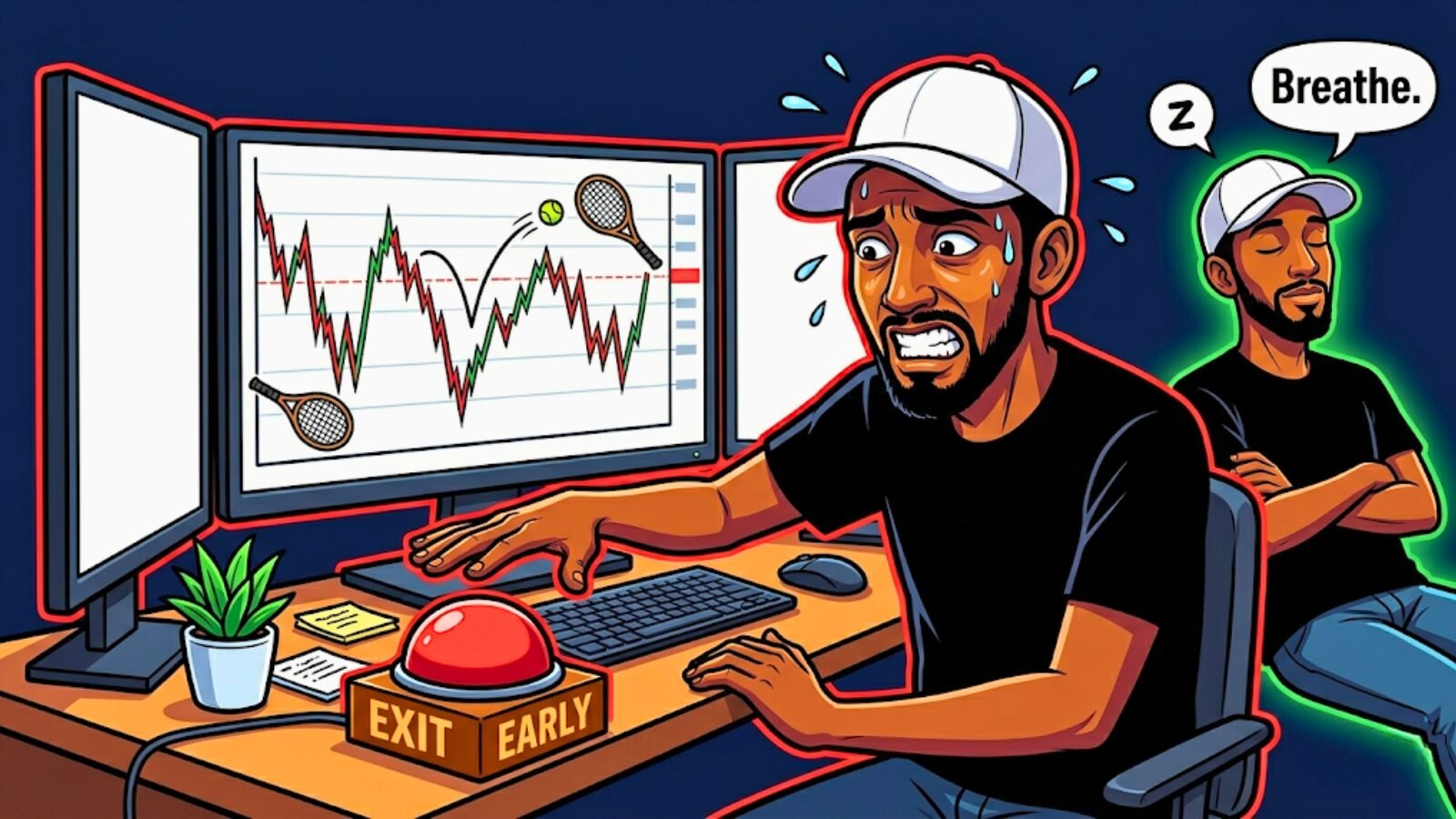
Emotions are not going away. The question is where they are being directed. When emotional energy gets tied to monetary outcomes, specifically to the P&L number updating in real time, that is when interference shows up. It shows up as closing a position too early because it hurts to watch. It shows up as holding too long because walking away from a loser feels like admitting something. It even shows up in fully automated systems, where traders who swore they would never interfere end up overriding or tweaking their own automation after a drawdown.

The shift that actually works for most is redirecting that emotional energy toward what is within control. Position sizing. Risk parameters. Hold duration. The execution of the plan. Those are things a trader can control. The monetary outcome of a filled order is not, and trying to control it emotionally creates friction that costs more over time than the original discomfort ever would have.

This is something I wrote about at length in Pull the Trigger: How to Stop Missing the Trades That Pay. Moving the pain away from the P&L and toward the accuracy of execution changes the entire emotional relationship with trading. When missing a trade hurts more than losing on one, the motivation to follow the plan gets a lot stronger.

Physical Health Is Part of the Trading System

This came up in a real way during this session, and it is something that deserves more attention than the trading community usually gives it.

There is a direct connection between physical condition and mental performance. That is not a soft claim. It shows up in how long focus can be sustained during a session, how quickly the mind resets after a loss, how steady the emotional baseline is when volatility spikes.

The traders who have neglected this and experienced a health crisis mid-career know how fast things can unravel. A trading system that was working, with statistics to back it up, can become nearly unusable when the body is not operating well. Not because the system changed, but because the person running it is compromised.

Starting self-care early in a trading career is not a luxury. It is a compounding investment in performance. Every session benefits from it, even if the connection is not obvious in the moment.

This means treating physical health as part of the trading process, not as something that happens after trading is figured out. Fitness, sleep, nutrition, stress management. These are not separate from the system. They are the foundation the system runs on.

Tools That Support the Process Without Adding to the Load

One of the ongoing challenges for a trader who also creates content is building a workflow that serves both without one of them suffering.

Session recordings are valuable on both sides. For the trader, they serve as game film. For the audience, they provide a transparent look at a real trading process. But editing raw session footage is a significant time commitment, and the tools have to be right.

During this session, some time went into exploring Descript’s Creator package for handling both trading session recordings and other video content. Their features for automating social media clips is worth testing. YouTube Studio’s native editing tools were also evaluated and found to be too limited for what detailed session content actually requires.

The principle here is straightforward. Any tool added to the workflow has to earn its place. If it adds more friction than it removes, it is not the right tool yet. The goal is to find setups that serve both the trading process and the content pipeline without creating new problems to manage.

Sponsored Zoi Teli'a
Feel your best. Trade your best. Your mindset is your edge. It starts with how you feel.
Shop Now →

The Whole System, Not Just the Chart

A trading system is not just what happens on the screen. It is also how a trader prepares before the session, how positions get managed while they are open, and how the person sitting at the desk is taking care of themselves day to day.

Most of the energy in trading education goes to the first third. The setup → The signal → The entry → The financial outcome. That is important, but it is not complete.

No-trade days are a reminder that the business of trading involves a lot more than the trades themselves. Research gets done. Frameworks get refined. The self-management piece gets the attention it usually does not get during active sessions.

The trader who puts real work into all three components of the trifecta, preparation, position management, and self-management, is building something that holds up over time. The one who only works on signals and exits is building something fragile, and will likely not understand why when it starts to break down.

Trade it easy ✌🏾

Meme illustration showing two traders: one flipping a desk after one bad session, and one sitting calmly with a journal and a green chart, representing the audit mindset in trading.

Short-Term Noise, Long-Term Focus: The Discipline Behind Trader Confidence

Trading is risky! Past performance does not guarantee future results. Click here to read our full Disclaimer

Not every session goes as planned. That is just part of trading. Some days the market cooperates. Some days it does not. And on the days it does not, most traders start to question everything. The strategy. The process. Themselves.

That is the trap.

What separates traders who stay consistent from those who spiral after a rough day is not a better strategy or a better read on the market. It is discipline in the process, and a long enough view to understand that one session, or even one rough week, does not define the career.

The Audit Mindset: Why Regular Strategy Reviews Are Non-Negotiable

Most traders only sit down to seriously review their strategy when something goes wrong. A bad stretch happens, the losses stack up, and then suddenly it is time to figure out what is broken. That is reactive thinking, and reactive thinking leads to reactive changes that are almost never the right call.

A better approach is to schedule strategy audits before anything feels broken.

The difference between a daily review and a strategy audit is important. A daily review reminder for that session of what criteria to focus on, what signals to be aware of, how to stay locked in to the plan no matter how the market moves. That is something that should happen every single day. But an audit is deeper. It looks at the strategy itself over a longer stretch, ideally a month or a quarter, to assess overall health.

A real audit should include:

  • Best performing sessions
  • Worst performing sessions
  • Performance metrics across a meaningful sample of trades
  • Documentation through screen recordings and journal notes

What this process does is take the “when should I change something?” question off the table. Instead of constantly second-guessing whether the strategy needs adjusting, that question gets answered at a scheduled time, with real data, not emotion.

Audits also do something else that does not get talked about enough. They keep a trader sharp on the details of their own system. Over time, even the most disciplined traders can let the smaller nuances of a strategy drift into the background. The audit brings it all back into focus.

When to Modify Your Strategy (And How to Know)

Changing a strategy in the middle of a rough stretch is one of the fastest ways to make things worse. There are similarities, but the market does not print the same way twice, and when the pressure is on, it is easy to convince yourself that the strategy is broken when it is not.

The smarter move is to let the data do the talking.

After collecting weeks or months of session logs, there is something to actually work with. Patterns start to emerge. Certain trigger types may show consistent underperformance. Some setups may need sharper criteria. Others may need to be removed altogether. But that decision should come from looking at the historical record, not from how the last few sessions felt.

There is a meaningful difference between sharpening trigger criteria and removing a trigger entirely. Sharpening means the setup still has merit, but the certian conditions need to be more specific. Removing means the data is pointing to something that is just not producing results across a wide enough sample. Both are valid. But neither should be done in the heat of a bad stretch.

Patience is the skill here. And patience is hard when money is on the line. That is exactly why having a scheduled audit removes so much of that pressure. The question is no longer “should I change this now?” It is “I will assess this on the first Saturday of the month, and then I will know.”

Documentation as a Confidence Tool

One of the most underrated tools in a trader’s process is documentation. Not just journaling trades, but documenting the actual setup. Chart configurations. Platform settings. The reasoning behind why things are built the way they are.

In this session a small moment of doubt crept in about whether a signal was being read correctly. It happens. But because the strategy had been reviewed that morning, as it is every morning, the doubt was resolved quickly. The reference was right there. The analysis was confirmed, and the session moved forward.

That is the real value of documentation. Not as a compliance exercise. Not just to have records. But as a confidence tool that kicks in exactly when it is needed most.

Screenshots and screen recordings are simple and practical for this. When a chart setup or platform configuration is dialed in, record it. It takes a few minutes and can save hours of trying to reconstruct something that worked but got lost in an update or a reset.

Pull the Trigger: How to Stop Missing the Trades That Pay speaks directly to this kind of internal alignment. Knowing the system. Trusting the system. And having the documentation to back up that trust when doubt shows up uninvited.

Attention Is the Real Value

Markets move to the places where attention is concentrated. That is not a theory. That is just how markets works.

When a significant portion of participants have built strategies around the same reference points, those areas will naturally attract orders. The chart tools, the indicators, the automation levels, the VWAP, all of it carries value. Not because of the math behind it, but because people pay attention to it. And where attention goes, orders follow.

A lot of retail traders understand this conceptually but struggle to trust it when it matters. Instead of staying anchored to the process and the analysis, they start looking outward. Checking what others are saying. Seeking confirmation from outside sources. Waiting for permission to act on what their own system is telling them.

That habit erodes confidence faster than any losing trade ever could.

The shift from seeking external validation to trusting an internally documented process is one of the biggest steps any trader can take. It is not about being arrogant about the analysis. It is about doing the work, building the records, and then having the discipline to lean on what has been built.

Attention is the real currency in this business. And building a process around where that attention concentrates is where the edge actually lives.

Staying in the Long Game

Short-term performance is not a reliable measure of strategy health. That might be obvious when said out loud, but it is easy to forget when in the middle of a rough stretch.

A few weeks or even a few months of underperformance does not mean a strategy is broken. Markets go through different phases of volatility shifts and varied conditions. A strategy that is built around sound logic and consistently applied will go through periods where results feel frustrating. That is normal.

What is not normal, and what tends to create the most damage, is abandoning something too early because of short-term noise. The discipline required to hold a long view while staying fully present in each session is one of the harder things to develop. But it is also one of the most valuable.

Staying consistent with your routine and approach over a longer period matters more than any single session outcome. One expense for the day does not change the trajectory of a well-built process. What matters is that the process stays intact, that the decisions being made are grounded in the system, and that the daily review routine continues without interruption.

That routine is the anchor. When markets get uncertain, the routine brings everything back to center.

Sponsored Zoi Teli'a
Feel your best. Trade your best. Your mindset is your edge. It starts with how you feel.
Shop Now →

Tools That Support the Process (Not Replace It)

Charting tools, automation levels, journaling platforms, footprint charts, all of it can be incredibly useful. But tools only work as well as the system built around them.

One of the more practical lessons learned over time is that documenting how tools are configured is just as important as using them correctly. It is easy to forget the specific settings on a chart that took a long time to dial in. When a platform resets or a workspace gets rebuilt, those settings do not come back automatically. Screenshots and screen recordings solve that problem simply and directly.

More broadly, tools should be used intentionally. The value is not in having access to the most sophisticated setups. The value is in understanding exactly what each tool is showing, why it matters, and how it fits into the overall strategy. That depth of understanding only comes from time with the system, consistent use, and yes, documentation.

The Discipline Behind Consistency

Discipline in this business is not about being perfect. It is not about never having an expense or always knowing exactly what the market is going to do. It is about building a process that holds up across all kinds of market conditions, reviewing that process consistently, and trusting the work that has been put into it.

The audit mindset is part of that. Documentation is part of that. A daily review routine is part of that. And so is the long view: understanding that this is not a short game, and that the goal is not to judge an entire strategy off of what happened on any given Tuesday.

For traders still working through the mental side of executing a system, Pull the Trigger: How to Stop Missing the Trades That Pay is a resource built around exactly those challenges. The psychological barriers that keep traders from acting on what they know, and how to move through them.

The tools and the strategy matter. But the mindset holds everything together.

Trade it easy ✌🏾

A well-dressed man being stopped by a bouncer at a velvet rope, representing the difference between seeing a trading setup and having permission to act on it. Text reads: "You see the setup. The plan says no."

Awareness Isn’t a Greenlight: Trading What’s in the Plan, Not What You See

Trading is risky! Past performance does not guarantee future results. Click here to read our full Disclaimer

There was a moment in today’s session where a setup printed clean on the chart, and the first thought wasn’t that’s a setup. It was, I didn’t want it to be tradable, but it is.

That sentence stuck with me long after the close. It wasn’t really about the trade. It was about the gap between seeing a thing and being cleared to act on it. That gap is where a lot of trading decisions slip. Not from lack of skill, but from confusing awareness with permission.

This post is about three things that decide what happens inside that gap. The first is psychology. The second is the tools that hold the process up. The third is the testing pipeline that says what is actually allowed in the plan. Pull any one of those out, and the whole thing starts to lean.

Show Up Even When the Feeling Isn't There

Some mornings, staying in bed sounds better than the open. That happened to me on this day. The feeling was, let’s get some more sleep, skip the day. However, I got up anyway. Not because feelings are bad. It’s a perfectly human response to not feel up to it sometimes. The thing is, I love the business of day trading. So I show up.

Trading only when motivation is high can make it harder to build momentum and consistency over time. The market still shows up on the low-energy mornings, so the edge comes from having a routine that is realistic and sustainable, even when the feeling is not there.

Showing up does not mean forcing trades. It means getting to your desk, running the premarket routine, and letting the day decide what it is. If the day has nothing for the system, that’s fine. The win is showing up and getting in your reps. Once that becomes routine, the low-motivation mornings stop feeling like threats. They become just another start to a normal session.

Awareness Isn't a Greenlight

There’s a big difference between seeing a pattern and being allowed to trade it.

A setup printed that I noticed and named, but I did not take. The thinking was simple. That setup is not greenlit yet. It hasn’t been tested through replay or forward testing. It hasn’t been logged across enough sessions. So it stays in what I call the back pocket. It’s awareness, not action.

A lot of traders skip this step. Something looks good, so it gets traded. The problem isn’t that the setup is bad. The problem is that the trader has no way to know yet. Without testing, the next time it shows up the move could play the opposite way, and there’s no rulebook for what to do when it does. That is how an untested setup quietly slips into live execution and starts mixing with the trades that have actually earned their place.

The back pocket protects the plan. It lets the trader stay observant in real time without bending the rules. And it pays off later, because every back pocket observation becomes a candidate for the testing pipeline. Instead of being one-off impulse trades, those observations become future system inputs. The lesson I keep coming back to is this: seeing it is not trading it. Every clean read is a candidate for tomorrow’s plan, not today’s order.

Pull the Trigger: How to Stop Missing the Trades That Pay leans on the same point. The fastest path to confidence is removing as much of the unknown as possible. The back pocket does that one observation at a time.

The Hindsight Capital Trap

Hindsight Capital is the running highlight reel that shows up in real time. It’s the voice that says, I could have done this, that, and the third, right after the chart finishes a move.

That voice is loud. It is also cheap. Hindsight is always free.

The right question to ask when that voice gets loud is this: was there anything that could have been seen in real time, before the move, that would let a repeatable signal get built around it? If the answer is yes, that observation has a future. It goes into the testing pipeline. If the answer is no, it stays a story. A nice story, but a story.

A one-off “look what just happened” doesn’t qualify as a system input. A signal earns its spot only if it survives game film, backtesting, and real-time data in a simulated environment. Skipping that filter is how a trader starts chasing pretty echoes of patterns instead of trading the system that has actually been validated.

Indicators show this in plain sight. There’s a crowd that calls indicators useless. But if a tool reliably points to where activity is concentrating, calling that information useless is a choice. The way I phrased it during the session: how can identifying exactly where an algorithm is executing be useless information? It isn’t. The choice to ignore it is what makes it useless.

Hindsight capital becomes a problem only when it tricks the trader into acting on stories instead of signals. Logged honestly, it becomes raw material. Acted on impulsively, it becomes drawdown.

Confirmation Cuts Both Ways

Most traders worry about looking for confirmation that says yes when they want a trade to be real. That’s the well-known trap.

The version that almost no one talks about is the opposite. Looking for confirmation that says no when the trader doesn’t want the setup to be valid.

That is exactly what happened here. The print showed up, the system said it was tradable, and the immediate reaction was, I didn’t want it to be tradable, but it is. So the trigger got skipped. Then the move went, and the chase started. The retrace got an order placed on it. No fill. Hindsight said the first chance was the only clean one.

The cost of that pattern is not the missed trade. The cost is the next ten missed trades, because once a trader starts hunting for reasons not to take a setup, the brain gets very good at finding them. Engulfing print? Skip. Sitting on the line? Skip. Doesn’t feel right? Skip.

Naming the pattern out loud is half the cure. I’m looking for confirmation that says no. That sentence kills the loop. A pattern can’t be corrected if it isn’t admitted. Verbal journaling during the session catches it in the moment, when it can still be fixed.

Calling an Audible vs. Rationalizing

Sometimes the next trigger gets taken even when the trader doesn’t love the setup, on purpose, to avoid sliding into trigger-shy mode.

Sometimes the position gets closed earlier than the original target, at a logical reference point that already lives in the plan, instead of forcing the full play.

Both can be smart. Both can also be cover stories. The difference matters.

Here’s the litmus test I use: can this decision get tied back to plan logic, or is it getting tied back to a feeling? If it ties back to plan logic, it’s an audible like a quarterback adjusting the play to another play in the playbook by what he reads in the defense. If it ties back to a feeling, it’s rationalizing.

In this session, position two got closed at a known automation point in the area, not the original target. The reason was clear. The area was full of “indecision”. The exit point was already a reference inside the strategy. That made it an audible. The trade can still work, the read can still be wrong, and the decision is still clean.

Compare that to closing because the chart “feels off” with no plan reference. Same exit price, completely different decision. One builds the system. The other slowly tears it down. Both look identical on the trade log. The journal is where the difference lives.

Sponsored Zoi Teli'a
Feel your best. Trade your best. Your mindset is your edge. It starts with how you feel.
Shop Now →

Tools That Earn Their Spot in the Stack

A tool only earns its spot if it actually gets followed.

The indicator debate is a good example. Tools don’t pull the trigger. They sharpen the read. They map out where decisions are likely to get made. That’s their job. Calling that map useless because someone chose not to look at it doesn’t change what it shows.

The supporting tools matter just as much as the chart tools. A short tour of what holds the process up day to day:

  • A live journaling system with templates and shortcuts. Quickly naming the moment with short verbal tags (not explaining it) makes it easier to stay focused while still creating clean labels for journaling and replay.
  • A premarket awareness routine and a checklist that survive a low-motivation day. The checklist doesn’t care how the trader feels. Logging your feeling for the day inside the checklist can be valuable information for future reference.
  • Predetermined hard stops. A visual cue, a timer, anything that ends the trading day for the trader instead of leaving it up to the trader to decide in the moment.

In the session that started this post, the red background warning was that cue. Once it showed up, the day was over. No debate, no extra setup, no “just one more.” That is what a trusted tool looks like. The trader follows it.

The deeper version of this layered approach lives in Pull the Trigger: How to Stop Missing the Trades That Pay, and a lot of what’s covered there came straight out of journaling sessions like this one.

Build, Test, Greenlight

Every greenlit setup walks through the same pipeline.

  1. Observe a pattern in live action.
  2. Name it and log it, with screenshots and game film attached.
  3. Backtest it through replay and historical sessions.
  4. Test it in real-time with simulated orders.
  5. Greenlight it into the plan only if it’s repeatable and rule-based.

That’s it. Until step five, the setup stays out of live execution, even when it looks obvious in the moment. The setup that printed in that session was a clean example. The pattern was real. The observation got logged. But the rules around it were not built yet, so the trade did not get taken. It went into the back pocket.

This loop only runs if there are consistency mechanisms holding it up. Daily review is the first one. Public reps, like livestreaming the session or trading with a partner/group, are another. Streaming forces a level of accountability that’s almost impossible to fake. So does logging every position the same way, every day, even on quiet sessions.

A community that holds the same standard makes the loop stronger. The gap between I think this works and I have proven this works is wide. The pipeline is what closes it.

Trade the Plan That's Already Been Earned

Awareness is not action. Hindsight is not foresight. Feel is not plan.

The cleanest trades come from the patterns that already had permission to be taken. Everything else, the setup that almost qualifies, the move that would have paid, the trigger that probably works, belongs in the back pocket until the testing pipeline says otherwise. That is how a system stays a system instead of slowly becoming a collection of impulses.

For traders working through the same gap between awareness and action, Pull the Trigger: How to Stop Missing the Trades That Pay goes deeper into the routines, the journaling, and the mindset shifts that built this approach over time.

Trade it easy ✌🏾