Trading is risky! Past performance does not guarantee future results. Click here to read our full Disclaimer

There was a moment in today’s session where a setup printed clean on the chart, and the first thought wasn’t that’s a setup. It was, I didn’t want it to be tradable, but it is.
That sentence stuck with me long after the close. It wasn’t really about the trade. It was about the gap between seeing a thing and being cleared to act on it. That gap is where a lot of trading decisions slip. Not from lack of skill, but from confusing awareness with permission.
This post is about three things that decide what happens inside that gap. The first is psychology. The second is the tools that hold the process up. The third is the testing pipeline that says what is actually allowed in the plan. Pull any one of those out, and the whole thing starts to lean.
Show Up Even When the Feeling Isn't There
Some mornings, staying in bed sounds better than the open. That happened to me on this day. The feeling was, let’s get some more sleep, skip the day. However, I got up anyway. Not because feelings are bad. It’s a perfectly human response to not feel up to it sometimes. The thing is, I love the business of day trading. So I show up.
Trading only when motivation is high can make it harder to build momentum and consistency over time. The market still shows up on the low-energy mornings, so the edge comes from having a routine that is realistic and sustainable, even when the feeling is not there.
Showing up does not mean forcing trades. It means getting to your desk, running the premarket routine, and letting the day decide what it is. If the day has nothing for the system, that’s fine. The win is showing up and getting in your reps. Once that becomes routine, the low-motivation mornings stop feeling like threats. They become just another start to a normal session.
Awareness Isn't a Greenlight
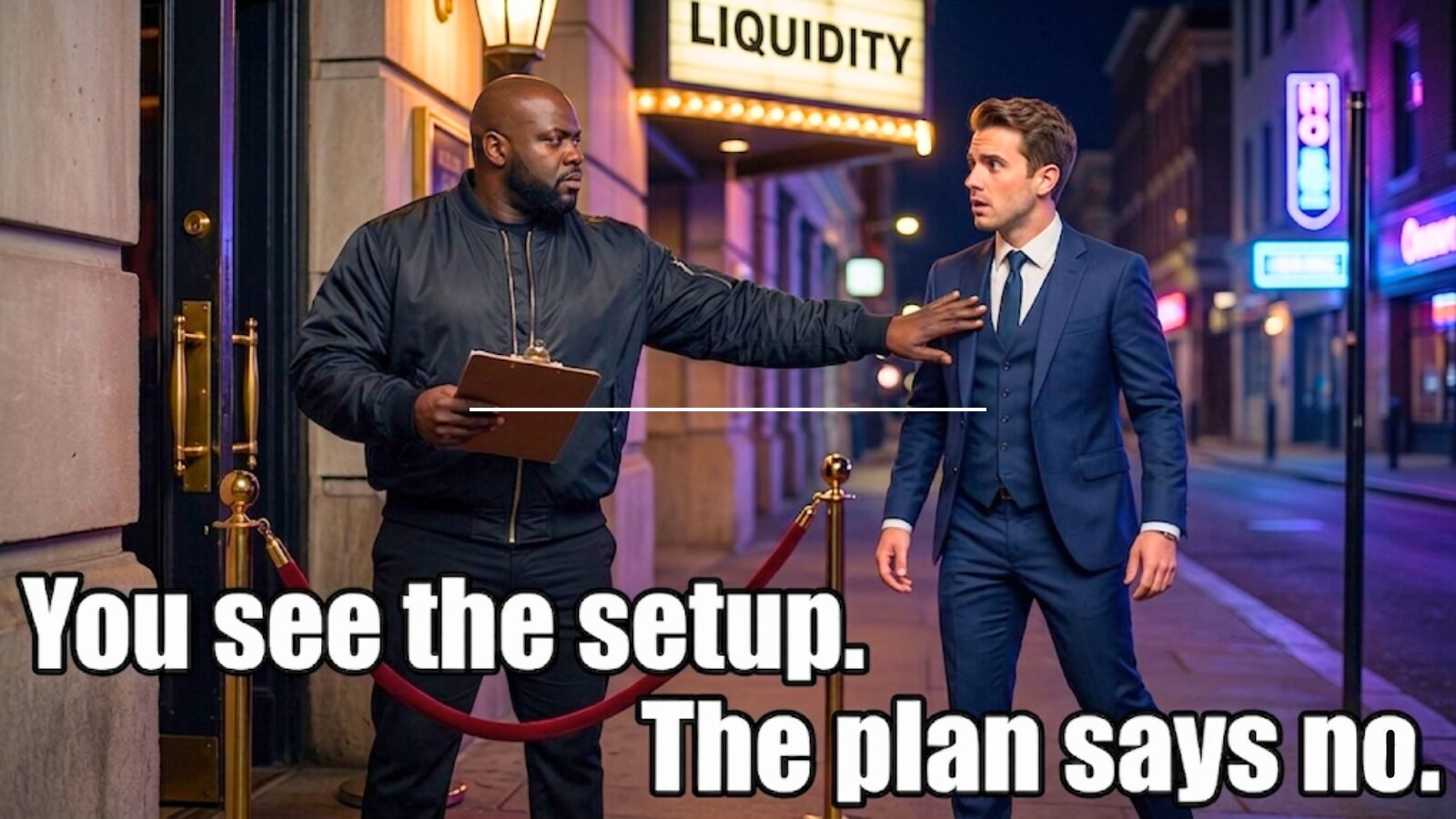
There’s a big difference between seeing a pattern and being allowed to trade it.
A setup printed that I noticed and named, but I did not take. The thinking was simple. That setup is not greenlit yet. It hasn’t been tested through replay or forward testing. It hasn’t been logged across enough sessions. So it stays in what I call the back pocket. It’s awareness, not action.
A lot of traders skip this step. Something looks good, so it gets traded. The problem isn’t that the setup is bad. The problem is that the trader has no way to know yet. Without testing, the next time it shows up the move could play the opposite way, and there’s no rulebook for what to do when it does. That is how an untested setup quietly slips into live execution and starts mixing with the trades that have actually earned their place.
The back pocket protects the plan. It lets the trader stay observant in real time without bending the rules. And it pays off later, because every back pocket observation becomes a candidate for the testing pipeline. Instead of being one-off impulse trades, those observations become future system inputs. The lesson I keep coming back to is this: seeing it is not trading it. Every clean read is a candidate for tomorrow’s plan, not today’s order.
Pull the Trigger: How to Stop Missing the Trades That Pay leans on the same point. The fastest path to confidence is removing as much of the unknown as possible. The back pocket does that one observation at a time.

The Hindsight Capital Trap
Hindsight Capital is the running highlight reel that shows up in real time. It’s the voice that says, I could have done this, that, and the third, right after the chart finishes a move.
That voice is loud. It is also cheap. Hindsight is always free.
The right question to ask when that voice gets loud is this: was there anything that could have been seen in real time, before the move, that would let a repeatable signal get built around it? If the answer is yes, that observation has a future. It goes into the testing pipeline. If the answer is no, it stays a story. A nice story, but a story.
A one-off “look what just happened” doesn’t qualify as a system input. A signal earns its spot only if it survives game film, backtesting, and real-time data in a simulated environment. Skipping that filter is how a trader starts chasing pretty echoes of patterns instead of trading the system that has actually been validated.
Indicators show this in plain sight. There’s a crowd that calls indicators useless. But if a tool reliably points to where activity is concentrating, calling that information useless is a choice. The way I phrased it during the session: how can identifying exactly where an algorithm is executing be useless information? It isn’t. The choice to ignore it is what makes it useless.
Hindsight capital becomes a problem only when it tricks the trader into acting on stories instead of signals. Logged honestly, it becomes raw material. Acted on impulsively, it becomes drawdown.
Confirmation Cuts Both Ways
Most traders worry about looking for confirmation that says yes when they want a trade to be real. That’s the well-known trap.
The version that almost no one talks about is the opposite. Looking for confirmation that says no when the trader doesn’t want the setup to be valid.
That is exactly what happened here. The print showed up, the system said it was tradable, and the immediate reaction was, I didn’t want it to be tradable, but it is. So the trigger got skipped. Then the move went, and the chase started. The retrace got an order placed on it. No fill. Hindsight said the first chance was the only clean one.
The cost of that pattern is not the missed trade. The cost is the next ten missed trades, because once a trader starts hunting for reasons not to take a setup, the brain gets very good at finding them. Engulfing print? Skip. Sitting on the line? Skip. Doesn’t feel right? Skip.
Naming the pattern out loud is half the cure. I’m looking for confirmation that says no. That sentence kills the loop. A pattern can’t be corrected if it isn’t admitted. Verbal journaling during the session catches it in the moment, when it can still be fixed.
Calling an Audible vs. Rationalizing
Sometimes the next trigger gets taken even when the trader doesn’t love the setup, on purpose, to avoid sliding into trigger-shy mode.
Sometimes the position gets closed earlier than the original target, at a logical reference point that already lives in the plan, instead of forcing the full play.
Both can be smart. Both can also be cover stories. The difference matters.
Here’s the litmus test I use: can this decision get tied back to plan logic, or is it getting tied back to a feeling? If it ties back to plan logic, it’s an audible like a quarterback adjusting the play to another play in the playbook by what he reads in the defense. If it ties back to a feeling, it’s rationalizing.
In this session, position two got closed at a known automation point in the area, not the original target. The reason was clear. The area was full of “indecision”. The exit point was already a reference inside the strategy. That made it an audible. The trade can still work, the read can still be wrong, and the decision is still clean.
Compare that to closing because the chart “feels off” with no plan reference. Same exit price, completely different decision. One builds the system. The other slowly tears it down. Both look identical on the trade log. The journal is where the difference lives.
Tools That Earn Their Spot in the Stack
A tool only earns its spot if it actually gets followed.
The indicator debate is a good example. Tools don’t pull the trigger. They sharpen the read. They map out where decisions are likely to get made. That’s their job. Calling that map useless because someone chose not to look at it doesn’t change what it shows.
The supporting tools matter just as much as the chart tools. A short tour of what holds the process up day to day:
- A live journaling system with templates and shortcuts. Quickly naming the moment with short verbal tags (not explaining it) makes it easier to stay focused while still creating clean labels for journaling and replay.
- A premarket awareness routine and a checklist that survive a low-motivation day. The checklist doesn’t care how the trader feels. Logging your feeling for the day inside the checklist can be valuable information for future reference.
- Predetermined hard stops. A visual cue, a timer, anything that ends the trading day for the trader instead of leaving it up to the trader to decide in the moment.
In the session that started this post, the red background warning was that cue. Once it showed up, the day was over. No debate, no extra setup, no “just one more.” That is what a trusted tool looks like. The trader follows it.
The deeper version of this layered approach lives in Pull the Trigger: How to Stop Missing the Trades That Pay, and a lot of what’s covered there came straight out of journaling sessions like this one.
Build, Test, Greenlight
Every greenlit setup walks through the same pipeline.
- Observe a pattern in live action.
- Name it and log it, with screenshots and game film attached.
- Backtest it through replay and historical sessions.
- Test it in real-time with simulated orders.
- Greenlight it into the plan only if it’s repeatable and rule-based.
That’s it. Until step five, the setup stays out of live execution, even when it looks obvious in the moment. The setup that printed in that session was a clean example. The pattern was real. The observation got logged. But the rules around it were not built yet, so the trade did not get taken. It went into the back pocket.
This loop only runs if there are consistency mechanisms holding it up. Daily review is the first one. Public reps, like livestreaming the session or trading with a partner/group, are another. Streaming forces a level of accountability that’s almost impossible to fake. So does logging every position the same way, every day, even on quiet sessions.
A community that holds the same standard makes the loop stronger. The gap between I think this works and I have proven this works is wide. The pipeline is what closes it.
Trade the Plan That's Already Been Earned
Awareness is not action. Hindsight is not foresight. Feel is not plan.
The cleanest trades come from the patterns that already had permission to be taken. Everything else, the setup that almost qualifies, the move that would have paid, the trigger that probably works, belongs in the back pocket until the testing pipeline says otherwise. That is how a system stays a system instead of slowly becoming a collection of impulses.
For traders working through the same gap between awareness and action, Pull the Trigger: How to Stop Missing the Trades That Pay goes deeper into the routines, the journaling, and the mindset shifts that built this approach over time.
Trade it easy ✌🏾



