Trading is risky! Past performance does not guarantee future results. Click here to read our full Disclaimer

Not every losing session means something is broken. Sometimes a bad day is just a bad day. The market did not cooperate, conditions were not ideal, and the results reflected that. Nothing more.
But then there are sessions that are telling a different story. Not a single bad day, but a pattern. Multiple positions, across multiple sessions, all pointing in the same direction. That kind of consistency in the wrong direction is not noise. It is data. And data is worth listening to.
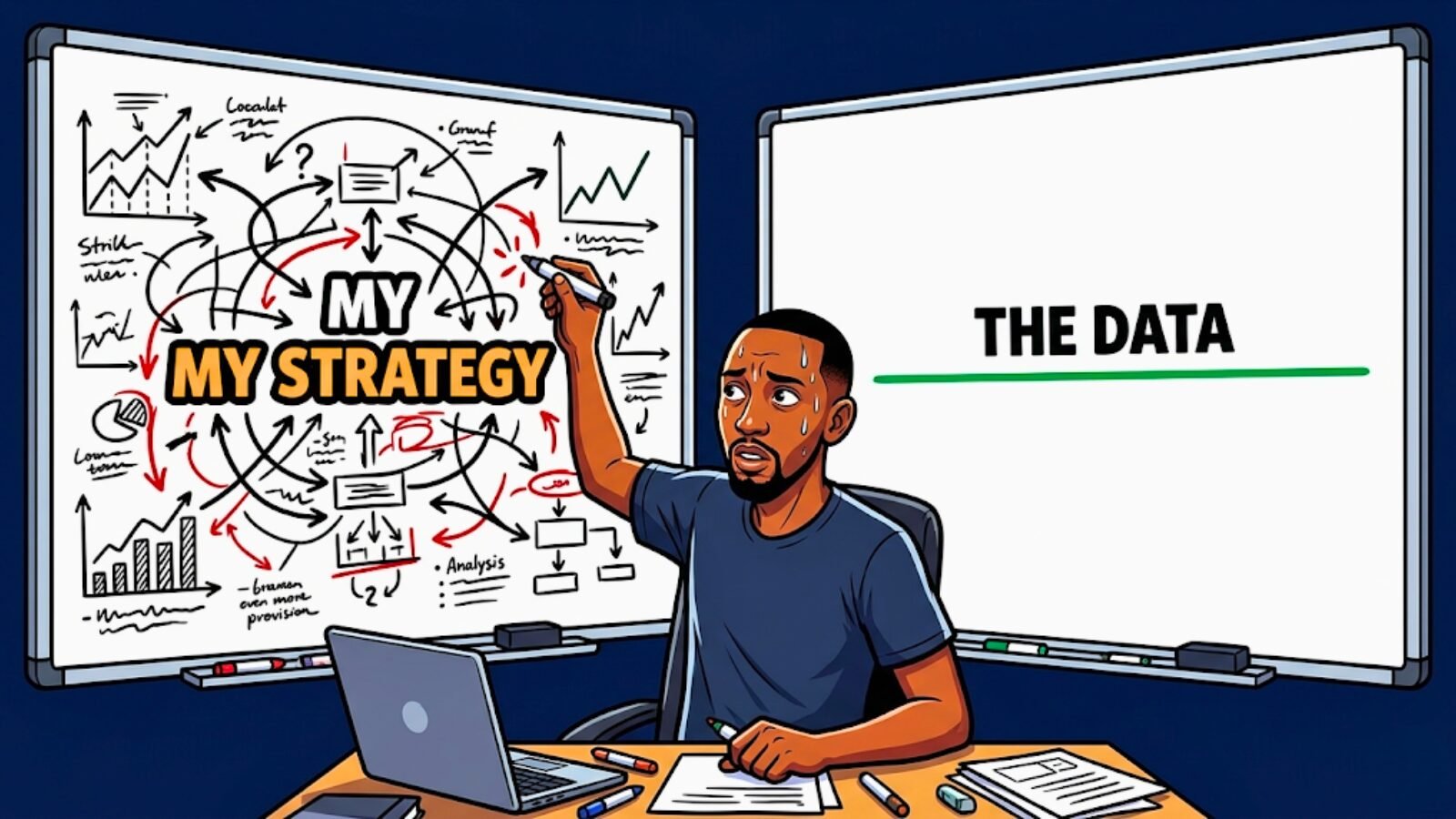
This session was one of those. Every position was an expense. A technical issue created confusion mid-session. A rule got bent that was warranted for fully troubleshooting the technical issue. And when it was all said and done, the most valuable thing that came out of it was not on the chart at all. It was a clear signal that a full strategy reassessment is reasonable at this point.
A session that costs money but produces a plan is not a failure. It is information with a price tag.
What Are Consistent Losses Actually Telling You?
There is a temptation after a rough session to treat it as a verdict. The strategy does not work. Something needs to change immediately. Blow it up and start over.
That reaction is almost always premature, and it is driven by emotion rather than evidence.
A single session is not a sample size. Even two or three in a row is not enough to draw a reliable conclusion about a strategy’s actual performance. What consistent losses across a meaningful number of sessions are actually telling a trader is simpler than that: it is time to look closer. Not react. Look.
The distinction matters. Reacting means making changes under emotional pressure, in the middle of a rough stretch, without the data to back up the decision. Looking means pulling the historical record, reviewing the sessions objectively, and asking the right questions before touching anything.
Sessions are data points, not verdicts. The trader who understands that has a structural advantage over the one who rewrites the strategy every time the results get uncomfortable.
How Much Data Is Enough Before Making a Change?
This is one of the most practical questions in trading and one of the least discussed.
The honest answer is that there is no universal number. But there is a principle that holds up: the decision to modify a strategy should never be made from a sample size so small that market variance alone could explain the results.
Three months of active session data is a reasonable floor. Not just three months of watching the market. Three months of actual execution, documented sessions, and tracked outcomes across different market conditions. That timeframe tends to capture enough variety, different volatility environments, different volume profiles, different macro conditions, to give a clearer picture of whether the strategy is underperforming or whether the market just ran through an unfavorable phase.
Simulated environments help here too. Prop firms and paper trading platforms are not just for beginners. They are real-world behavioral labs. The decisions made under simulated conditions, with a fraction of the capital at risk, are real decisions. The psychological patterns that show up are real patterns. That data is worth something, and it is far cheaper to collect than the same data gathered with full capital on the line.
Real data always beats arbitrary numbers when defining risk thresholds. A trader who sets expense limits based on what feels reasonable is guessing. A trader who sets them based on collected session data is building something defensible.

What Should the Protocol Be When a Technical Issue Hits Mid-Session?
This came up directly this session and it deserves its own treatment because technical issues in live trading are a certainty, not a possibility.
- An unexpected alert from the platform.
- An order that does not confirm the way it should.
- A chart that freezes at the worst possible moment.
These things happen. The question is not whether they will occur. The question is whether there is a rule in place before they do.
Without a pre-decided protocol, a technical issue becomes a real-time judgment call made under stress, with capital on the line, and with split attention between the problem and the position. That combination produces bad decisions consistently.
The rule that has held up over time is straightforward:
No open position when the issue occurs?
→ Stop trading, resolve the issue completely, then reassess whether to continue the session.
Open position when the issue occurs?
→ Close the position first, then resolve the issue, then reassess.
The order of those steps matters. Trying to resolve a technical problem while holding an open position is trying to do two things at once in a high-pressure environment. That split focus is where emotions spiral and mistakes compound.
Having the rule before the problem is the only version that actually works. A rule decided in the middle of a crisis is not a rule. It is a guess with a justification attached to it.
Why Is Checking P&L Mid-Session a Problem?
There is a rule worth keeping that is harder to follow than it sounds: once attention goes to the P&L during a live session, the session comes to an end IMMEDIATELY.
The reason is straightforward. The moment focus shifts from execution to outcome, the decision-making framework changes. Entries get taken to recover losses. Exits get held longer than the plan calls for. Positions get sized differently based on what the account is up or down rather than what the setup warrants.
None of those adjustments are based on what the market is doing. They are based on your desires around what the account balance is doing. And the market does not care how your account balance aligns with your desires.
This session included a moment where looking at the P&L became necessary to understand what had happened during a technical issue. That is an understandable exception. But continuing to trade after that moment is where the rule got bent. Naming that clearly, without blame and without excuses, is part of what makes the next session cleaner.
Accountability is not the same as self-criticism. It is just an honest reading of what happened so the next decision can be better.
What Is the Only Trading Goal That Is Actually Within Control?
My goal in any session is not to be profitable. That outcome is influenced by too many variables outside of any single trader’s control: market conditions, volatility, participant behavior, news events, algorithmic activity, just to name a few.
The goal that is fully within control is 100% accuracy with the plan. Did the triggers taken match the criteria? Were the exits executed according to the rules? Were the positions skipped for the right reasons? That standard can be met in a losing session and missed in a winning one.
This reframe does not ignore results. It just puts them in the right order. Full attention goes to the process first. Results follow from process, over a large enough sample. Chasing results directly, at the expense of process, is how a strategy that was working gets distorted until it is unrecognizable.
The drawdown experienced in this session is recoverable. Drawdowns always are, as long as the process stays intact. What is much harder to recover from is the version where the process gets abandoned mid-drawdown and the trader ends up with neither results nor a functioning system.
How Do You Reassess a Strategy Without Overreacting?
There is a meaningful difference between reassessing and reacting. Reacting happens in the heat of a rough stretch. Reassessing happens with data, structure, and a clear set of questions.
A useful starting point is separating two questions that often get conflated: is the system broken, or is the application off?
A broken system means the logic behind the approach no longer fits the market it was built for. Application issues mean the system is sound but the execution has drifted from the original criteria. Both are real problems, but they require completely different solutions. Changing the system to fix an application problem is one of the more common and costly mistakes in strategy development.
The approach I learned the hard way to apply religiously is to let the data lead. Mechanical responses from analytics tools are valuable, but they do not automatically translate to profitable outcomes. Understanding why a mechanical signal is or is not producing results requires looking at the full picture, including the conditions around the signal, the execution accuracy, and whether the risk parameters are calibrated correctly.
That review is now scheduled. Three or more months of data are available to work from. The session today, despite the expenses, produced the clarity and the motivation to do that work properly.
For traders working through the psychological side of staying grounded during a drawdown while preparing for a strategy review, Pull the Trigger: How to Stop Missing the Trades That Pay covers the mindset piece directly. Staying committed to the process when the results are not there is one of the harder skills to develop. It is also one of the most important.
A Losing Session Can Still Be a Productive One
The sessions that cost the most money are not always the ones that cost the most in the long run. The expensive ones, in the real sense, are the sessions where nothing gets learned, no patterns are recognized, and the same mistakes repeat without examination.
This session cost money. It also produced a scheduled strategy review, a reinforced technical issue protocol, and a named accountability point around a bent rule. That is a return on investment that shows up in future sessions, even if it does not show up in today’s results.
The traders who grow are the ones who treat data seriously, including the data that is uncomfortable to look at.
Solid foundations are built on simplicity. That includes the process of figuring out what is not working.
Trade it easy ✌🏾



