Trading is risky! Past performance does not guarantee future results. Click here to read our full Disclaimer

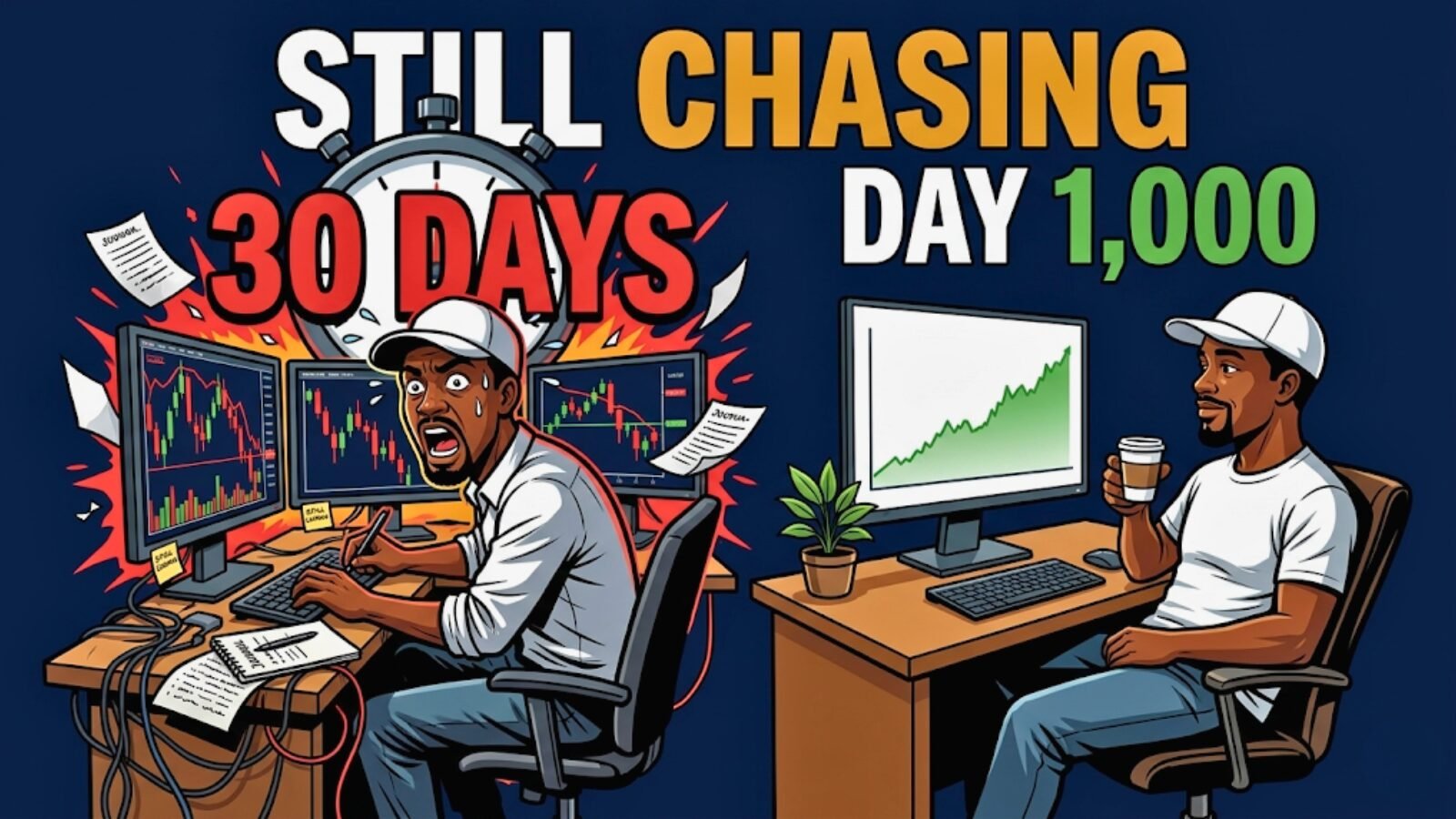
There is a version of trading culture on social media that makes it look like speed is the goal. Hit the payout fast. Go funded in 30 days. Scale up before the month is out. And if that is not happening, something must be wrong.
That version of trading is not the whole picture. And for a lot of developing traders, buying into it is one of the more expensive mistakes that gets made, not in dollars, but in confidence and clarity.
This session was a small expense on the scoreboard. One position, one trade window, charts that froze more than once. Not a highlight reel moment by traditional standard. But what came out of it was a simplified strategy, validated data from the night before’s study session, and a clearer mental framework for measuring progress on a timeline that actually makes sense.
Profitability is a byproduct of process mastery, not a race.
Is Social Media Giving Traders a False Picture of the Timeline?
The funded account payout content is everywhere. Traders posting screenshots of hitting targets in their first week. Comments full of “why haven’t you done this yet?” energy directed at anyone who is still in the development phase.
Here is what that content almost never shows: whether those results came from a repeatable, systems-based process or from an aggressive, high-risk approach that happened to hit on a few good days.
Fast results and sustainable trading are not the same thing. A trader who gambles their way to a quick payout and one who builds a disciplined, rules-based system over time are doing two completely different things. The timeline looks different because the activity is different. Treating those two paths as comparable creates a distortion that serves no one.
Jesse Livermore, one of the most studied traders in market history, took the better part of three decades to fully find his stride. And that was in an era with far less complexity than what exists today. Modern markets run on automated systems, algorithmic participants, layered liquidity dynamics, and a constant flood of information noise that simply did not exist in earlier eras. The environment is objectively harder to navigate. A longer development curve is not a character flaw. It reflects the complexity of what is being learned in relation to the uniqueness of the individual trader.
Your Time Is Your Time. Not to Be Compared.
Every trader enters the market with a different set of variables:
- Financial history
- Relationship with risk
- Psychological patterns
- Current responsibilities
- Personal beliefs and values
Just to name a few from the laundry list of personality traits built over years before a single trade was ever placed. All of this in addition to the differences in the amount of time available to dedicate to study, practice, and review.
None of those are visible in a social media post. What is visible is the highlight, which is almost always decontextualized from everything that shaped it.
Letting someone else’s timeline define what progress looks like is giving away the power to measure the journey accurately. That power belongs to the trader doing the work, and protecting it matters.
The practical response to comparison culture is simple: quiet the noise. Literally mute or block that noise, if needed. The accounts that trigger doubt or rush are not serving the process. Protecting focus is not weakness. It is part of the job.
As I noted in the Premarket Awareness of the journal as a reminder going into this particular morning: “Your time is your time, not to be compared.” That line landed differently after a night of studying strategy adjustments and showing up to a session that did not go the way the preparation suggested it might.

What Does It Look Like to Simplify a Strategy in Real Time?
The night before this session, time went into studying strategy adjustments. The result was a meaningful simplification: fewer trigger types, cleaner rules, more clarity about what the plan was actually asking for.
Going into the live session with a freshly adjusted approach is a different experience than going in with a system that has been running on autopilot for weeks. There is more attention on each moment because the plan is being watched in a new way. That is not a bad thing. It is part of how a system gets validated.
The session itself did not produce many opportunities under the new rules, which is actually useful data. A simplified system that generates fewer triggers is not automatically worse than a complex one that generates many. If the triggers it does generate are higher quality and more aligned with the overall logic of the approach, fewer can be better.
There is a difference between adjusting a strategy and abandoning it. Adjusting means taking what is already there and making it more precise. Abandoning means scrapping the logic entirely because the results got uncomfortable. The first comes from data. The second comes from frustration. Keeping that distinction clear is part of what makes a strategy review productive rather than reactive.
Can Breath Work Actually Change How a Trading Session Goes?
This session started after a night that did not produce ideal rest. That kind of start creates a real choice: push through with depleted focus or take a few minutes to reset before the screen time begins.
Breath work made the difference going into this particular session. Not as a motivational ritual, but as a practical tool for sharpening attention and settling the nervous system before making decisions that involve real capital.
The connection between physical state and trading performance is direct. Focus quality, emotional steadiness, the ability to observe a signal without immediately reacting to it, all of these are affected by how the body is running. Pre-session breath work is not a luxury add-on to the trading routine. For sessions that start from a depleted baseline, it is one of the more reliable tools for closing the gap between where physical readiness is and where it needs to be.
This is also a theme that runs through Pull the Trigger: How to Stop Missing the Trades That Pay. The mental and physical states a trader carries into a session shape execution quality before the first candle prints.
What Happens When the Charts Keep Freezing?
The platform froze multiple times during this session. That kind of technical friction during a live session is a genuine test of composure. The instinct is to get frustrated, force the next action, or make a decision based on incomplete visual information.
None of those responses serve the plan.
The better response is to treat each freeze as a forced pause. If no position is on, wait. If a position is open and the situation is genuinely unclear, the protocol applies:
→ Close the position. → Resolve the issue. → Reassess whether to continue.
Beyond the in-session response, repeated technical issues are a signal worth taking seriously over time. A trading operation that depends on a single point of failure in the technology layer is fragile. Building redundancy into the setup, whether that is a backup charting source, a second internet connection, or a faster machine for handling simultaneous recordings, reduces the number of sessions where the environment is working against execution before a single trigger even appears.
The key thing to note here is having your response to a technical issue clearly identified in the plan before you face it in real-time. Every situation you can prepare for ahead of time reduces the likelihood of emotionally spiraling from a minor hiccup into a catastrophic disaster.
How Do You Find the Win in a Session That Cost Money?
One position that produced yet another expense. Charts that constantly froze. No additional triggers within the trade window under the newly simplified rules.
And still, the session produced something valuable.
In reviewing the session afterward, two potential setups became visible under the adjusted rules that were not part of the original approach. Both showed potential. Neither was taken because the rules did not call for them yet. That is exactly how it should work. But the observation is now on record, and the backtesting work to validate whether those patterns hold up is now on the task list.
A day where strategy adjustments get observed in a live environment and the data reinforces the direction of the review is still a productive day. The scorecard for a session does not have to be P&L. It can be: did the plan get followed, did the data reveal something useful, and does tomorrow’s approach start from a more informed position than yesterday’s?
Using every session as a feedback loop rather than a verdict is what separates the traders who build something over time from the ones who reset every week based on how the last few days felt.
The Journey Does Not Have a Deadline
The market does not issue certificates. There is no graduation date, no finish line that unlocks consistent profitability, no timeline that applies universally to every trader working through the development process.
What there is: a process that compounds when it is followed consistently, data that becomes more useful the more carefully it is collected, and a trading operation that gets stronger every time a session, even a losing one, produces a clearer picture of what the next adjustment should be.
The journey does not have a deadline because the work itself does not have an end point. There is always another session, another study night, another adjustment that makes the approach a little sharper than it was before. That is not a consolation for slow progress. That is what the process actually looks like when it is working. Speed was never the point. Getting it right is.
“Patience is the key to success, not speed.” – Jesse Livermore
Trade it easy ✌🏾



