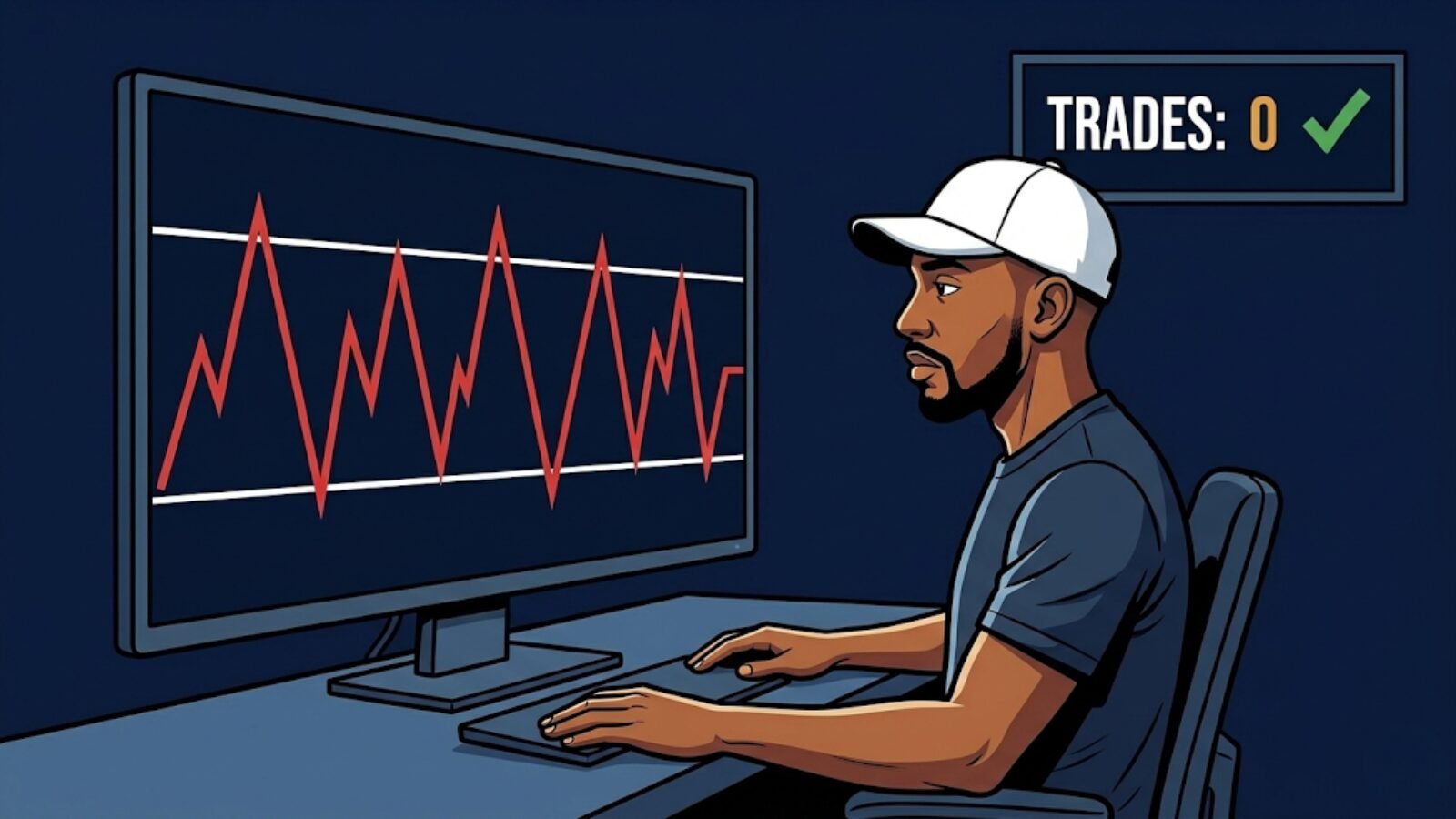
Meme illustration comparing a frantic trader with a "30 Days" countdown clock labeled "Still Chasing" to a calm, unbothered trader at Day 1,000 with a coffee and a clean desk, representing why trading timelines cannot be compared and patience is the real edge.

How Long Does It Take to Become a Consistently Profitable Trader?

Trading is risky! Past performance does not guarantee future results. Click here to read our full Disclaimer

There is a version of trading culture on social media that makes it look like speed is the goal. Hit the payout fast. Go funded in 30 days. Scale up before the month is out. And if that is not happening, something must be wrong.

That version of trading is not the whole picture. And for a lot of developing traders, buying into it is one of the more expensive mistakes that gets made, not in dollars, but in confidence and clarity.

This session was a small expense on the scoreboard. One position, one trade window, charts that froze more than once. Not a highlight reel moment by traditional standard. But what came out of it was a simplified strategy, validated data from the night before’s study session, and a clearer mental framework for measuring progress on a timeline that actually makes sense.

Profitability is a byproduct of process mastery, not a race.

Is Social Media Giving Traders a False Picture of the Timeline?

The funded account payout content is everywhere. Traders posting screenshots of hitting targets in their first week. Comments full of “why haven’t you done this yet?” energy directed at anyone who is still in the development phase.

Here is what that content almost never shows: whether those results came from a repeatable, systems-based process or from an aggressive, high-risk approach that happened to hit on a few good days.

Fast results and sustainable trading are not the same thing. A trader who gambles their way to a quick payout and one who builds a disciplined, rules-based system over time are doing two completely different things. The timeline looks different because the activity is different. Treating those two paths as comparable creates a distortion that serves no one.

Jesse Livermore, one of the most studied traders in market history, took the better part of three decades to fully find his stride. And that was in an era with far less complexity than what exists today. Modern markets run on automated systems, algorithmic participants, layered liquidity dynamics, and a constant flood of information noise that simply did not exist in earlier eras. The environment is objectively harder to navigate. A longer development curve is not a character flaw. It reflects the complexity of what is being learned in relation to the uniqueness of the individual trader.

Your Time Is Your Time. Not to Be Compared.

Every trader enters the market with a different set of variables:

  • Financial history
  • Relationship with risk
  • Psychological patterns
  • Current responsibilities
  • Personal beliefs and values

Just to name a few from the laundry list of personality traits built over years before a single trade was ever placed. All of this in addition to the differences in the amount of time available to dedicate to study, practice, and review.

None of those are visible in a social media post. What is visible is the highlight, which is almost always decontextualized from everything that shaped it.

Letting someone else’s timeline define what progress looks like is giving away the power to measure the journey accurately. That power belongs to the trader doing the work, and protecting it matters.

The practical response to comparison culture is simple: quiet the noise. Literally mute or block that noise, if needed. The accounts that trigger doubt or rush are not serving the process. Protecting focus is not weakness. It is part of the job.

As I noted in the Premarket Awareness of the journal as a reminder going into this particular morning: “Your time is your time, not to be compared.” That line landed differently after a night of studying strategy adjustments and showing up to a session that did not go the way the preparation suggested it might.

What Does It Look Like to Simplify a Strategy in Real Time?

The night before this session, time went into studying strategy adjustments. The result was a meaningful simplification: fewer trigger types, cleaner rules, more clarity about what the plan was actually asking for.

Going into the live session with a freshly adjusted approach is a different experience than going in with a system that has been running on autopilot for weeks. There is more attention on each moment because the plan is being watched in a new way. That is not a bad thing. It is part of how a system gets validated.

The session itself did not produce many opportunities under the new rules, which is actually useful data. A simplified system that generates fewer triggers is not automatically worse than a complex one that generates many. If the triggers it does generate are higher quality and more aligned with the overall logic of the approach, fewer can be better.

There is a difference between adjusting a strategy and abandoning it. Adjusting means taking what is already there and making it more precise. Abandoning means scrapping the logic entirely because the results got uncomfortable. The first comes from data. The second comes from frustration. Keeping that distinction clear is part of what makes a strategy review productive rather than reactive.

Can Breath Work Actually Change How a Trading Session Goes?

This session started after a night that did not produce ideal rest. That kind of start creates a real choice: push through with depleted focus or take a few minutes to reset before the screen time begins.

Breath work made the difference going into this particular session. Not as a motivational ritual, but as a practical tool for sharpening attention and settling the nervous system before making decisions that involve real capital.

The connection between physical state and trading performance is direct. Focus quality, emotional steadiness, the ability to observe a signal without immediately reacting to it, all of these are affected by how the body is running. Pre-session breath work is not a luxury add-on to the trading routine. For sessions that start from a depleted baseline, it is one of the more reliable tools for closing the gap between where physical readiness is and where it needs to be.

This is also a theme that runs through Pull the Trigger: How to Stop Missing the Trades That Pay. The mental and physical states a trader carries into a session shape execution quality before the first candle prints.

What Happens When the Charts Keep Freezing?

The platform froze multiple times during this session. That kind of technical friction during a live session is a genuine test of composure. The instinct is to get frustrated, force the next action, or make a decision based on incomplete visual information.

None of those responses serve the plan.

The better response is to treat each freeze as a forced pause. If no position is on, wait. If a position is open and the situation is genuinely unclear, the protocol applies:

→ Close the position. → Resolve the issue. → Reassess whether to continue.

Beyond the in-session response, repeated technical issues are a signal worth taking seriously over time. A trading operation that depends on a single point of failure in the technology layer is fragile. Building redundancy into the setup, whether that is a backup charting source, a second internet connection, or a faster machine for handling simultaneous recordings, reduces the number of sessions where the environment is working against execution before a single trigger even appears.

The key thing to note here is having your response to a technical issue clearly identified in the plan before you face it in real-time. Every situation you can prepare for ahead of time reduces the likelihood of emotionally spiraling from a minor hiccup into a catastrophic disaster.

Sponsored Zoi Teli'a
Feel your best. Trade your best. Your mindset is your edge. It starts with how you feel.
Shop Now →

How Do You Find the Win in a Session That Cost Money?

One position that produced yet another expense. Charts that constantly froze. No additional triggers within the trade window under the newly simplified rules.

And still, the session produced something valuable.

In reviewing the session afterward, two potential setups became visible under the adjusted rules that were not part of the original approach. Both showed potential. Neither was taken because the rules did not call for them yet. That is exactly how it should work. But the observation is now on record, and the backtesting work to validate whether those patterns hold up is now on the task list.

A day where strategy adjustments get observed in a live environment and the data reinforces the direction of the review is still a productive day. The scorecard for a session does not have to be P&L. It can be: did the plan get followed, did the data reveal something useful, and does tomorrow’s approach start from a more informed position than yesterday’s?

Using every session as a feedback loop rather than a verdict is what separates the traders who build something over time from the ones who reset every week based on how the last few days felt.

The Journey Does Not Have a Deadline

The market does not issue certificates. There is no graduation date, no finish line that unlocks consistent profitability, no timeline that applies universally to every trader working through the development process.

What there is: a process that compounds when it is followed consistently, data that becomes more useful the more carefully it is collected, and a trading operation that gets stronger every time a session, even a losing one, produces a clearer picture of what the next adjustment should be.

The journey does not have a deadline because the work itself does not have an end point. There is always another session, another study night, another adjustment that makes the approach a little sharper than it was before. That is not a consolation for slow progress. That is what the process actually looks like when it is working. Speed was never the point. Getting it right is.

“Patience is the key to success, not speed.” – Jesse Livermore

Trade it easy ✌🏾

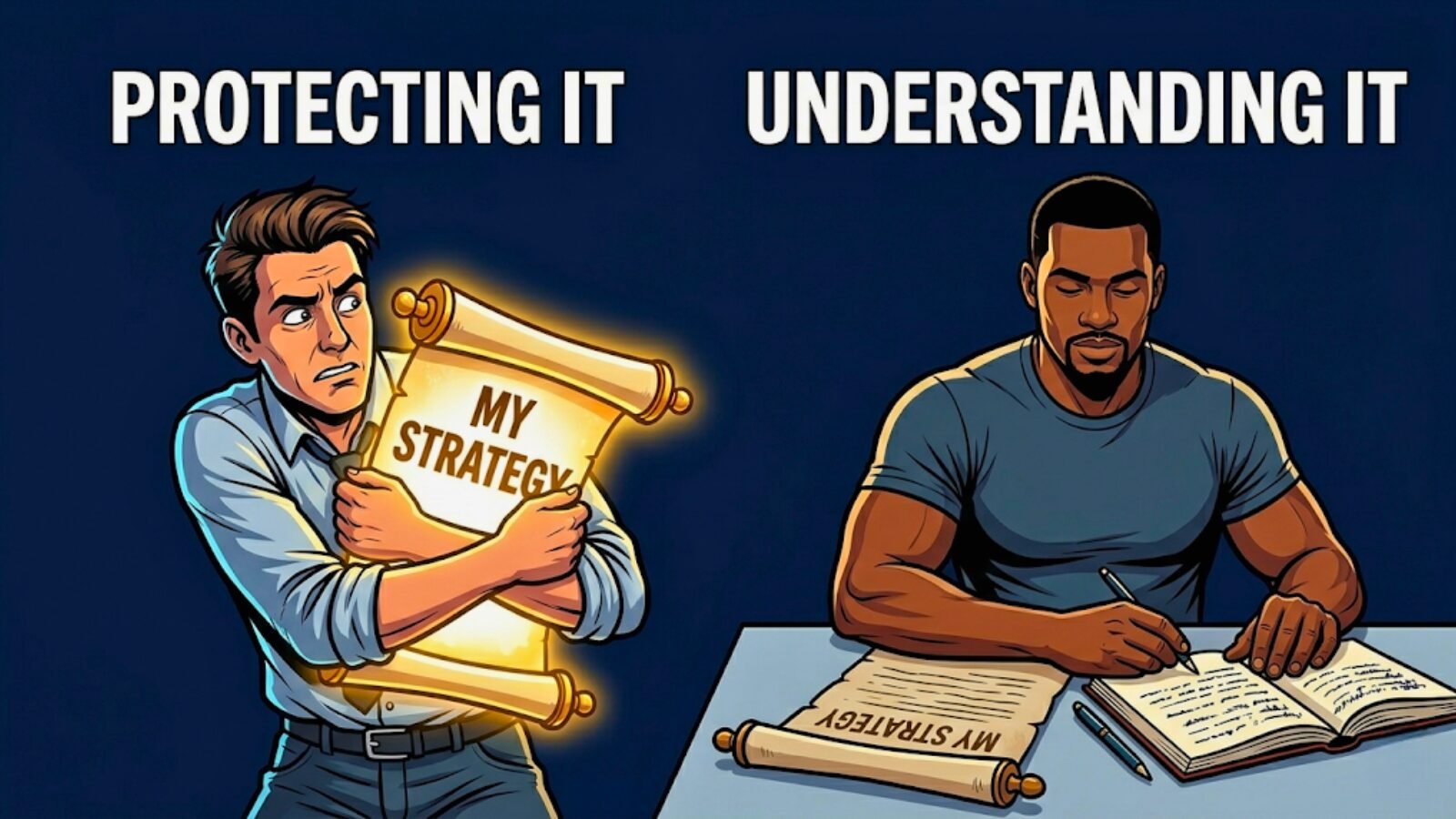
Meme illustration of a sweating trader torn between an overcomplicated whiteboard labeled "My Strategy" and a clean whiteboard labeled "The Data," representing the difference between reacting emotionally to a rough stretch and reassessing a trading strategy with real collected data.

When Should You Reassess Your Trading Strategy?

Trading is risky! Past performance does not guarantee future results. Click here to read our full Disclaimer

Not every losing session means something is broken. Sometimes a bad day is just a bad day. The market did not cooperate, conditions were not ideal, and the results reflected that. Nothing more.

But then there are sessions that are telling a different story. Not a single bad day, but a pattern. Multiple positions, across multiple sessions, all pointing in the same direction. That kind of consistency in the wrong direction is not noise. It is data. And data is worth listening to.

This session was one of those. Every position was an expense. A technical issue created confusion mid-session. A rule got bent that was warranted for fully troubleshooting the technical issue. And when it was all said and done, the most valuable thing that came out of it was not on the chart at all. It was a clear signal that a full strategy reassessment is reasonable at this point.

A session that costs money but produces a plan is not a failure. It is information with a price tag.

What Are Consistent Losses Actually Telling You?

There is a temptation after a rough session to treat it as a verdict. The strategy does not work. Something needs to change immediately. Blow it up and start over.

That reaction is almost always premature, and it is driven by emotion rather than evidence.

A single session is not a sample size. Even two or three in a row is not enough to draw a reliable conclusion about a strategy’s actual performance. What consistent losses across a meaningful number of sessions are actually telling a trader is simpler than that: it is time to look closer. Not react. Look.

The distinction matters. Reacting means making changes under emotional pressure, in the middle of a rough stretch, without the data to back up the decision. Looking means pulling the historical record, reviewing the sessions objectively, and asking the right questions before touching anything.

Sessions are data points, not verdicts. The trader who understands that has a structural advantage over the one who rewrites the strategy every time the results get uncomfortable.

How Much Data Is Enough Before Making a Change?

This is one of the most practical questions in trading and one of the least discussed.

The honest answer is that there is no universal number. But there is a principle that holds up: the decision to modify a strategy should never be made from a sample size so small that market variance alone could explain the results.

Three months of active session data is a reasonable floor. Not just three months of watching the market. Three months of actual execution, documented sessions, and tracked outcomes across different market conditions. That timeframe tends to capture enough variety, different volatility environments, different volume profiles, different macro conditions, to give a clearer picture of whether the strategy is underperforming or whether the market just ran through an unfavorable phase.

Simulated environments help here too. Prop firms and paper trading platforms are not just for beginners. They are real-world behavioral labs. The decisions made under simulated conditions, with a fraction of the capital at risk, are real decisions. The psychological patterns that show up are real patterns. That data is worth something, and it is far cheaper to collect than the same data gathered with full capital on the line.

Real data always beats arbitrary numbers when defining risk thresholds. A trader who sets expense limits based on what feels reasonable is guessing. A trader who sets them based on collected session data is building something defensible.

What Should the Protocol Be When a Technical Issue Hits Mid-Session?

This came up directly this session and it deserves its own treatment because technical issues in live trading are a certainty, not a possibility.

  • An unexpected alert from the platform.
  • An order that does not confirm the way it should.
  • A chart that freezes at the worst possible moment.

These things happen. The question is not whether they will occur. The question is whether there is a rule in place before they do.

Without a pre-decided protocol, a technical issue becomes a real-time judgment call made under stress, with capital on the line, and with split attention between the problem and the position. That combination produces bad decisions consistently.

The rule that has held up over time is straightforward:

No open position when the issue occurs?

→ Stop trading, resolve the issue completely, then reassess whether to continue the session.

Open position when the issue occurs?

→ Close the position first, then resolve the issue, then reassess.

The order of those steps matters. Trying to resolve a technical problem while holding an open position is trying to do two things at once in a high-pressure environment. That split focus is where emotions spiral and mistakes compound.

Having the rule before the problem is the only version that actually works. A rule decided in the middle of a crisis is not a rule. It is a guess with a justification attached to it.

Why Is Checking P&L Mid-Session a Problem?

There is a rule worth keeping that is harder to follow than it sounds: once attention goes to the P&L during a live session, the session comes to an end IMMEDIATELY.

The reason is straightforward. The moment focus shifts from execution to outcome, the decision-making framework changes. Entries get taken to recover losses. Exits get held longer than the plan calls for. Positions get sized differently based on what the account is up or down rather than what the setup warrants.

None of those adjustments are based on what the market is doing. They are based on your desires around what the account balance is doing. And the market does not care how your account balance aligns with your desires.

This session included a moment where looking at the P&L became necessary to understand what had happened during a technical issue. That is an understandable exception. But continuing to trade after that moment is where the rule got bent. Naming that clearly, without blame and without excuses, is part of what makes the next session cleaner.

Accountability is not the same as self-criticism. It is just an honest reading of what happened so the next decision can be better.

What Is the Only Trading Goal That Is Actually Within Control?

My goal in any session is not to be profitable. That outcome is influenced by too many variables outside of any single trader’s control: market conditions, volatility, participant behavior, news events, algorithmic activity, just to name a few.

The goal that is fully within control is 100% accuracy with the plan. Did the triggers taken match the criteria? Were the exits executed according to the rules? Were the positions skipped for the right reasons? That standard can be met in a losing session and missed in a winning one.

This reframe does not ignore results. It just puts them in the right order. Full attention goes to the process first. Results follow from process, over a large enough sample. Chasing results directly, at the expense of process, is how a strategy that was working gets distorted until it is unrecognizable.

The drawdown experienced in this session is recoverable. Drawdowns always are, as long as the process stays intact. What is much harder to recover from is the version where the process gets abandoned mid-drawdown and the trader ends up with neither results nor a functioning system.

Sponsored Zoi Teli'a
Feel your best. Trade your best. Your mindset is your edge. It starts with how you feel.
Shop Now →

How Do You Reassess a Strategy Without Overreacting?

There is a meaningful difference between reassessing and reacting. Reacting happens in the heat of a rough stretch. Reassessing happens with data, structure, and a clear set of questions.

A useful starting point is separating two questions that often get conflated: is the system broken, or is the application off?

A broken system means the logic behind the approach no longer fits the market it was built for. Application issues mean the system is sound but the execution has drifted from the original criteria. Both are real problems, but they require completely different solutions. Changing the system to fix an application problem is one of the more common and costly mistakes in strategy development.

The approach I learned the hard way to apply religiously is to let the data lead. Mechanical responses from analytics tools are valuable, but they do not automatically translate to profitable outcomes. Understanding why a mechanical signal is or is not producing results requires looking at the full picture, including the conditions around the signal, the execution accuracy, and whether the risk parameters are calibrated correctly.

That review is now scheduled. Three or more months of data are available to work from. The session today, despite the expenses, produced the clarity and the motivation to do that work properly.

For traders working through the psychological side of staying grounded during a drawdown while preparing for a strategy review, Pull the Trigger: How to Stop Missing the Trades That Pay covers the mindset piece directly. Staying committed to the process when the results are not there is one of the harder skills to develop. It is also one of the most important.

A Losing Session Can Still Be a Productive One

The sessions that cost the most money are not always the ones that cost the most in the long run. The expensive ones, in the real sense, are the sessions where nothing gets learned, no patterns are recognized, and the same mistakes repeat without examination.

This session cost money. It also produced a scheduled strategy review, a reinforced technical issue protocol, and a named accountability point around a bent rule. That is a return on investment that shows up in future sessions, even if it does not show up in today’s results.

The traders who grow are the ones who treat data seriously, including the data that is uncomfortable to look at.

Solid foundations are built on simplicity. That includes the process of figuring out what is not working.

Trade it easy ✌🏾

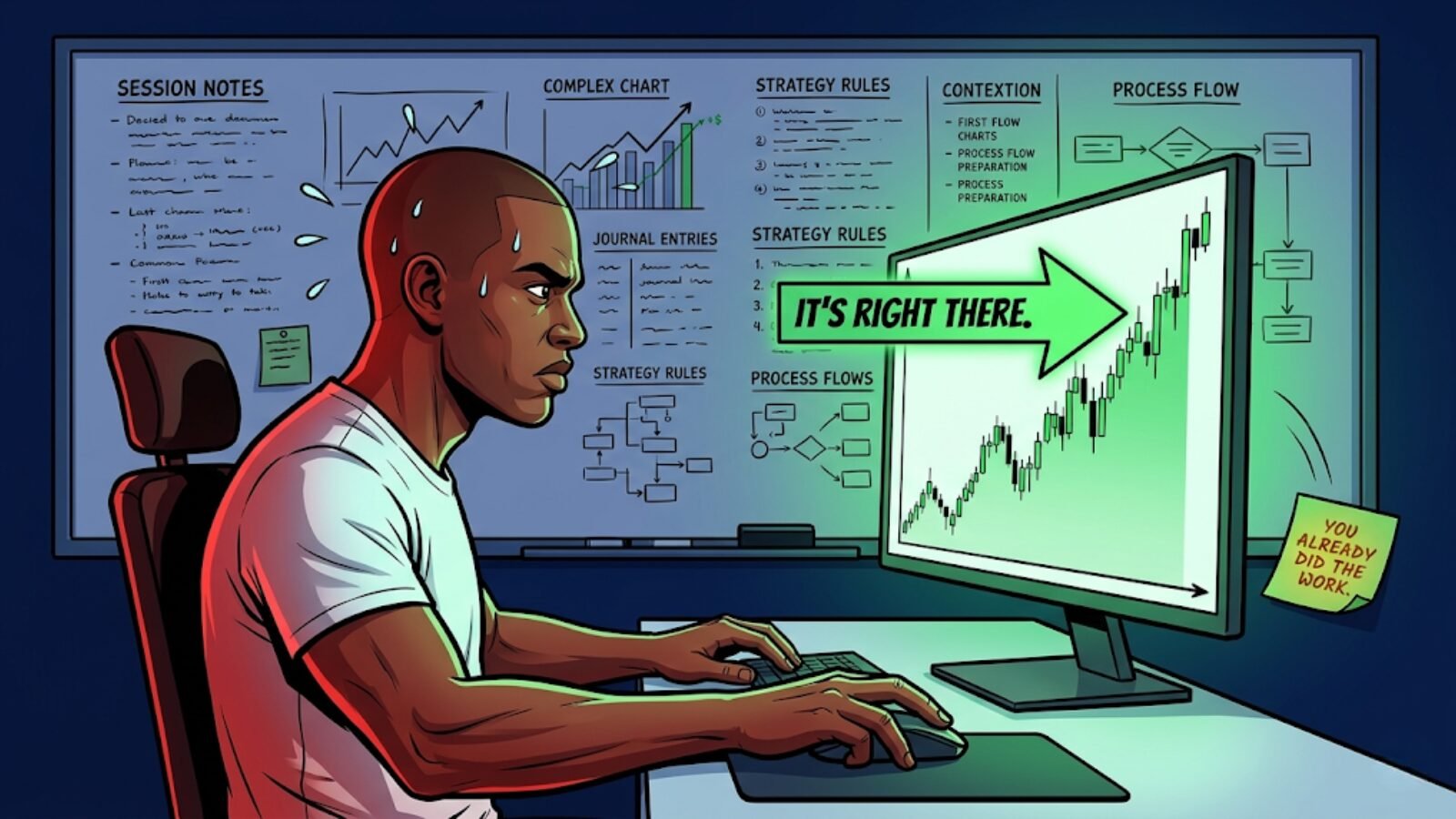
Meme illustration of a focused trader quietly closing a bad position while an ego version of themselves dressed in an "I Was Right" pageant sash stands behind them demanding to stay in the trade, representing real-time ego management and plan adherence in live trading.

How Do You Trade When Your Ego Is in the Room?

Trading is risky! Past performance does not guarantee future results. Click here to read our full Disclaimer

The market moved from bear market territory to new all-time highs faster than most traders could adjust. And a lot of them got caught on the wrong side of that shift, not because their charts were wrong, but because their thinking was too rigid to move with what was actually happening.

That is the setup for this session. And the biggest trade of the day had nothing to do with price.

It had to do with catching an ego-hijacking mistake in real time, correcting it, and staying focused on the plan instead of protecting the appearance of being right. That sequence, repeated consistently over time, is what separates traders who grow from traders who stay stuck in the same patterns year after year.

The moment a trader thinks they have it all figured out, the market will show them a new trick. The edge is not in being right. It is in being flexible enough to respond to what is actually in front of them.

The Market Does Not Care About the Narrative

Market conditions can flip fast. The broader narrative had been leaning bearish for weeks. And then, without much warning, price pushed back into all-time high territory and held there.

Traders who were locked into the bear market story got left behind. Not because their analysis was misinterpreted, but because they held onto it longer than the market warranted.

Bruce Lee’s concept of being like water comes to mind here and it applies directly to trading. Water does not resist the shape of its container. It moves into whatever space is available. A trader who operates the same way, flexible in response to what is actually happening rather than what was expected to happen, has a genuine competitive advantage over one who is fighting to be right about a narrative that has already changed.

Flexibility is not weakness. Rigidity is not discipline. Knowing the difference between the two is one of the more important things a developing trader can internalize.

Tools and reference levels help with this. Having clear visual markers for where price is relative to significant areas takes some of the narrative pressure off. The chart either supports the read or it does not. That clarity is easier to act on than a story that may or may not still be relevant.

What Is Automation Actually Solving?

Automated trading tools have become more accessible to retail traders over the last several years. And the conversation around them has gotten a little confused.

The appeal is understandable. If emotions are causing problems, remove the human from the equation. Build a system that executes without hesitation, without fear, without second-guessing. Let the algorithm do what the trader cannot seem to do consistently.

The problem with that framing is that automation does not remove human nature. It just moves it to a different part of the process.

A trader who cannot bring themselves to take a losing trade manually will often override their automated system after a drawdown. A trader paralyzed by analysis before entry will second-guess every parameter of the automation during setup. The fear of risk and the analysis paralysis do not disappear when a bot is running. They show up in how the bot gets built, adjusted, and overridden.

Self-awareness is the tool that automation cannot replace. Specifically, understanding whether visual data or numeric data is more natural to process, whether pattern recognition or statistical analysis is the stronger instinct, and whether a given system is actually built around personal strengths or borrowed from someone whose strengths are different.

Operating within natural strengths rather than forcing someone else’s approach is not a shortcut. It is how a trader actually builds something sustainable. A system that was not designed for the person running it will eventually find an area of resistance, regardless of how well it works on paper, for the originator, or another trader.

Real-Time Ego Management: What Does It Actually Look Like?

This is the part of the session worth spending the most time on.

The first trigger on the position taken today was a mistake. The trigger was jumped before the full criteria were met. It was clear almost immediately that the entry was off.

And right on cue, the ego showed up.

The internal argument started fast: maybe it will work out anyway, maybe staying in is fine, maybe the read is still right even if the entry was early. That argument is not about the trade. It is about not wanting to be wrong. Not wanting to look like a mistake was made, even when the only audience is a screen recording or an internal monologue.

The redirection was to ask a different question. Not “am I right about where price is going?” but “am I right for the plan?” Those are two completely different standards. One is about the outcome of the trade. The other is about the integrity of the process.

The position was exited. The correct trigger was waited for. The re-entry happened at the right criteria. That sequence cost more in the short term than just holding the original position might have. But the alternative, letting ego take over a mistake situation, has turned minimal costs into much larger ones nine times out of ten based on real historical experience.

Being right or wrong for the plan is the only standard that matters. Being right or wrong for the money, or for the appearance of not having made a mistake, is how small errors become expensive ones.

Trading is business. The market is not personal. There is no purpose in making market activity personal, even when it feels that way in the moment.

What Does Combat Experience Teach About Managing Fear in Trading?

The comparison between trading psychology and military service comes to mind for me in moments like this session, and it deserves a direct treatment because the parallel is real.

In a combat zone, chaos is the baseline condition. Things happen that are outside of anyone’s control. The choice available in those moments is not between calm and chaos. It is between focusing energy on what can be controlled or letting it get consumed by what cannot.

That same choice exists in every trading session.

Nearly every trader faces psychological triggers around money. That is not a personal failing. It is human nature. Your financial status is tied to your wellbeing, tying it to your nervous system. That wiring leads to treating loss as a threat, and the market is specifically designed to trigger that response at the worst possible moments.

The goal is not to shut those emotions off. That is not realistic and chasing it creates its own problems. The goal is to redirect 100% of emotional energy toward plan adherence and controllable variables.

  • Position sizing
  • Entry criteria
  • Hold duration
  • Exit rules

These are things within control. The monetary outcome of a filled order is not.

This is a core theme in Pull the Trigger: How to Stop Missing the Trades That Pay. The fear does not have to go away for execution to improve. It has to go somewhere more useful.

One more thing worth saying about ego specifically: it is not the villain it gets made out to be in trading circles. Ego has a job. It is trying to protect you. Without fail ego is on duty to protect your self-image, financial security, or the sense of being competent. Learning to manage what ego is trying to protect, and redirecting that energy toward plan adherence, is more productive than trying to fire it permanently. The traders who say they have no ego are usually the ones who have not looked closely enough.

Economic Events and the Market's Own Timeline

Several economic news events were scheduled during this session. The response at each scheduled time was minimal. Muted volatility, nothing dramatic.

The real volatility spike came well after the news window closed, thirteen minutes later, with no obvious direct connection to the event itself. Something else drew participant interest at that moment. The market moved on its own terms.

This is a pattern worth filing away. Scheduled news events create expectations. The market does not always cooperate with those expectations. Waiting for confirmation of actual movement rather than anticipating what the news should cause keeps execution cleaner and reduces the risk of getting caught in a false read.

Consistency to the strategy matters more than fixating on any single event or any single session’s result. The session outcome today was modest. The value was in the reps: ego management under real conditions, plan adherence when it was uncomfortable, and re-entry at the correct criteria after catching and correcting a mistake. Those reps compound. The P&L from any single session does not tell that story.

Sponsored Zoi Teli'a
Feel your best. Trade your best. Your mindset is your edge. It starts with how you feel.
Shop Now →

The Most Important Reps Are Not Always the Biggest Wins

The trader who manages themselves flows with the variance of market conditions better. That is not a motivational statement. It is a practical observation from years of watching what separates consistent performers from inconsistent ones.

The biggest sessions, the days with the cleanest setups and the most satisfying results, are not necessarily the most instructive ones. The sessions where something goes wrong and gets caught and corrected in real time, those are the reps that actually build the skill.

Today was one of those sessions. A mistake was made. It was recognized quickly. The ego pushed back. The focus was redirected to the plan. The correct entry was waited for and taken. Positions were closed before the window ended.

That sequence, done enough times, becomes the default response. Not a heroic act of discipline, just a practiced habit.

The long game in trading is built exactly this way.

Trade it easy ✌🏾