Trading is risky! Past performance does not guarantee future results. Click here to read our full Disclaimer

The market moved from bear market territory to new all-time highs faster than most traders could adjust. And a lot of them got caught on the wrong side of that shift, not because their charts were wrong, but because their thinking was too rigid to move with what was actually happening.
That is the setup for this session. And the biggest trade of the day had nothing to do with price.
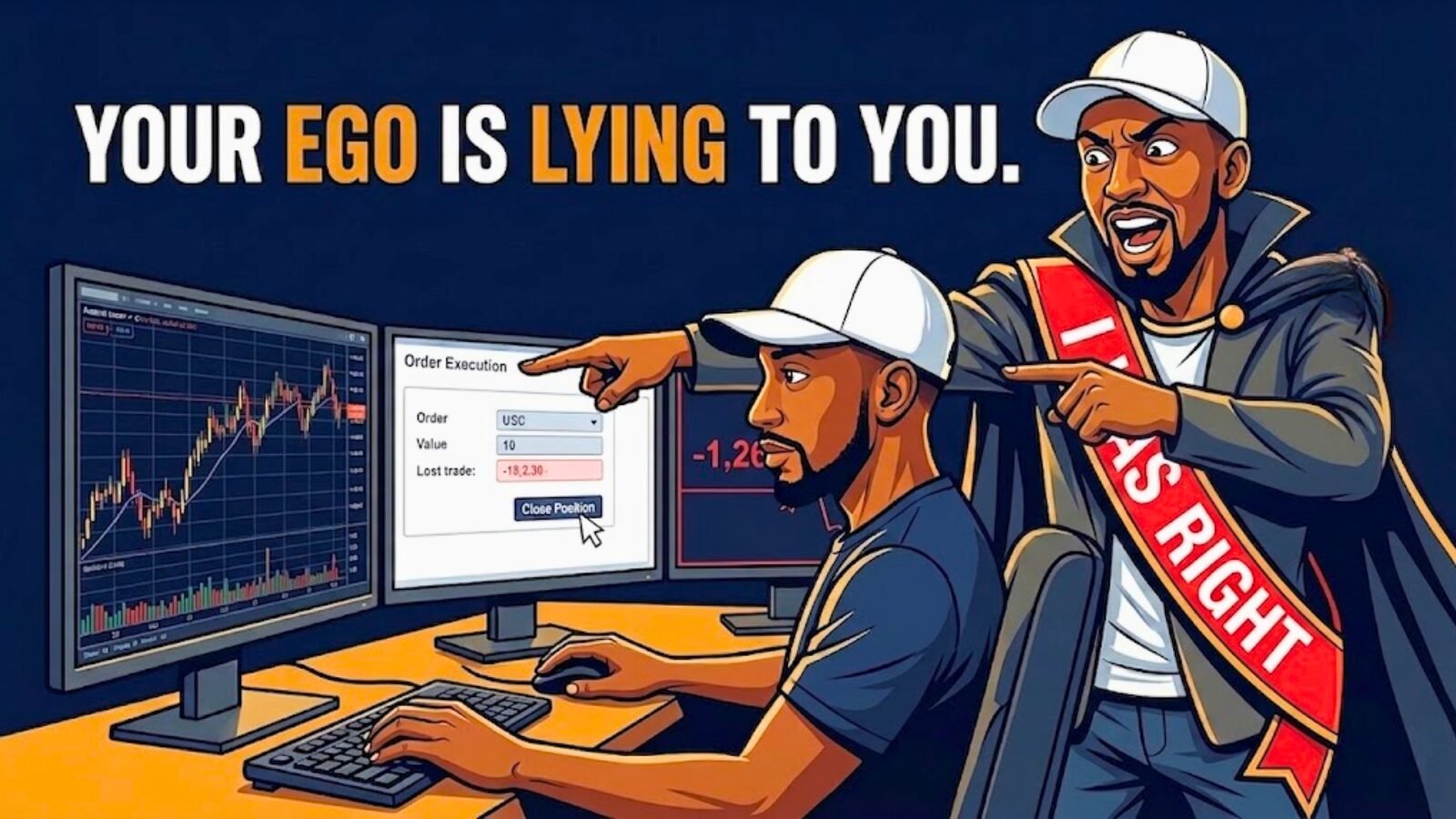
It had to do with catching an ego-hijacking mistake in real time, correcting it, and staying focused on the plan instead of protecting the appearance of being right. That sequence, repeated consistently over time, is what separates traders who grow from traders who stay stuck in the same patterns year after year.
The moment a trader thinks they have it all figured out, the market will show them a new trick. The edge is not in being right. It is in being flexible enough to respond to what is actually in front of them.
The Market Does Not Care About the Narrative
Market conditions can flip fast. The broader narrative had been leaning bearish for weeks. And then, without much warning, price pushed back into all-time high territory and held there.
Traders who were locked into the bear market story got left behind. Not because their analysis was misinterpreted, but because they held onto it longer than the market warranted.
Bruce Lee’s concept of being like water comes to mind here and it applies directly to trading. Water does not resist the shape of its container. It moves into whatever space is available. A trader who operates the same way, flexible in response to what is actually happening rather than what was expected to happen, has a genuine competitive advantage over one who is fighting to be right about a narrative that has already changed.
Flexibility is not weakness. Rigidity is not discipline. Knowing the difference between the two is one of the more important things a developing trader can internalize.
Tools and reference levels help with this. Having clear visual markers for where price is relative to significant areas takes some of the narrative pressure off. The chart either supports the read or it does not. That clarity is easier to act on than a story that may or may not still be relevant.
What Is Automation Actually Solving?
Automated trading tools have become more accessible to retail traders over the last several years. And the conversation around them has gotten a little confused.
The appeal is understandable. If emotions are causing problems, remove the human from the equation. Build a system that executes without hesitation, without fear, without second-guessing. Let the algorithm do what the trader cannot seem to do consistently.
The problem with that framing is that automation does not remove human nature. It just moves it to a different part of the process.
A trader who cannot bring themselves to take a losing trade manually will often override their automated system after a drawdown. A trader paralyzed by analysis before entry will second-guess every parameter of the automation during setup. The fear of risk and the analysis paralysis do not disappear when a bot is running. They show up in how the bot gets built, adjusted, and overridden.
Self-awareness is the tool that automation cannot replace. Specifically, understanding whether visual data or numeric data is more natural to process, whether pattern recognition or statistical analysis is the stronger instinct, and whether a given system is actually built around personal strengths or borrowed from someone whose strengths are different.
Operating within natural strengths rather than forcing someone else’s approach is not a shortcut. It is how a trader actually builds something sustainable. A system that was not designed for the person running it will eventually find an area of resistance, regardless of how well it works on paper, for the originator, or another trader.

Real-Time Ego Management: What Does It Actually Look Like?
This is the part of the session worth spending the most time on.
The first trigger on the position taken today was a mistake. The trigger was jumped before the full criteria were met. It was clear almost immediately that the entry was off.
And right on cue, the ego showed up.
The internal argument started fast: maybe it will work out anyway, maybe staying in is fine, maybe the read is still right even if the entry was early. That argument is not about the trade. It is about not wanting to be wrong. Not wanting to look like a mistake was made, even when the only audience is a screen recording or an internal monologue.
The redirection was to ask a different question. Not “am I right about where price is going?” but “am I right for the plan?” Those are two completely different standards. One is about the outcome of the trade. The other is about the integrity of the process.
The position was exited. The correct trigger was waited for. The re-entry happened at the right criteria. That sequence cost more in the short term than just holding the original position might have. But the alternative, letting ego take over a mistake situation, has turned minimal costs into much larger ones nine times out of ten based on real historical experience.
Being right or wrong for the plan is the only standard that matters. Being right or wrong for the money, or for the appearance of not having made a mistake, is how small errors become expensive ones.
Trading is business. The market is not personal. There is no purpose in making market activity personal, even when it feels that way in the moment.
What Does Combat Experience Teach About Managing Fear in Trading?
The comparison between trading psychology and military service comes to mind for me in moments like this session, and it deserves a direct treatment because the parallel is real.
In a combat zone, chaos is the baseline condition. Things happen that are outside of anyone’s control. The choice available in those moments is not between calm and chaos. It is between focusing energy on what can be controlled or letting it get consumed by what cannot.
That same choice exists in every trading session.
Nearly every trader faces psychological triggers around money. That is not a personal failing. It is human nature. Your financial status is tied to your wellbeing, tying it to your nervous system. That wiring leads to treating loss as a threat, and the market is specifically designed to trigger that response at the worst possible moments.
The goal is not to shut those emotions off. That is not realistic and chasing it creates its own problems. The goal is to redirect 100% of emotional energy toward plan adherence and controllable variables.
- Position sizing
- Entry criteria
- Hold duration
- Exit rules
These are things within control. The monetary outcome of a filled order is not.
This is a core theme in Pull the Trigger: How to Stop Missing the Trades That Pay. The fear does not have to go away for execution to improve. It has to go somewhere more useful.
One more thing worth saying about ego specifically: it is not the villain it gets made out to be in trading circles. Ego has a job. It is trying to protect you. Without fail ego is on duty to protect your self-image, financial security, or the sense of being competent. Learning to manage what ego is trying to protect, and redirecting that energy toward plan adherence, is more productive than trying to fire it permanently. The traders who say they have no ego are usually the ones who have not looked closely enough.
Economic Events and the Market's Own Timeline
Several economic news events were scheduled during this session. The response at each scheduled time was minimal. Muted volatility, nothing dramatic.
The real volatility spike came well after the news window closed, thirteen minutes later, with no obvious direct connection to the event itself. Something else drew participant interest at that moment. The market moved on its own terms.
This is a pattern worth filing away. Scheduled news events create expectations. The market does not always cooperate with those expectations. Waiting for confirmation of actual movement rather than anticipating what the news should cause keeps execution cleaner and reduces the risk of getting caught in a false read.
Consistency to the strategy matters more than fixating on any single event or any single session’s result. The session outcome today was modest. The value was in the reps: ego management under real conditions, plan adherence when it was uncomfortable, and re-entry at the correct criteria after catching and correcting a mistake. Those reps compound. The P&L from any single session does not tell that story.
The Most Important Reps Are Not Always the Biggest Wins
The trader who manages themselves flows with the variance of market conditions better. That is not a motivational statement. It is a practical observation from years of watching what separates consistent performers from inconsistent ones.
The biggest sessions, the days with the cleanest setups and the most satisfying results, are not necessarily the most instructive ones. The sessions where something goes wrong and gets caught and corrected in real time, those are the reps that actually build the skill.
Today was one of those sessions. A mistake was made. It was recognized quickly. The ego pushed back. The focus was redirected to the plan. The correct entry was waited for and taken. Positions were closed before the window ended.
That sequence, done enough times, becomes the default response. Not a heroic act of discipline, just a practiced habit.
The long game in trading is built exactly this way.
Trade it easy ✌🏾



