Trading is risky! Past performance does not guarantee future results. Click here to read our full Disclaimer

The market does not owe anyone a setup.
That is one of those things that sounds simple but takes real experience to actually internalize. There are sessions where everything lines up. The conditions match the system, the triggers appear, and the plan gets executed cleanly. And then there are sessions like this one, where the market does its own thing, the environment works against the approach being used, and the honest result of the day is a small win that barely moves the needle.
That kind of session is not a failure. In fact, handled correctly, it might be one of the more important kinds of sessions a trader can have.
Not Every Session Is Built for Every System
Markets cycle through different states. They trend, consolidate, and spike on news. They grind in tight ranges on low volume. No single approach is designed to thrive in every one of those environments, and the traders who understand that have a massive psychological advantage over the ones who do not.
This session was a clear example. The market had been pushing into new all-time highs repeatedly on relatively low volume, holding in a narrow range at previous session highs. That kind of environment limits the number of opportunities a system like the one being run here is designed to capitalize on. The triggers were limited. The setup count was low. That is not the system failing. That is the system working exactly as designed, not generating signals when the right conditions are not there.
The distinction matters more than most traders give it credit for. A system not triggering is not the same as a system not working.
All Strategies Work, Just Not All the Time
There is a quote that has taken on more meaning over time through firsthand experience developing multiple approaches: all strategies work, just not all the time.
The truth behind it is not immediately obvious when first heard. It sounds like an excuse, like something a losing trader says to avoid accountability. But after years of building, testing, and refining multiple strategies, the depth of it becomes clear.
Every strategy is built around a set of conditions. When those conditions are present, the strategy performs. When they are not, adds to drawdown or it sits out. The mistake most traders make is judging the strategy by the sessions where the conditions were absent, ignoring the ones where the perfect conditions were present.
Building a strategy from scratch, rather than borrowing someone else’s approach, is what makes this understanding real. When the logic behind every rule is understood because it was developed and tested personally, there is no confusion about why a quiet session happened. The reasoning is baked in. The strategy is not broken. The environment just did not cooperate today.
That kind of clarity is only available to the trader who did the work to build their own system.

Following the Plan When There Is Nothing to Work With
Here is where a lot of traders lose the session even before a single trade is placed.
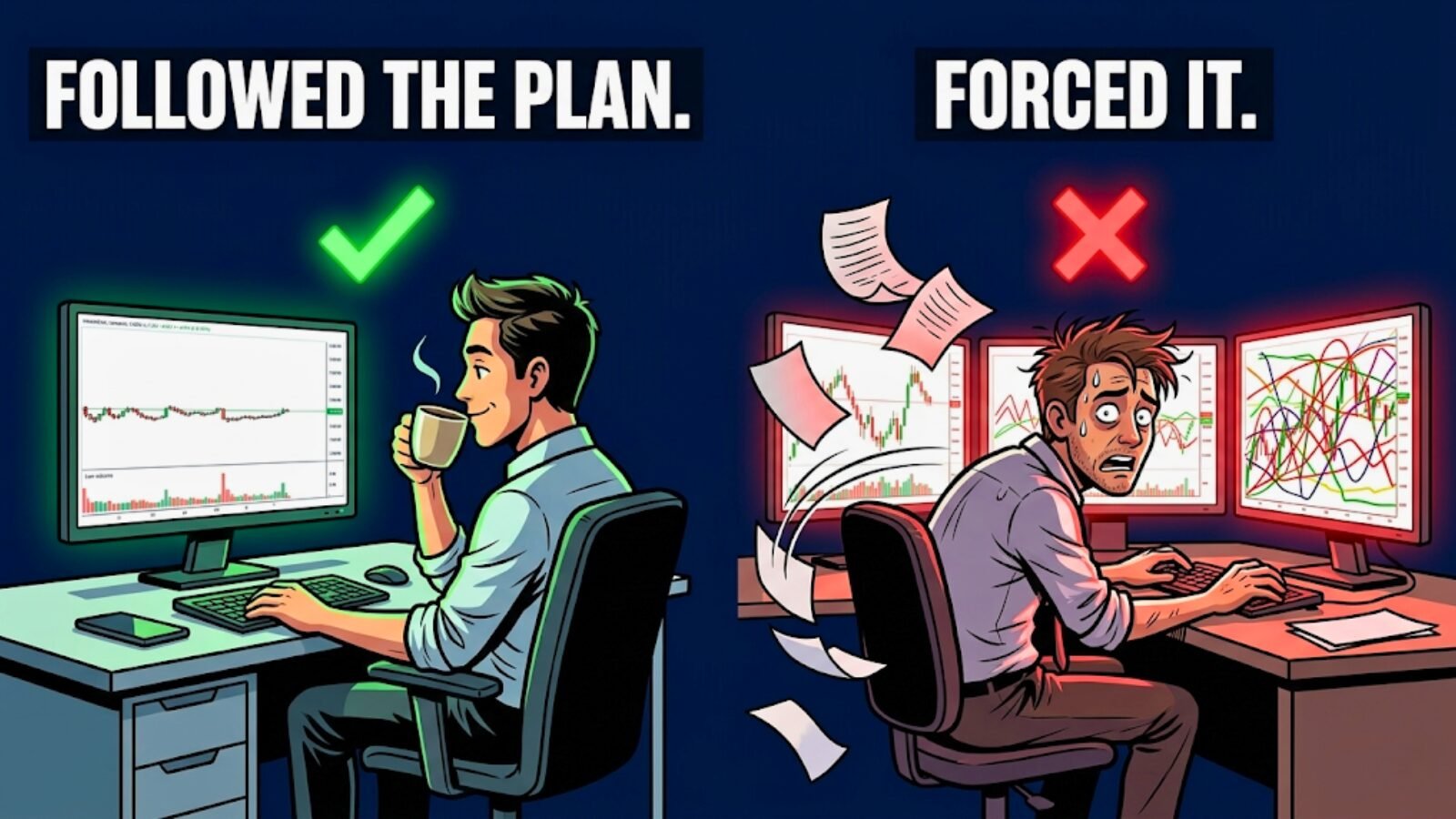
When conditions are slow and setups are not forming the way the system expects, the temptation is to start improvising. Widen the criteria. Take a trade that is close enough. Do something to justify being there.
That is exactly the wrong response, and it tends to be driven more by boredom and frustration than by any actual read on the market.
Keeping your plan as the primary emotional focus redirects that energy. Instead of trying to force the market to cooperate, the plan becomes the anchor. Is there a trigger or is there not? If not, wait. If there is, execute. The emotional noise that comes from trying to make something happen gets replaced by the mental clarity of following a rule-based process.
This session produced a small positive result. One position, taken when the trigger appeared, executed at the appropriate level. That is a win. Not because of the size of the result, but because of the accuracy of the execution. The plan was followed in conditions that could have easily led to overtrading or frustration-based decisions.
Trading accurately is not the same as trading profitably in every session. But it is the foundation that eventually produces consistent results over time. That distinction is one of the most important things a developing trader can absorb.
The Trap of Seeking External Validation
One thing that comes up consistently in conversations with traders who are stuck is the habit of looking outward for confirmation of what they already know inwardly.
A pattern is recognized that the trader sees as an opportunity for developing or improving a system. And instead of following that instinct, there is a search for someone else to agree. A chat room, a Twitter feed, a Discord channel, a YouTube stream running in the background. Something external that says “yes, this is the right call.”
That habit is expensive in more ways than one. The time spent seeking confirmation is time not spent executing. And over time, it trains the brain to distrust its own process, which is exactly the opposite of what needs to happen for a trader to develop genuine confidence.
Leaning into what organically draws attention as a trader, building around it, testing it, and developing it into a real system, is the alternative. When the system comes from personal interest and personal effort, the confidence to act on it is built into the foundation. It does not need external approval because the work behind it is already understood.
Confidence in reading the market and executing on that read is not optional for anyone trying to make this sustainable. It has to be developed, and it can only be developed by doing the work and trusting the output of that work.
This is a theme that runs through Pull the Trigger: How to Stop Missing the Trades That Pay as well. The psychology behind hesitation is almost always rooted in a distrust of one’s own process. The fix is not more information from outside. It is more confidence built from within.
Passion Shows Up Before the Results Do
Nine and a half years of trading. Only two of those years were profitable in a meaningful way: 2024 and 2025.
That timeline is worth sitting with for a moment.
Most people would have stopped long before reaching year nine. The question that naturally follows is why keep going through the unprofitable years. And the honest answer is that the passion was never tied to the money. Trading is the only thing that consistently generates the motivation for me to be up early every morning without needing an external push. It does not feel like discipline. It just feels like where the energy naturally goes.
That is what real interest in something looks like. Not the social media version of passion, where every day is exciting and the results are always good. The actual version: showing up consistently over years, through private, solo-sessions that produce nothing, through stretches that feel like they will never turn around, because the process itself holds enough interest to stay in it.
That kind of engagement with a craft is also what leads to the deepest level of skill. Not the trader who finds the shortcut and cashes out in year two, but the one who is still here in year ten with a decade of real data, real experience, and a system built from scratch that reflects everything learned along the way.
The passion is in the daily activity. Not in the result of the day.
Healthy Detachment Is Part of the Process Too
One thing worth mentioning because it does not come up enough: a healthy relationship with trading includes fully stepping away from it.
Weekends are weekends. Holidays are holidays. There is no yearning to get back to the markets on a Saturday morning. No checking charts during family time. The boundaries are real.
That kind of detachment is not a sign of low commitment. It is a sign of sustainability. Traders who cannot turn it off are carrying the market home with them, and that weight accumulates in ways that eventually affect the quality of the execution. Rest and recovery are key contributors to performance.
The goal is to show up fully on trading days and fully disengage when trading is done. That rhythm, maintained over time, is part of what makes the long game possible.
When the Market Does Not Cooperate, How You Trade Is the Result
On the days when the conditions do not cooperate, the performance measure shifts.
It is no longer about what the account gained or lost. It is about whether the plan was followed. Whether the system was respected. Whether the session produced accurate execution, even if it produced minimal results.
This session was a green day on a low-opportunity day in conditions that were not designed to produce much. The position taken was taken correctly. No other trades were forced, or fabricated, in real-time beyond the rules of the system. That is how the business remains operational, indefinitely.
The long-term edge is built exactly in sessions like this one. Not by finding a way to manufacture trades that were never there, but by maintaining the discipline to operate within the plan when operating outside of it would have been easy to justify.
Trade it easy ✌🏾



