Trading is risky! Past performance does not guarantee future results. Click here to read our full Disclaimer

No triggers today or yesterday for back-to-back sessions at the desk without a single position taken.
And not only is that not a problem. That makes for a great week so far!
That framing took years to actually arrive at, and it is worth sitting with because it runs counter to almost everything the trading content space promotes. The message out there is almost always: more setups, better entries, tighter criteria, more boredom, find the edge… blah blah blah.
The question that almost never gets asked is whether the trader sitting at the desk is actually capable of executing the strategy they already have.
The session note going into this morning was direct: “Lifestyle outside of trading has a direct relationship with your active window.”
The week started with two standby days for the job, reduced sleep quality, and lower energy at the desk. Today’s overnight session produced more new all-time highs before the retracing hard below the previous level, settling into a mechanical range with no triggers that qualified under the current criteria. The decision was to observe cleanly, document what was happening, and not force participation.
That is what disciplined execution looks like when the conditions are not there.
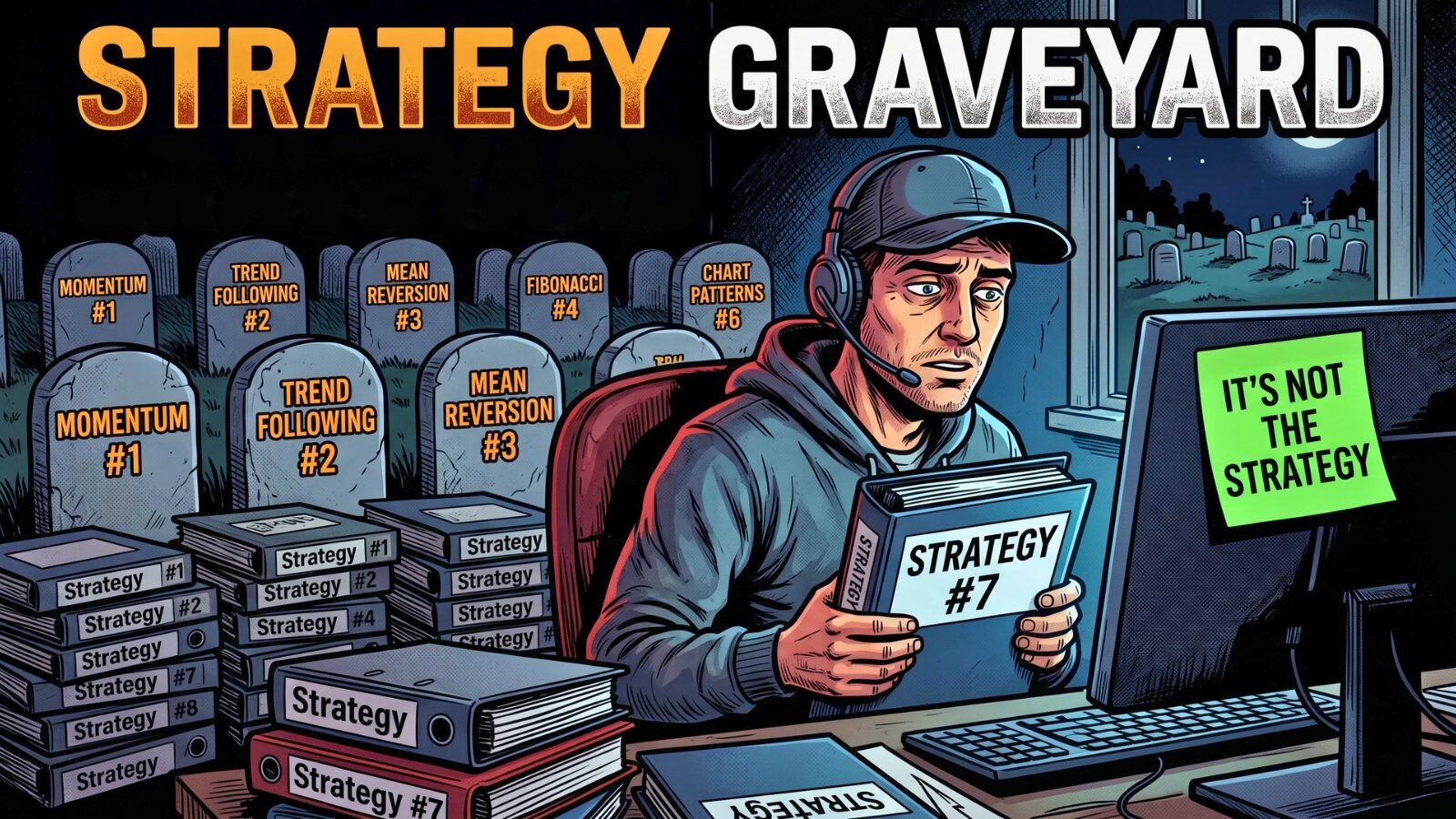
If You Can't Trade Any Strategy Consistently, the Strategy Is Not Your Problem
This is a stream of consciousness that surfaced during today’s livestream, and it is worth stating directly because most developing traders spend years believing the opposite.
If a trader cannot take a valid setup when it forms, hold a position through normal market movement without interfering, and exit according to the plan rather than emotion, the problem is not the strategy. It does not matter which strategy is being used. The same hesitation, the same overanalysis, the same impulse to exit early or stay in too long will show up regardless of what the setup looks like.
Changing the strategy is not the fix. Changing strategies without fixing the execution problem just introduces a new set of rules to violate.
The goal, before profitability, before hitting any specific target, before anything else, is to build the ability to see the setup and take the trigger without hesitation, overthinking, or overanalyzing. Consistently. Across different market conditions. Across winning trades and losing ones. That ability to remain consistently disciplined is the prerequisite. Everything else follows from it.
If you cannot trade any strategy with consistency and discipline, the strategy is not what deserves your corrective action attention. You must first improve your degree of execution.
The Personal Journey: When a Working Strategy Got Abandoned
The first month of futures trading doubled the account.
The strategy was working. The results were there. And then, for no good reason that made any real sense, I changed the strategy.
What followed was years of compounding damage that had very little to do with the market and everything to do with undocumented psychological issues around fear, money, and risk-taking that had never been examined directly. The fear of losing what had been gained. The discomfort of taking calculated risks consistently. The distorted relationship with money that shows up in trading decisions in ways that are almost impossible to recognize from the inside until they are named.
The strategy was not broken. The execution was. And because the psychological issues behind the poor execution were never documented or addressed, changing the strategy just gave those same issues a new environment to operate in. Same patterns, different rules.
Looking back at that period now, the most expensive decision was not any single losing trade. It was abandoning something that was producing results before the reason for those results was fully understood. The documentation was not there to support the understanding. The psychology had not been examined with depth. And so what was working quietly disappeared into a series of strategy changes that never resolved the actual problem.

Why Generic Trading Psychology Does Not Work (for most people)
The trading psychology content available today is abundant and mostly useless for any specific situation.
That is not an exaggeration. Most of what gets produced in this space operates at such a high level of generality that it cannot connect to the actual moment where the execution breaks down.
“Control your emotions.”
“Trust the process.”
“Be patient.”
These things are true in the same way that “eat less and move more” is true for weight loss. The advice is correct but it helps almost no one who is actually struggling while dealing the variance of real life.
Psychology is individual. The specific fear that causes one trader to freeze on a valid setup is different from the one causing another trader to exit too early. The belief patterns and lived experiences around money, risk, and self-worth that shape execution are not universal. Generic advice cannot reach those patterns because it was never designed to.
What works on a broader scale is finding a framework flexible enough to be applied to any specific situation. Not a script or a set of affirmations. A framework for identifying the actual psychological barrier, understanding where it comes from, and building a practical response to it that holds up under live trading conditions.
That search is a big part of what eventually led to writing Pull the Trigger: How to Stop Missing the Trades That Pay. The book documents my personal journey through the execution problem and the framework that came out of it, specifically because the generic version of this conversation was not enough. The work had to be personal before it could be useful.
The Casino Always Wins — And Here Is What That Actually Means for Traders
The casino analogy (aka ”gambling” – every trader’s favorite word) gets used a lot in trading circles and it usually gets applied incorrectly, as a warning about odds or house edge. The more useful version of the analogy points in a different direction entirely.
A casino needs winners to stay in business. If nobody ever won, nobody would come back. The house does not win by ensuring everyone loses. It wins by operating with a consistent process across a large enough volume of outcomes that the statistical edge compounds over time. The individual outcome of any single hand, any single spin, does not change the long-term result of the process.
The financial market operates on similar logic for the traders who participate in it over a long enough timeline. The participants who extract value consistently are the ones with the mental and psychological capacity to take full advantage of wins and cut losses within a repeatable framework. Not the ones who are always right. The ones who execute their process consistently enough that the edge, whatever it is, gets expressed across a meaningful sample of sessions.
That reframe changes the goal entirely. The goal effectively shifts from making money to building the ability to execute consistently within a system, regardless of the edge. The money is the byproduct of that ability, not the direct target.
Chasing the money directly, before that execution ability is built, is trying to win at the casino without understanding the game.
What Recognizing a Setup Instantly Actually Looks Like
During today’s session, several technical formations appeared that had surface-level similarities to valid setups under the current system. Each one resolved quickly and cleanly: it either met the criteria or it did not. No debate. No sitting with it for three candles trying to convince the analysis to go one way or another. No second-guessing after the decision was made.
That kind of instant recognition is not natural talent. It is the product of accumulated screen time, honest documentation of what qualifies and what does not, strict adherence to a detailed preparation routine, and enough repetition with the same criteria that the pattern language becomes genuinely familiar rather than something that has to be consciously reconstructed in real time.
There is a version of this that developing traders underestimate heavily: the difference between a trader who debates every signal and a trader who reads it cleanly is not intelligence or experience level in the general sense. It is familiarity with a specific, documented system built on enough observed repetition that the recognition is automatic.
Today’s session produced that kind of reading throughout the window. Nothing qualified. The read was clear. No trades were needed to validate the session.
Lifestyle Outside the Window Shapes What Happens Inside It
This is worth addressing directly because it does not get enough attention in trading education.
The session note going into this morning said it plainly: lifestyle outside of trading has a direct relationship with the active window.
Being on standby for the day job during what was supposed to be a long holiday weekend produced two consecutive sessions of reduced energy, lighter sleep, and lower eagerness at the desk. Nothing dramatic happened during the standby period. That is not the point. The physiological cost of sustained alertness shows up in the quality of attention available during the trading window regardless.
A string of no-trigger days during a period like this is not a red flag. It is an honest response to a compromised input. Trading is a long-term commitment to the unforeseeable future. No single stretch of quiet sessions changes the trajectory of that commitment. Two tradable days last week and both closed in profit. The week before a standby period is not the week to measure the system against.
The goal is not to trade every day. The goal is to trade well when the conditions are right and to protect the process when they are not.
- Lifestyle management
- Sleep
- Physical health
- Self (energy) awareness
These are inputs into execution quality. Treating them as separate from the trading operation is one of the more common and quietly expensive mistakes a developing trader can make.
Solve the Right Problem First
The strategy will not save a trader whose execution is unreliable. This is not a knock on strategy development. Building a solid, personally understood, rule-based system is essential and it takes real time. But a perfectly designed strategy in the hands of a trader who hesitates on valid setups, exits early when positions feel uncomfortable, or violates rules under emotional pressure will not produce consistent results regardless of how well the system was designed.
The sequence matters. Execution and psychological discipline first. Strategy refinement built on top of clean, consistent execution second. Profitability as the natural outcome of that foundation over a large enough sample.
Today’s session had no trades, clean recognition of non-qualifying setups throughout the window, and a reinforced understanding of what the real work in this practice actually is. The market did its thing. The process held. That is a productive Wednesday.
Lifestyle. Execution. Psychology. These are the variables. The strategy is the vehicle.
Build the driver first.
Trade it easy ✌🏾



