Trading is risky! Past performance does not guarantee future results. Click here to read our full Disclaimer

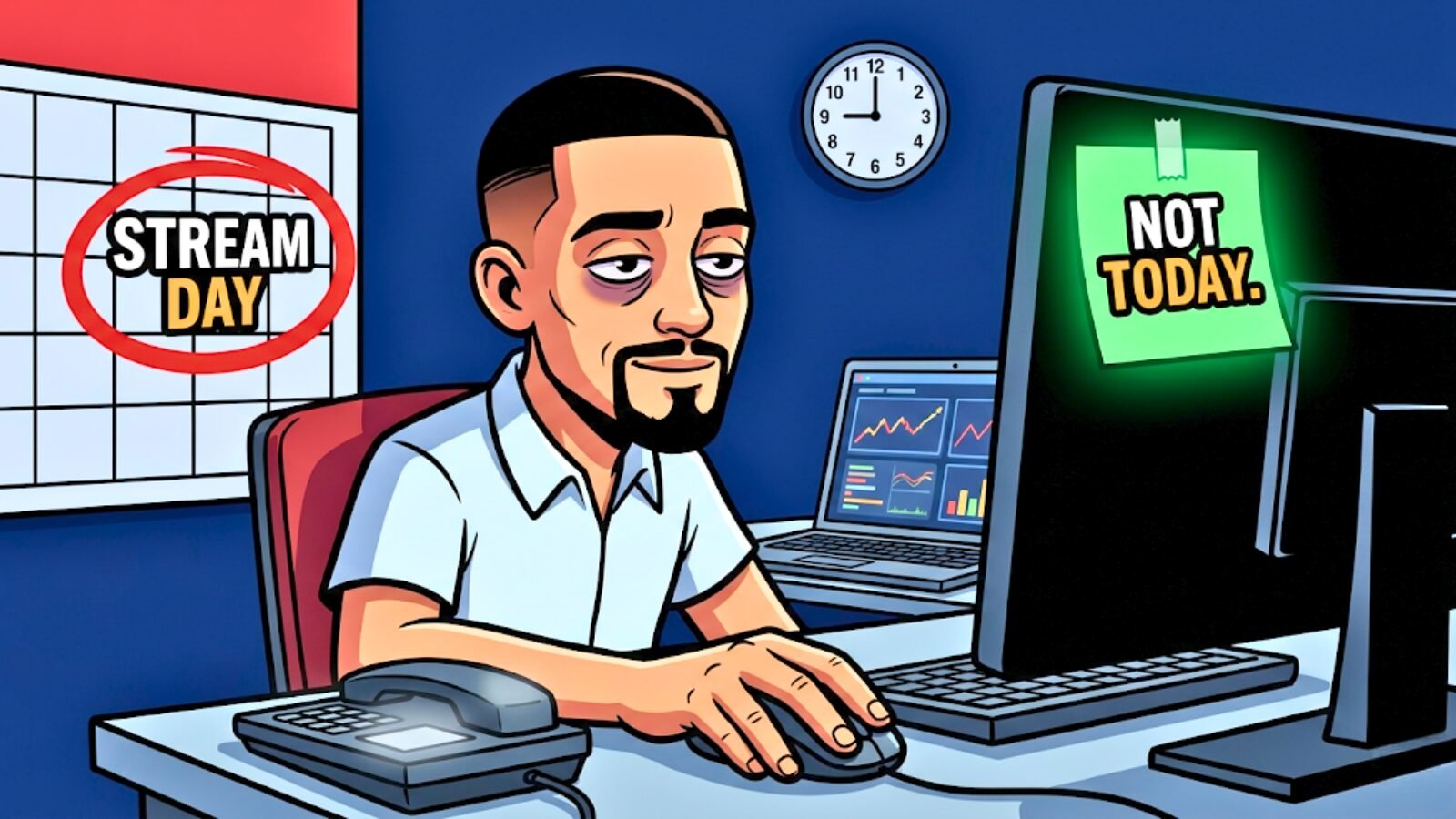
Tuesday’s are reserved to be at the desk, run the pre-trade routine, stream the session, and trade.
But every plan has an exception.
Coming off 48 hours of on-call standby through the long weekend, the energy going into the morning was not where it needed to be. The pre-trade routine finished at 9:12 instead of the usual 9:00 to 9:05 window. That seven-minute difference is small on a clock and significant as a signal. When the routine runs late without an obvious external reason, the body is usually already telling the story before the brain has named it.
The decision was a no-trade day. The stream did not happen. And looking back at how the morning unfolded, it was exactly the right call.
What Does On-Call Fatigue Actually Do to Trading Performance?
Most people understand physical tiredness. Sleep six hours instead of eight and the day is harder. That connection is obvious.
The kind of fatigue that came into Tuesday’s session is less obvious and worth naming directly because it affects more traders than the conversation around trading psychology usually acknowledges.
Being on call for 48 hours over a holiday weekend did not involve anything major happening. No disasters, no emergencies, no all-night incidents. Just the sustained background awareness that the phone could ring at any moment, requiring an immediate, professional response.
That awareness does not stay in the background. It occupies a layer of cognitive attention even during rest. The nervous system stays in a mild state of readiness the entire time, which means the sleep that does happen is lighter, the recovery is incomplete, and the mental freshness that a trading session requires is simply not there the next morning.
The parallel to trading is direct. A trader carrying anxiety about an open position into a new session brings that unresolved tension into every decision made during that session. On-call awareness works the same way. Nothing bad happened over the weekend. The body did not care. The standby cost was paid regardless.
Trading while carrying that kind of unresolved mental load is not the same as trading rested. The decisions feel the same from the inside. The quality is different.
You're Not Missing Anything If Your Energy Is Requesting a Break
The guilt that comes with skipping a scheduled session is real and worth addressing directly.
There is a version of trading discipline that says show up regardless. Push through. The market does not care how tired a trader is and neither should the trader. Grind through it.
That version of discipline is expensive.
The market will be there tomorrow (and if it’s not, we probably have much bigger problems on our hands than trading digital paper for fiat currency). The setup that forms today will form again in a similar shape in a future session. The opportunity cost of sitting out one morning in a compromised state is real, but it is small compared to the cost of taking a poorly-executed trade in that same state. One of those outcomes is recoverable immediately. The other carries forward into the next session as a loss on the books and a knock on the confidence.
The session note that sat at the top of the premarket awareness going into Tuesday was simple: “You’re not missing anything if your energy is requesting a break.”
That line is not permission to be lazy. It is permission to be honest. There is a meaningful difference between the two, and keeping that distinction clear is part of what makes the decision-making process around no-trade days reliable rather than arbitrary.
Choosing to honor what the body is reporting rather than push through for the sake of a schedule is not weakness. It is applying the same self-awareness to personal state management that gets applied to risk management at the desk. The system has rules. One of those rules is that the person running the system has to be in a condition to run it well.

How Systems Protect Performance Across Every Area of Life
Trading has a way of reinforcing habits that matter well outside the trading window. One of the clearest of these is the value of building systems for everything.
At the day job, systems were put in place specifically to reduce the chance of being caught off guard during on-call periods. Documentation improved while the handoff processes became sharper. The goal was to reduce the cognitive load of standby by ensuring that if the phone did ring, the response could be clean and fast rather than scrambled and reactive.
Those systems worked. The weekend was quiet specifically because the preparation behind the on-call period was solid.
But here is the honest part that systems cannot fully solve: even with everything well-prepared, being on overnight standby still disturbs sleep and still depletes energy. The body’s alert state does not fully disengage just because the systems are good. It stays active because the possibility of interruption is still real.
Systems reduce the frequency and severity of disruption. They cannot eliminate the physiological cost of sustained alertness. That cost gets paid regardless.
This is worth knowing clearly because it changes how the morning after an on-call period gets evaluated. The question is not “did anything go wrong?” The question is “what did the sustained readiness cost in terms of recovery?” Those are two different questions with two different answers. The first might be nothing. The second is always something.
Building awareness of that distinction is a system in itself, one that protects trading performance by treating the body’s energy state as data rather than something to push through.
How Do You Evaluate a New Trading Tool Without It Becoming a Distraction?
The decision to use Tuesday’s session for tool evaluation rather than trading was deliberate. The energy was not there for live execution. It was sufficient for focused, low-stakes research work.
Aurafy has been on the testing list for a couple of weeks. Tuesday was the most extended evaluation window so far. The interface continues to show real potential as an AI-powered trading journal. The manual trade entry functionality worked cleanly in testing. The challenge remains on the data import side.
Multiple CSV formatting iterations were worked through trying to get Sierra Chart trade data to import correctly. The issue comes down to missing fields in Aurafy’s CSV template: there is no field available for mapping the date and time of each trade, and some statistics are not displaying correctly even after a successful import. Screenshots and modified CSV files were prepared to be sent directly to the Aurafy developer through Discord for support. R-Trader Pro was also tested as a potential alternative data export source during the same session.
The evaluation is ongoing. The criteria for a tool earning a permanent place in the workflow has not changed: does it reduce documentation friction without creating new friction somewhere else? Aurafy is not there yet on the import side. The manual entry path might be the more practical route in the short term while the developer works through the CSV mapping issues.
Worth noting: the willingness to reach out directly to the developer rather than just giving up on the import issue is part of how a tool gets a fair evaluation. Early-stage tools have rough edges. That is not automatically disqualifying. How the developer responds to a clear, documented support request will say more about the tool’s long-term viability than any single feature gap.
What Does a Productive No-Trade Day Actually Look Like?
☑ No streaming
☑ No positions
☑ Trading journal tool research, troubleshooting, and developer outreach
☑ 3-mile run after the session to reset the body and close out the morning with something physical
By the most obvious measure, nothing trading-related happened.
By every other measure that matters for the long-term health of the trading operation, quite a bit happened.
A tool evaluation moved forward with real data and a direct support request. An honest self-assessment was made before the session opened, and the decision it produced was followed through without second-guessing. The morning ended with a physical reset (that cleared the mind and energy beautifully) rather than a frustrated sit at a desk that was not producing anything.
This is what protecting the process actually looks like on a day when the conditions are not right for live execution. Not checking out. Not abandoning the routine. Redirecting the available energy toward work that serves the operation without requiring the mental sharpness that live trading demands.
The traders who build something durable over time are not the ones who push through every session regardless of how they feel. They are the ones who know the difference between a bad excuse and an honest signal, and who have built enough self-awareness to tell which one is which in real time.
The System Includes You
A schedule is a plan. Energy is the input the plan runs on.
When the input is genuinely compromised, the output will reflect that, regardless of how sound the plan is. This is true in trading, in business, and in any high-performance field where quality of decision-making is the primary variable.
Building awareness of personal energy signals is part of the system. Using the pre-trade routine as a diagnostic, not just a ritual, is part of the system. Having the discipline to honor what that diagnostic reveals, even when it means skipping a scheduled session, is part of the system.
This is something addressed in Pull the Trigger: How to Stop Missing the Trades That Pay: the psychological and physical state carried into a session shapes every decision made during it. Not as a side note, but as a foundational input into execution quality. Taking that seriously is not an excuse to avoid hard work. It is the long-game version of hard work.
The traders who last are the ones who treat themselves as part of the trading operation, not separate from it. The system does not run without the person running it. Protecting the person protects the system.
You’re not missing anything if your energy is requesting a break.
Trade it easy ✌🏾



