Trading is risky! Past performance does not guarantee future results. Click here to read our full Disclaimer

Some mornings just aren’t the best. The alarm gets ignored. The body feels heavy. The mind is somewhere between sleep and the charts. And yet, the market opens on schedule whether a trader is ready or not.
That was the honest reality of this session. The overnight range had been pushing toward all-time highs. Conditions were anything but calm. And somewhere between waking up later than planned and sitting down at the desk, there was already a battle going on before a single order hit the market.
What happened matters less than what it revealed. And what it revealed is something most trading content completely skips over: a technical edge is not the strongest edge a trader can develop. It might not even be in second place.
A Technical Edge Is Your First Line of Defense
Let’s be clear about what a technical edge is. It’s the repeatable stuff. The patterns, the levels, the signals. The things that can be pointed at on a chart and explained to another person. This is usually where most traders spend 90% of their time and energy.
And for good reason. Technical edge is the easiest to understand. It’s the easiest to explain. It’s the easiest to test. Walk into almost any trading community and the conversation is almost always about setups and signals.
But here’s the thing. A technical edge is a defense. It keeps a trader from taking random, impulsive trades with nothing behind them. That is genuinely valuable. Without it, every session becomes random guessing with no structure.
The problem is that so many traders treat technical edge like it’s the whole game. Like if the right setup or the right indicator or the right system can just be found, everything else will take care of itself.
It doesn’t work that way. Not in the long run.
The Real Edge Lives Deeper Than the Chart
There’s a level of edge that most traders never develop because it requires something more uncomfortable than studying price action. It requires studying yourself.
This idea showed up clearly in that morning session. The market was range-bound. Price was bouncing around without giving much clean direction. Conditions were not ideal. And layered on top of that was a tired mind and split attention.
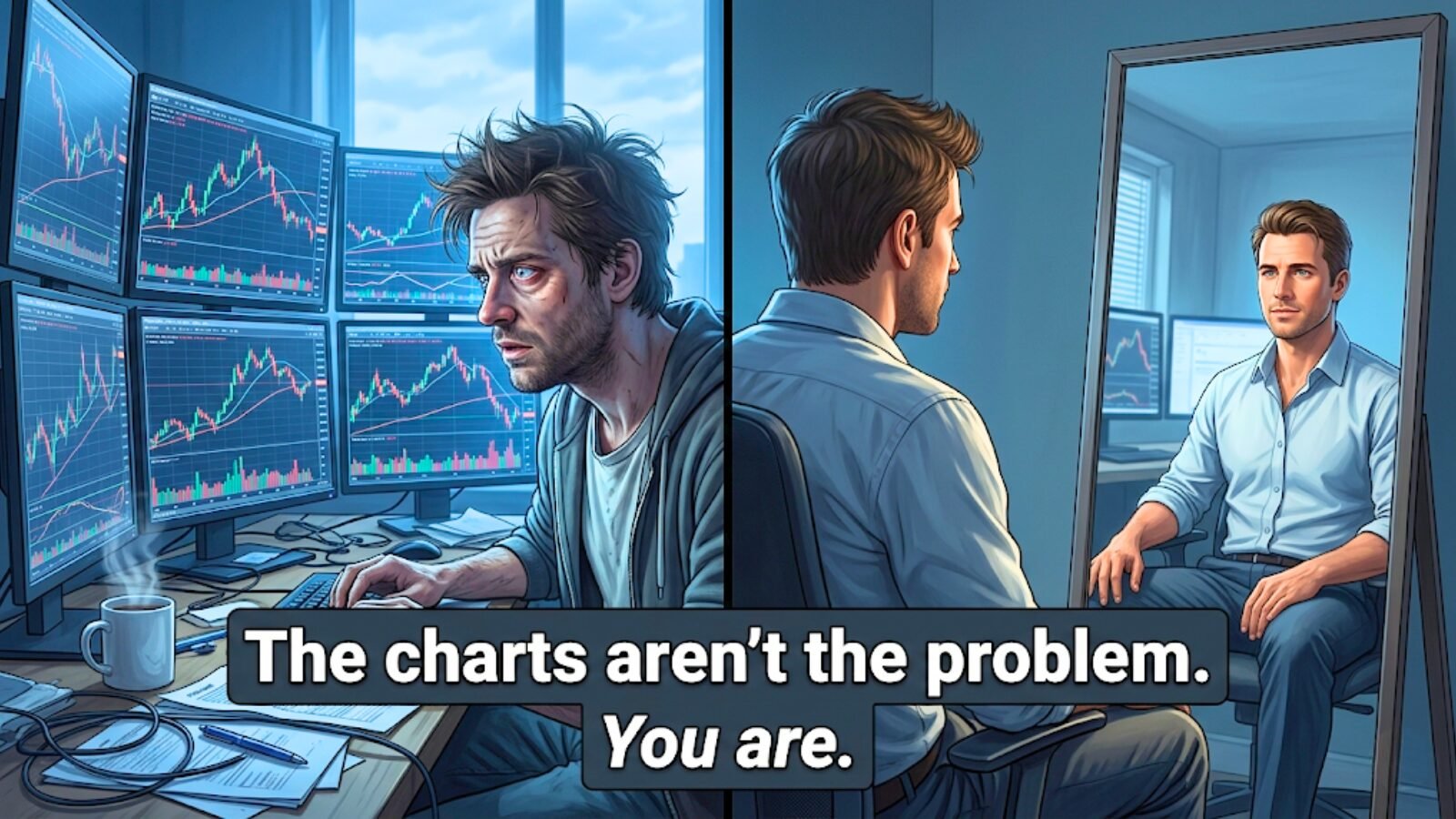
The chart wasn’t the problem. The operator was.
When a trader isn’t at 100%, the technical edge is still sitting there in the system. The levels don’t change. The signals don’t disappear. But the person reading them is operating at a fraction of their usual awareness. And that gap between what the system says and what the trader actually does is where real damage gets done.
In Pull the Trigger: How to Stop Missing the Trades That Pay, this operator gap is at the center of the whole conversation. The fear of missing trades, the hesitation, the second-guessing, these aren’t really about the chart. They’re about the person sitting in front of it. That’s where the real work happens.

The "Market Is Out to Get Me" Feeling
One of the most common things traders say when sessions keep going sideways is some version of “the market is targeting me.” Stops keep getting hit. Breakouts keep failing. Setups keep stopping just short of their targets.
Here’s an honest take on that feeling: it’s almost never true.
What’s actually happening is that patterns built from historical price action don’t repeat perfectly. There’s variation. There’s noise. And when that variation lines up with a losing stretch, the brain starts connecting dots that aren’t really there.
And here’s what rarely gets mentioned: the patterns on the chart are the footprint of algorithmic systems at work, so when price gets noisy, it is more likely the algorithms are in conflict than it is the market targeting an individual trader.
For the overwhelming majority of traders, what feels like a personal attack from the market is really just a nuance in how a system was developed. The conditions used to build the strategy don’t match current conditions perfectly. That’s a feedback signal, not a conspiracy.
The dangerous part isn’t the false breakouts or the choppy sessions. The dangerous part is what a trader does with that “attack” feeling. That’s when revenge trades happen. That’s when the session window gets extended past the planned cutoff. That’s when size gets pushed up to “make it back.”
The feeling isn’t the problem. The reaction to the feeling is where accounts suffer.
Sleep, Focus, and the Cost of Showing Up at 70%
There’s a tendency in trading circles to talk about edge and psychology in broad strokes. But sometimes the most practical conversation is just about sleep.
Showing up to a trading session on less sleep than needed isn’t a neutral event. It costs something. The mind is slower to recognize what it’s seeing. The awareness needed to catch a mistake mid-trade is delayed. The patience required to wait for the right moment wears out faster.
That session was a direct example. The plan was in place. The key levels were identified. But attention kept splitting between what was happening on the chart and what was being communicated during the stream. And that split, however brief, was enough to lead to an entry that shouldn’t have been taken.
What’s worth noting is that the mistake was caught quickly and addressed right away. The damage stayed minimal. That kind of rapid self-awareness only exists when it has been practiced over time. It doesn’t show up the first session. It shows up after dozens and dozens of honest journal entries, reviews, and pattern recognition about personal behavior at the desk.
Tools and services don’t fix a tired mind. A high-end charting platform, reliable data, automation support, none of that changes what’s happening mentally when the body is running below its best. These tools are amplifiers. When the operator is sharp, they amplify good decisions. When the operator is off, they amplify problems.
Distraction Is a Variable in Your System
Here’s something worth building into how performance gets measured: distraction is a data point.
In this session, the position that went sideways wasn’t a mystery. The entry was taken while attention was partly elsewhere. The setup didn’t fully meet the required conditions. It was caught and exited near flat. But the reason it happened was honest and clear: focus was divided.
Most trading journals track entries, exits, results, and sometimes market conditions. Far fewer track operator state. But if a system is being applied by a human being who trades at varying levels of focus and energy, then operator state is part of the performance equation. Leaving it out of the journal means the data is incomplete.
A simple addition of a focus level or energy level check before each session, tracked consistently over months, will start to show patterns. Which conditions lead to cleaner execution. Which setups get botched more often on low-focus days. That data is worth having.
Language Shapes How Trades Get Executed
This might seem like a small thing, but it has had a real impact on how sessions run.
Words carry energy. “Sell-off” sounds like panic. “Value decline” sounds like a process. One of those frames invites an emotional response. The other invites a mechanical one.
The choice to use specific, custom language throughout a trading methodology isn’t just personal preference. It’s about keeping execution grounded in process rather than emotion. When the words used to describe a market event sound calm and procedural, the response to that event is more likely to be calm and procedural.
This comes up in Pull the Trigger as well. The way traders talk to themselves about what’s happening on the chart directly influences how they act on it. Building a vocabulary that strips unnecessary emotional weight from market events is a practical tool, not a gimmick. Whatever terminology works for a given trader, the goal is the same: keep the language neutral so the execution can match.
Discipline Is the Session Window
One of the most underrated parts of that session was what happened at the end of it. The window closed. Trading stopped. Despite being in a drawdown stretch and despite the pull to try and recover some ground, the session ended when it was supposed to.
That matters more than most people give it credit for.
There’s a version of that session that goes a different direction. Losses lead to frustration. Frustration leads to one more trade outside the window. One more leads to two. And the drawdown that was manageable becomes something much larger.
The session window isn’t just a rule on paper. It’s risk management. A hard cutoff, backed by a visual cue built into the trading environment as a reminder, is one of the most effective protections against the kind of damage that comes from emotional decision-making after a difficult stretch.
Discipline isn’t about saying no to trades. It’s about staying inside the agreement already made with the system before the session ever started.
When the Environment Doesn't Fit the System
Recent sessions have reflected a pattern a lot of traders know well: clean trending conditions have been harder to find. The first RTH hour of the NASDAQ futures market has been oscillating inside ranges, reversing before setups can fully develop, and creating friction for systems that perform best in momentum environments.
There are really only two productive responses to this situation.
The first is to accept the current environment for what it is and adjust expectations accordingly. Not every day is the same. Not every week is the same. Forcing a system into conditions it wasn’t designed for usually makes things worse, not better.
The second is to evolve the system, deliberately, through testing, outside of live sessions. The key word is deliberately. Adjusting a system in real time, mid-session, while emotionally elevated from recent losses, is how good systems get taken apart by bad decisions.
Review tools, replay functionality, journaling platforms. These are the resources that make real evolution possible without tearing up a live account in the process.
Building the Operator, Not Just the System
When looking back at what separates traders who eventually figure this out from those who stay stuck, the difference is almost never the sophistication of the strategy. It’s in the depth of self-knowledge.
A technical edge is the starting point. It’s necessary but not enough on its own. What allows that edge to actually translate into results over time is the operator behind it. How that person handles a bad morning. How they respond to a losing stretch. How they manage the gap between what the plan calls for and what the emotions are pushing toward in the moment.
This is the real edge nobody talks about. Not because it’s a secret, but because it’s harder to package. It can’t be drawn on a chart. It doesn’t show up in a backtest report. It develops slowly, over dozens and then hundreds of sessions, through honest journaling, consistent review, and the willingness to face uncomfortable truths about personal patterns.
The traders who put the same energy into studying themselves that they put into studying the market are the ones who last. And the ones who last are the ones who eventually figure it out.
That work starts well before the market opens. On the tired mornings, the range-bound days, the sessions where nothing clicks the way it should, that work is still happening. Every one of those sessions is data. Every honest journal entry is a deposit into the long game.
Trade it easy ✌🏾



