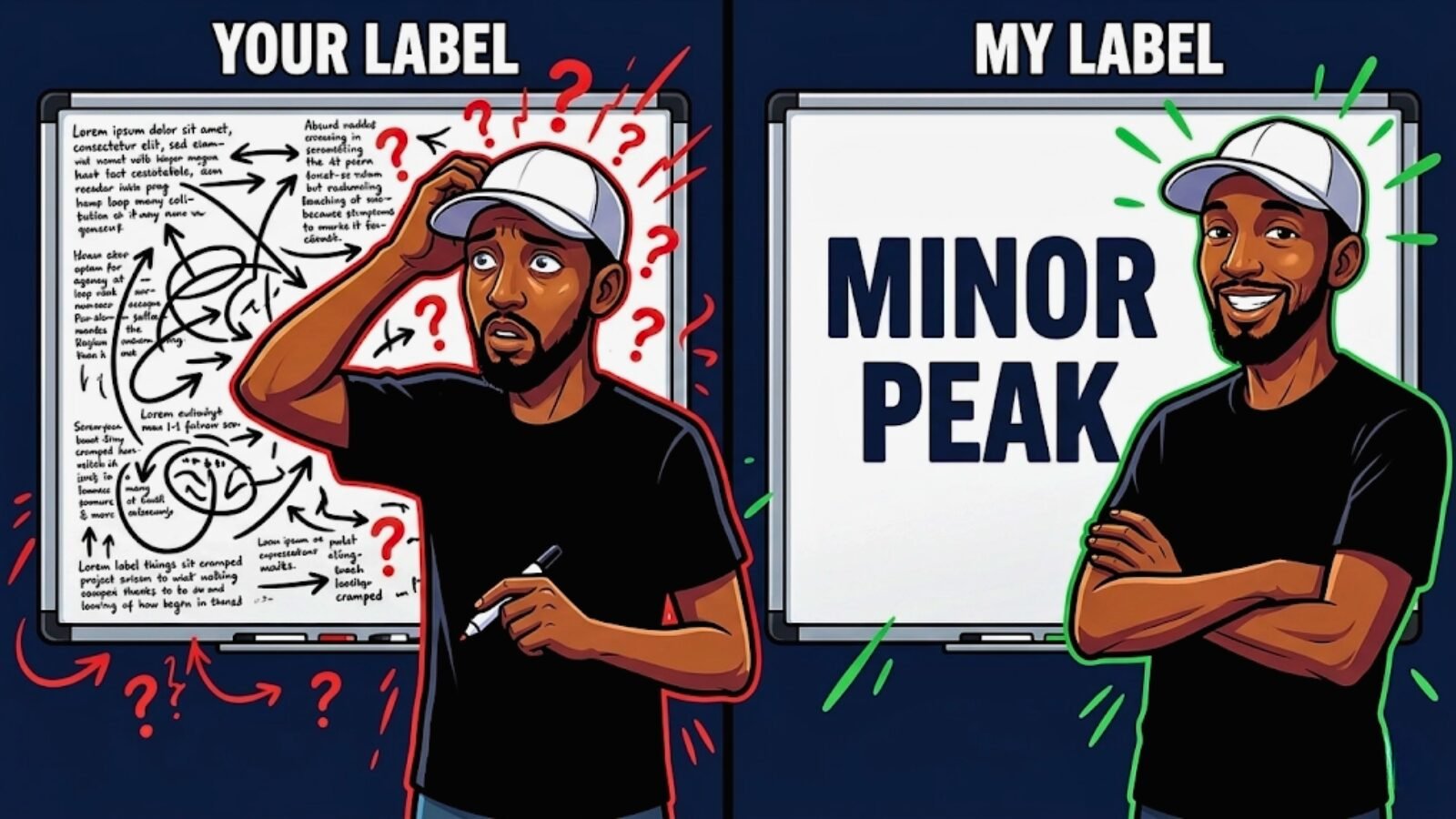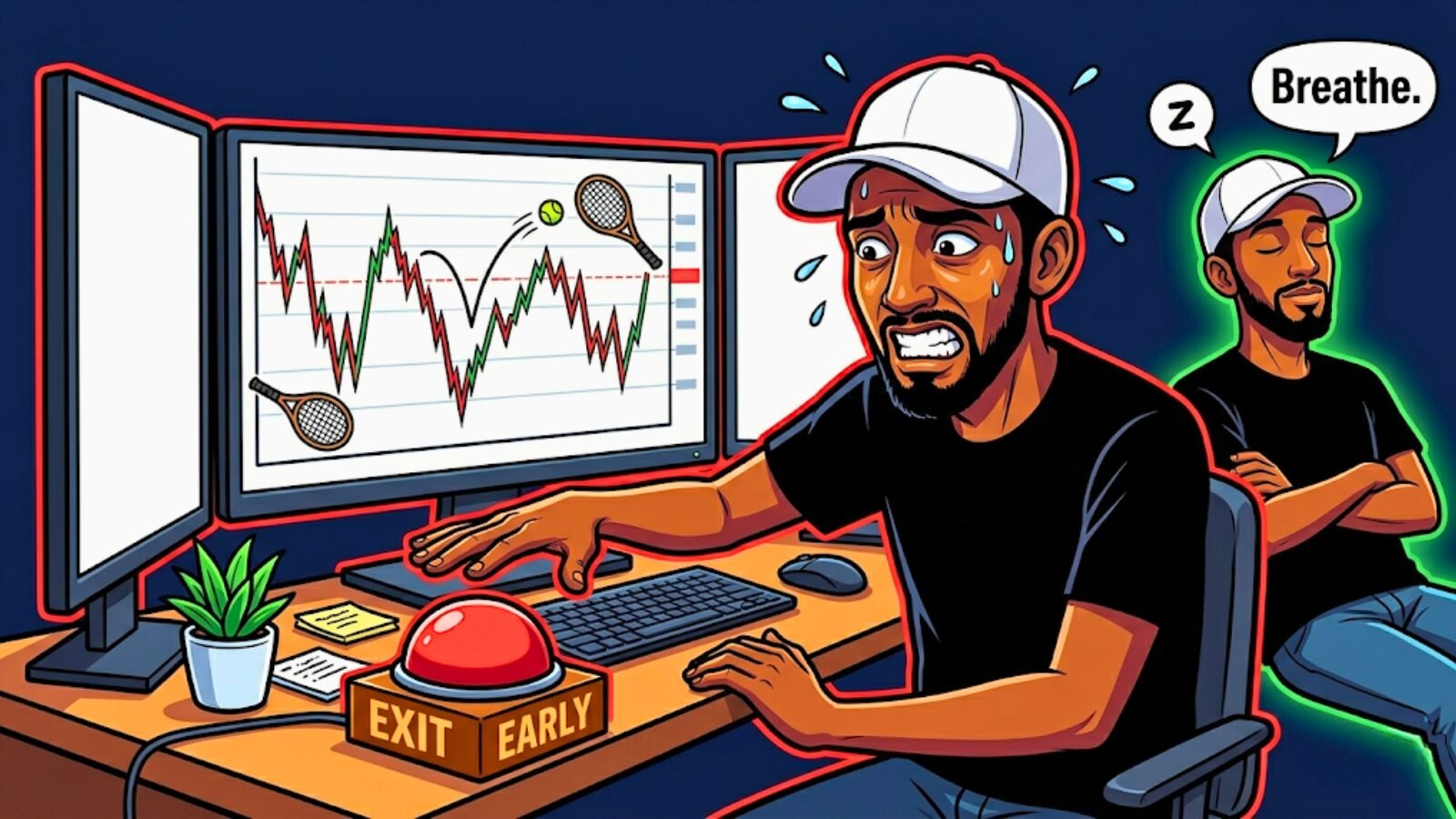
Meme illustration of a focused trader quietly closing a bad position while an ego version of themselves dressed in an "I Was Right" pageant sash stands behind them demanding to stay in the trade, representing real-time ego management and plan adherence in live trading.

How Do You Trade When Your Ego Is in the Room?

Trading is risky! Past performance does not guarantee future results. Click here to read our full Disclaimer

The market moved from bear market territory to new all-time highs faster than most traders could adjust. And a lot of them got caught on the wrong side of that shift, not because their charts were wrong, but because their thinking was too rigid to move with what was actually happening.

That is the setup for this session. And the biggest trade of the day had nothing to do with price.

It had to do with catching an ego-hijacking mistake in real time, correcting it, and staying focused on the plan instead of protecting the appearance of being right. That sequence, repeated consistently over time, is what separates traders who grow from traders who stay stuck in the same patterns year after year.

The moment a trader thinks they have it all figured out, the market will show them a new trick. The edge is not in being right. It is in being flexible enough to respond to what is actually in front of them.

The Market Does Not Care About the Narrative

Market conditions can flip fast. The broader narrative had been leaning bearish for weeks. And then, without much warning, price pushed back into all-time high territory and held there.

Traders who were locked into the bear market story got left behind. Not because their analysis was misinterpreted, but because they held onto it longer than the market warranted.

Bruce Lee’s concept of being like water comes to mind here and it applies directly to trading. Water does not resist the shape of its container. It moves into whatever space is available. A trader who operates the same way, flexible in response to what is actually happening rather than what was expected to happen, has a genuine competitive advantage over one who is fighting to be right about a narrative that has already changed.

Flexibility is not weakness. Rigidity is not discipline. Knowing the difference between the two is one of the more important things a developing trader can internalize.

Tools and reference levels help with this. Having clear visual markers for where price is relative to significant areas takes some of the narrative pressure off. The chart either supports the read or it does not. That clarity is easier to act on than a story that may or may not still be relevant.

What Is Automation Actually Solving?

Automated trading tools have become more accessible to retail traders over the last several years. And the conversation around them has gotten a little confused.

The appeal is understandable. If emotions are causing problems, remove the human from the equation. Build a system that executes without hesitation, without fear, without second-guessing. Let the algorithm do what the trader cannot seem to do consistently.

The problem with that framing is that automation does not remove human nature. It just moves it to a different part of the process.

A trader who cannot bring themselves to take a losing trade manually will often override their automated system after a drawdown. A trader paralyzed by analysis before entry will second-guess every parameter of the automation during setup. The fear of risk and the analysis paralysis do not disappear when a bot is running. They show up in how the bot gets built, adjusted, and overridden.

Self-awareness is the tool that automation cannot replace. Specifically, understanding whether visual data or numeric data is more natural to process, whether pattern recognition or statistical analysis is the stronger instinct, and whether a given system is actually built around personal strengths or borrowed from someone whose strengths are different.

Operating within natural strengths rather than forcing someone else’s approach is not a shortcut. It is how a trader actually builds something sustainable. A system that was not designed for the person running it will eventually find an area of resistance, regardless of how well it works on paper, for the originator, or another trader.

Real-Time Ego Management: What Does It Actually Look Like?

This is the part of the session worth spending the most time on.

The first trigger on the position taken today was a mistake. The trigger was jumped before the full criteria were met. It was clear almost immediately that the entry was off.

And right on cue, the ego showed up.

The internal argument started fast: maybe it will work out anyway, maybe staying in is fine, maybe the read is still right even if the entry was early. That argument is not about the trade. It is about not wanting to be wrong. Not wanting to look like a mistake was made, even when the only audience is a screen recording or an internal monologue.

The redirection was to ask a different question. Not “am I right about where price is going?” but “am I right for the plan?” Those are two completely different standards. One is about the outcome of the trade. The other is about the integrity of the process.

The position was exited. The correct trigger was waited for. The re-entry happened at the right criteria. That sequence cost more in the short term than just holding the original position might have. But the alternative, letting ego take over a mistake situation, has turned minimal costs into much larger ones nine times out of ten based on real historical experience.

Being right or wrong for the plan is the only standard that matters. Being right or wrong for the money, or for the appearance of not having made a mistake, is how small errors become expensive ones.

Trading is business. The market is not personal. There is no purpose in making market activity personal, even when it feels that way in the moment.

What Does Combat Experience Teach About Managing Fear in Trading?

The comparison between trading psychology and military service comes to mind for me in moments like this session, and it deserves a direct treatment because the parallel is real.

In a combat zone, chaos is the baseline condition. Things happen that are outside of anyone’s control. The choice available in those moments is not between calm and chaos. It is between focusing energy on what can be controlled or letting it get consumed by what cannot.

That same choice exists in every trading session.

Nearly every trader faces psychological triggers around money. That is not a personal failing. It is human nature. Your financial status is tied to your wellbeing, tying it to your nervous system. That wiring leads to treating loss as a threat, and the market is specifically designed to trigger that response at the worst possible moments.

The goal is not to shut those emotions off. That is not realistic and chasing it creates its own problems. The goal is to redirect 100% of emotional energy toward plan adherence and controllable variables.

  • Position sizing
  • Entry criteria
  • Hold duration
  • Exit rules

These are things within control. The monetary outcome of a filled order is not.

This is a core theme in Pull the Trigger: How to Stop Missing the Trades That Pay. The fear does not have to go away for execution to improve. It has to go somewhere more useful.

One more thing worth saying about ego specifically: it is not the villain it gets made out to be in trading circles. Ego has a job. It is trying to protect you. Without fail ego is on duty to protect your self-image, financial security, or the sense of being competent. Learning to manage what ego is trying to protect, and redirecting that energy toward plan adherence, is more productive than trying to fire it permanently. The traders who say they have no ego are usually the ones who have not looked closely enough.

Economic Events and the Market's Own Timeline

Several economic news events were scheduled during this session. The response at each scheduled time was minimal. Muted volatility, nothing dramatic.

The real volatility spike came well after the news window closed, thirteen minutes later, with no obvious direct connection to the event itself. Something else drew participant interest at that moment. The market moved on its own terms.

This is a pattern worth filing away. Scheduled news events create expectations. The market does not always cooperate with those expectations. Waiting for confirmation of actual movement rather than anticipating what the news should cause keeps execution cleaner and reduces the risk of getting caught in a false read.

Consistency to the strategy matters more than fixating on any single event or any single session’s result. The session outcome today was modest. The value was in the reps: ego management under real conditions, plan adherence when it was uncomfortable, and re-entry at the correct criteria after catching and correcting a mistake. Those reps compound. The P&L from any single session does not tell that story.

Sponsored Zoi Teli'a
Feel your best. Trade your best. Your mindset is your edge. It starts with how you feel.
Shop Now →

The Most Important Reps Are Not Always the Biggest Wins

The trader who manages themselves flows with the variance of market conditions better. That is not a motivational statement. It is a practical observation from years of watching what separates consistent performers from inconsistent ones.

The biggest sessions, the days with the cleanest setups and the most satisfying results, are not necessarily the most instructive ones. The sessions where something goes wrong and gets caught and corrected in real time, those are the reps that actually build the skill.

Today was one of those sessions. A mistake was made. It was recognized quickly. The ego pushed back. The focus was redirected to the plan. The correct entry was waited for and taken. Positions were closed before the window ended.

That sequence, done enough times, becomes the default response. Not a heroic act of discipline, just a practiced habit.

The long game in trading is built exactly this way.

Trade it easy ✌🏾

Meme illustration of an unbothered trader sipping coffee next to a completely flat, inactive chart labeled "Nothing Happened," with a second line reading "Best Session All Week," representing the real value of inactive trading sessions for observation, screen time, and mindset development.

Is an Inactive Trading Session a Wasted Session?

Trading is risky! Past performance does not guarantee future results. Click here to read our full Disclaimer

There are sessions where everything clicks. The market moves with intention, the triggers appear on schedule, and the execution is clean from open to close. Those sessions are satisfying in a way that is easy to measure.

And then there are sessions like this one.

No filled trades. One trigger missed while drawing levels. One trigger that did not get filled. A slow, grinding market rotating inside a defined range with no clear momentum in either direction. By the most obvious measure, nothing happened.

But here is what actually happened: observation, strategy thinking, screen time, and a reinforced understanding of how markets move mechanically regardless of whether a position is on. None of that shows up in a trade log. All of it compounds over time.

Confidence is refined through persistent repetition. That includes the sessions where the market gives nothing to work with.

Why Showing Up Matters More Than Feeling Ready

There was no strong motivation to be at the desk this particular morning. That is worth saying out loud because the trading community does not talk about it enough.

Not every session starts with energy and clarity. Some mornings the drive just is not there. And the temptation in those moments is to wait until it comes back. To take the day off. To tell yourself that trading without the right mindset is more dangerous than not trading at all.

There is some truth to that last part. But there is a difference between protecting the account from emotional decision-making and avoiding the screen because showing up feels hard.

Passion is not the same thing as motivation. Motivation is a feeling that comes and goes. Passion is what gets a person to the desk even on the days when the feeling is not there. After nine and a half years of trading through unprofitable stretches, slow markets, and sessions that produced nothing, the one constant has been showing up. Not because every day felt exciting, but because the process itself holds enough genuine interest to make presence the default.

That distinction matters. Waiting to feel ready before engaging the market is a habit that trains the a counterproductive response. The market does not wait for readiness. The plan does not care about your energy levels being perfectly aligned with your trading goals. Execution and readiness are not emotional states. They are practiced behaviors, and practicing them on low-energy days is part of what makes them reliable on high-stakes ones.

What Is the Market Actually Teaching When Nothing Is Happening?

Markets are mechanical. They follow patterns because the participants who move them are operating from similar logic, similar reference points, and similar risk parameters. And the ‘man-in-the-middle” mechanically coordinates their similarities. Session after session, price responds to the same levels in the same general ways. Not identically, but consistently enough that a trader who accumulates enough screen time starts to see the repetition clearly.

That repetition is one of the most underrated confidence builders in trading.

Fear in trading (as in all other areas of life) lives in the unknown. When a setup forms and there is uncertainty about whether it is real, whether the level will hold, whether the signal is valid, the hesitation that follows is not really about the trade. It is about the gap between what is seen and what is trusted. Screen time closes that gap. Not because more watching magically produces certainty, but because enough observation of mechanical market behavior makes the patterns feel familiar rather than threatening.

This session was a clear example. The price action throughout the window was slow and grinding, rotating around key levels without producing the conditions the strategy requires. Observing that without forcing trades is its own form of execution. Knowing when the system is not in play and staying out is a skill that takes repetition to build. The sessions that look like nothing are often the ones doing the most work.

The Hidden Benefits of Trading That Have Nothing to Do With Results

This came up directly during this session and it is something worth capturing.

Trading is commonly framed as a path to financial independence. And it can be. But reducing it to that framing misses most of what the practice actually develops in a person.

Here is what years of active market participation has built for me that has nothing to do with the account balance:

A better relationship with risk. The ability to take calculated chances without paralysis or recklessness is a skill that transfers into every area of life. Business decisions, investment choices, personal changes. Risk tolerance developed at a trading desk shows up everywhere.

Patience that is not passive. Waiting for the right trigger, session after session, trains a specific kind of patience. Not the kind that just waits and hopes, but the kind that knows exactly what it is waiting for and does not move until it arrives. That discipline is rare and it compounds.

Consistency as a daily practice. Showing up to the same routine, reviewing the same plan, applying the same criteria regardless of how the previous session went. That habit, built over years of trading, becomes a foundation for consistency in other pursuits too.

Consumer behavior and economic awareness. Following markets actively builds a working understanding of how capital flows, how sentiment shifts, how macroeconomic events translate into price movement. That awareness changes how decisions get made well outside the trading window.

Clarity about personal decision-making patterns. The market gives immediate feedback on how decisions are made under pressure. Over time, a trader learns exactly where their judgment is sharp and where it tends to drift. That self-knowledge is genuinely hard to acquire anywhere else. This coming from a veteran that had to make real life-threatening decisions over the span of 48 months. As illogical as it may be, nothing else compares to making decisions under the pressure of market behavior.

Trading as a long-term personal development vehicle is not a soft claim. It is what the experience of doing it seriously over time actually produces.

How Should New Strategy Ideas Be Tested Without Derailing the Process?

This session included some exploration of how a different method might be applied using existing reference levels for a prop firm environment. No trades were taken on it. No real capital was at risk. But the thinking was happening in real time during a live session.

That kind of exploration is valuable, and it also carries risk if it is not kept inside clear boundaries.

Here is the approach that has held up over time: observe a potential method across a meaningful range of sessions before drawing any conclusions about it. Not two days. Not a week. Long enough to see it in different market conditions, with different levels of volatility, across multiple session types. The challenge with testing a new approach is that a short sample in favorable conditions can look like a working system when it is really just a coincidence of timing.

The other piece worth addressing is what happens when back-to-back unfavorable outcomes occur during testing. This is where most traders either abandon a method too early or start tinkering with the rules mid-test, which defeats the entire purpose of testing. Having predetermined criteria for what constitutes a valid test, and knowing in advance what the data needs to show before making a judgment, keeps the process grounded in structure rather than reaction.

Exploration is a healthy and necessary part of systems development. It just has to live inside a framework, not outside of it.

Does What You Eat Actually Affect How You Trade?

The short answer is yes, and it is more direct than most traders want to admit.

This came up during the session because the energy going into it was low, and part of that was traced back to food choices made the night before. That connection is real. Mental clarity during screen time, the ability to stay focused through a slow grinding session, the emotional steadiness required to pass on a trigger that does not fully meet criteria, all of it is influenced by physical state.

Pre-session preparation is part of the trading system. Not optional, not a lifestyle bonus, but a real variable that affects execution quality. Sleep, nutrition, physical movement, stress management. These are inputs into every session whether they are acknowledged or not.

The trader who treats physical health as separate from trading performance will eventually encounter evidence that it is not. Building awareness of that connection early, and treating pre-session physical preparation with the same seriousness as pre-session chart analysis, is a compounding investment in long-term performance.

Sponsored Zoi Teli'a
Feel your best. Trade your best. Your mindset is your edge. It starts with how you feel.
Shop Now →

Zero Trades, Full Value

This session produced no filled trades. By the account balance measure, nothing changed. But by every other measure that matters for long-term development, the session delivered.

Screen time was accumulated. A new method was explored within appropriate boundaries. Mechanical market behavior was observed and reinforced. The discipline to pass on triggers that did not fully qualify was practiced. And a real conversation happened about what trading actually builds in a person beyond the results.

The long game in trading is built on sessions exactly like this one. Not every day will produce a trade. Not every trade will produce a win. What compounds over time is the practice of showing up, observing clearly, executing when the plan calls for it, and staying out when it does not.

As detailed in Pull the Trigger: How to Stop Missing the Trades That Pay, the psychological work of building execution confidence is not separate from the technical work of learning markets. It runs alongside it, session by session, until the two become the same thing.

Trade it easy ✌🏾

Split-panel meme illustration showing a calm trader sipping coffee with a green checkmark labeled "Followed the Plan" next to a chaotic trader drawing all over their chart labeled "Forced It," representing the discipline of sticking to your trading system when market conditions don't cooperate.

What Should You Do When the Market Doesn’t Match Your Strategy?

Trading is risky! Past performance does not guarantee future results. Click here to read our full Disclaimer

The market does not owe anyone a setup.

That is one of those things that sounds simple but takes real experience to actually internalize. There are sessions where everything lines up. The conditions match the system, the triggers appear, and the plan gets executed cleanly. And then there are sessions like this one, where the market does its own thing, the environment works against the approach being used, and the honest result of the day is a small win that barely moves the needle.

That kind of session is not a failure. In fact, handled correctly, it might be one of the more important kinds of sessions a trader can have.

Not Every Session Is Built for Every System

Markets cycle through different states. They trend, consolidate, and spike on news. They grind in tight ranges on low volume. No single approach is designed to thrive in every one of those environments, and the traders who understand that have a massive psychological advantage over the ones who do not.

This session was a clear example. The market had been pushing into new all-time highs repeatedly on relatively low volume, holding in a narrow range at previous session highs. That kind of environment limits the number of opportunities a system like the one being run here is designed to capitalize on. The triggers were limited. The setup count was low. That is not the system failing. That is the system working exactly as designed, not generating signals when the right conditions are not there.

The distinction matters more than most traders give it credit for. A system not triggering is not the same as a system not working.

All Strategies Work, Just Not All the Time

There is a quote that has taken on more meaning over time through firsthand experience developing multiple approaches: all strategies work, just not all the time.

The truth behind it is not immediately obvious when first heard. It sounds like an excuse, like something a losing trader says to avoid accountability. But after years of building, testing, and refining multiple strategies, the depth of it becomes clear.

Every strategy is built around a set of conditions. When those conditions are present, the strategy performs. When they are not, adds to drawdown or it sits out. The mistake most traders make is judging the strategy by the sessions where the conditions were absent, ignoring the ones where the perfect conditions were present.

Building a strategy from scratch, rather than borrowing someone else’s approach, is what makes this understanding real. When the logic behind every rule is understood because it was developed and tested personally, there is no confusion about why a quiet session happened. The reasoning is baked in. The strategy is not broken. The environment just did not cooperate today.

That kind of clarity is only available to the trader who did the work to build their own system.

Following the Plan When There Is Nothing to Work With

Here is where a lot of traders lose the session even before a single trade is placed.

When conditions are slow and setups are not forming the way the system expects, the temptation is to start improvising. Widen the criteria. Take a trade that is close enough. Do something to justify being there.

That is exactly the wrong response, and it tends to be driven more by boredom and frustration than by any actual read on the market.

Keeping your plan as the primary emotional focus redirects that energy. Instead of trying to force the market to cooperate, the plan becomes the anchor. Is there a trigger or is there not? If not, wait. If there is, execute. The emotional noise that comes from trying to make something happen gets replaced by the mental clarity of following a rule-based process.

This session produced a small positive result. One position, taken when the trigger appeared, executed at the appropriate level. That is a win. Not because of the size of the result, but because of the accuracy of the execution. The plan was followed in conditions that could have easily led to overtrading or frustration-based decisions.

Trading accurately is not the same as trading profitably in every session. But it is the foundation that eventually produces consistent results over time. That distinction is one of the most important things a developing trader can absorb.

The Trap of Seeking External Validation

One thing that comes up consistently in conversations with traders who are stuck is the habit of looking outward for confirmation of what they already know inwardly.

A pattern is recognized that the trader sees as an opportunity for developing or improving a system. And instead of following that instinct, there is a search for someone else to agree. A chat room, a Twitter feed, a Discord channel, a YouTube stream running in the background. Something external that says “yes, this is the right call.”

That habit is expensive in more ways than one. The time spent seeking confirmation is time not spent executing. And over time, it trains the brain to distrust its own process, which is exactly the opposite of what needs to happen for a trader to develop genuine confidence.

Leaning into what organically draws attention as a trader, building around it, testing it, and developing it into a real system, is the alternative. When the system comes from personal interest and personal effort, the confidence to act on it is built into the foundation. It does not need external approval because the work behind it is already understood.

Confidence in reading the market and executing on that read is not optional for anyone trying to make this sustainable. It has to be developed, and it can only be developed by doing the work and trusting the output of that work.

This is a theme that runs through Pull the Trigger: How to Stop Missing the Trades That Pay as well. The psychology behind hesitation is almost always rooted in a distrust of one’s own process. The fix is not more information from outside. It is more confidence built from within.

Passion Shows Up Before the Results Do

Nine and a half years of trading. Only two of those years were profitable in a meaningful way: 2024 and 2025.

That timeline is worth sitting with for a moment.

Most people would have stopped long before reaching year nine. The question that naturally follows is why keep going through the unprofitable years. And the honest answer is that the passion was never tied to the money. Trading is the only thing that consistently generates the motivation for me to be up early every morning without needing an external push. It does not feel like discipline. It just feels like where the energy naturally goes.

That is what real interest in something looks like. Not the social media version of passion, where every day is exciting and the results are always good. The actual version: showing up consistently over years, through private, solo-sessions that produce nothing, through stretches that feel like they will never turn around, because the process itself holds enough interest to stay in it.

That kind of engagement with a craft is also what leads to the deepest level of skill. Not the trader who finds the shortcut and cashes out in year two, but the one who is still here in year ten with a decade of real data, real experience, and a system built from scratch that reflects everything learned along the way.

The passion is in the daily activity. Not in the result of the day.

Sponsored Zoi Teli'a
Feel your best. Trade your best. Your mindset is your edge. It starts with how you feel.
Shop Now →

Healthy Detachment Is Part of the Process Too

One thing worth mentioning because it does not come up enough: a healthy relationship with trading includes fully stepping away from it.

Weekends are weekends. Holidays are holidays. There is no yearning to get back to the markets on a Saturday morning. No checking charts during family time. The boundaries are real.

That kind of detachment is not a sign of low commitment. It is a sign of sustainability. Traders who cannot turn it off are carrying the market home with them, and that weight accumulates in ways that eventually affect the quality of the execution. Rest and recovery are key contributors to performance.

The goal is to show up fully on trading days and fully disengage when trading is done. That rhythm, maintained over time, is part of what makes the long game possible.

When the Market Does Not Cooperate, How You Trade Is the Result

On the days when the conditions do not cooperate, the performance measure shifts.

It is no longer about what the account gained or lost. It is about whether the plan was followed. Whether the system was respected. Whether the session produced accurate execution, even if it produced minimal results.

This session was a green day on a low-opportunity day in conditions that were not designed to produce much. The position taken was taken correctly. No other trades were forced, or fabricated, in real-time beyond the rules of the system. That is how the business remains operational, indefinitely.

The long-term edge is built exactly in sessions like this one. Not by finding a way to manufacture trades that were never there, but by maintaining the discipline to operate within the plan when operating outside of it would have been easy to justify.

Trade it easy ✌🏾