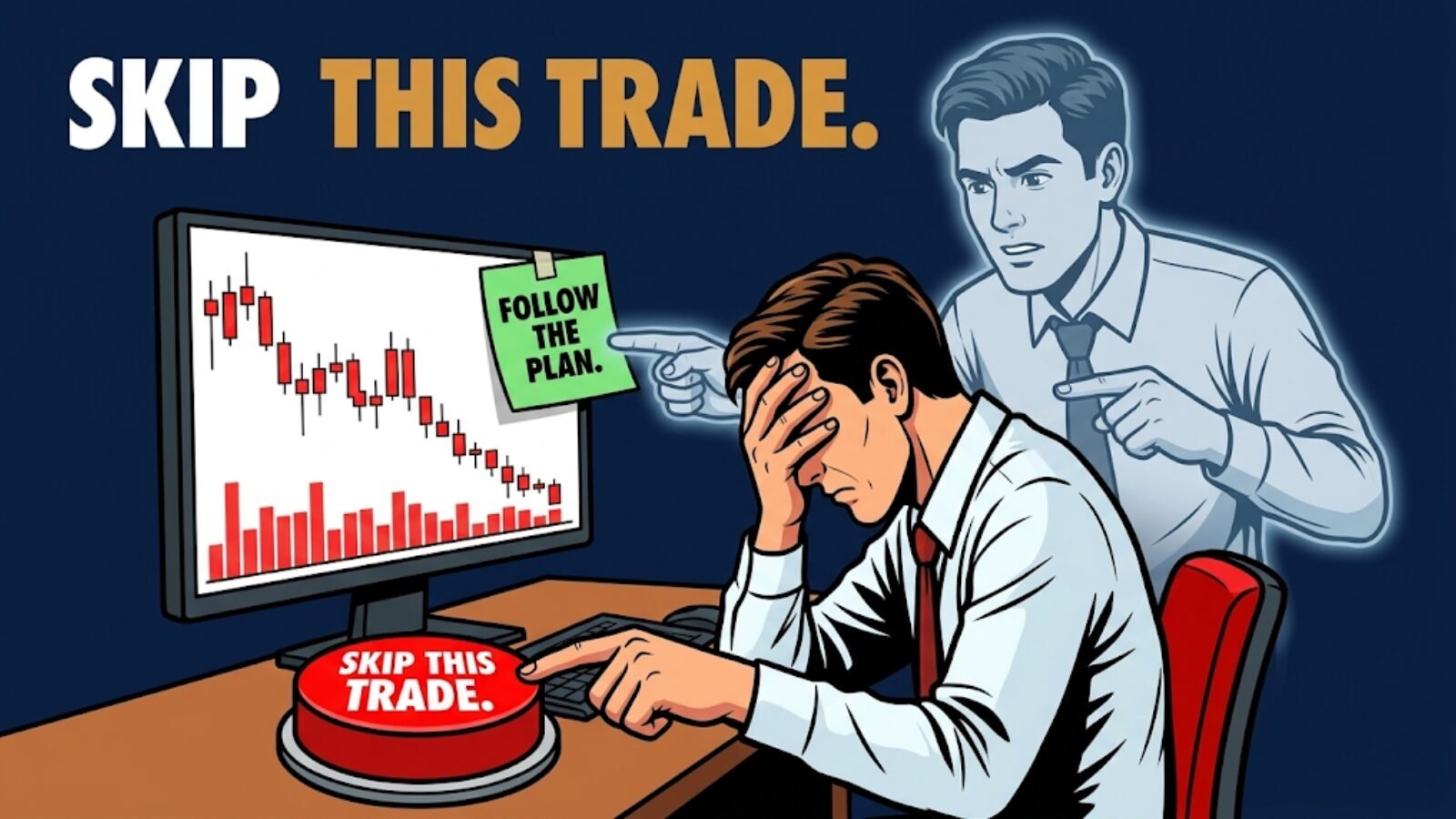
Meme illustration of a defeated trader hovering over a red "Skip This Trade" button while a confident ghost version of themselves points urgently at a sticky note reading "Follow the Plan," representing the cost of trigger shyness during a drawdown.

Why the Plan Is the Only Thing That Matters in a Drawdown

Trading is risky! Past performance does not guarantee future results. Click here to read our full Disclaimer

There is a question that comes up over and over in trading, especially during rough stretches: how do you stay consistent with a strategy when it is not working?

It is one of the most important questions a trader can ask. And the answer is both simpler than most people expect and harder than most people want to hear.

This session was a good example of what that looks like in real time. The market was volatile, the overnight range was wide, and things did not go smoothly out of the gate. The position resulted in an expense initially, and then a decision had to be made: pull back, or follow the plan and take the next trigger.

The plan was followed. The second trigger moved toward profit. The session closed in the green.

That sequence only happened because the trigger was pulled. And that is the whole point.

Drawdown Does Not Break Strategies. Trigger Shyness Does

When a strategy goes through a rough patch, the natural instinct is to pull back. Take fewer trades and be more selective. Wait for the “perfect” setup before committing again.

That instinct feels protective. It feels disciplined, but what it actually does is take all the downside of the losing period while cutting off access to the upside that eventually follows.

Losses are going to happen. That is not optional. What is optional is whether a trader is still in the game when the setup that recovers the day shows up. If trigger shyness has taken over, that moment comes and goes without participation. The loss stays on the books and the recovery never lands.

Getting all the downside without any of the upside is not risk management. It is the worst of both worlds.

The Trigger-Shy Spiral

Here is how the spiral usually works.

A trade loses. It hurts a little. The next valid signal appears and there is hesitation. The trade is skipped. That trade also loses. Now the hesitation feels justified. “Good thing I sat that one out.”

Then the next signal appears. Hesitation again. This trade would have won. Now there is regret. The next signal appears and there is pressure to make up for the missed winner. The trade is taken but for the wrong reasons, under emotional pressure instead of plan-based logic. That one loses too.

None of this is a strategy problem. It is entirely a psychology problem that compounds fast.

The habit being built during this spiral is the habit of not pulling the trigger. That habit does not stay in the losing periods. It carries over into the winning ones. When the strategy starts performing again, the same hesitation shows up because it was reinforced over and over during the drawdown. The muscle was trained in the wrong direction.

This is something I spent a lot of time writing through in Pull the Trigger: How to Stop Missing the Trades That Pay. The fear that builds during a losing stretch does not automatically go away when the results improve. It has to be actively addressed. And the way to address it is to keep executing, especially when it is uncomfortable.

The Only Way to Overtrade

Overtrading gets talked about a lot. Most of the time it gets framed as taking too many trades or trading too frequently. The real definition is simpler than that.

The only way to overtrade is to trade outside the plan.

If the plan says take this signal and the signal appears, taking the trade is not overtrading. It is executing the plan that was developed through real work. If the plan does not include a signal and a trade gets taken anyway, that is overtrading, regardless of how convincing the setup looked in the moment. Regardless if it was the 2nd trade or the 20th trade.

Everything comes back to the plan. Consistency comes from the plan. Discipline is measured against the plan. Results, over a large enough sample size, reflect the plan. Without the plan as the anchor, every decision becomes a judgment call made under pressure, which is exactly the environment where bad habits form fastest.

There is a version of trading advice circulating online that says to be picky with entries. Wait for the A-plus setups. Skip the ones that do not feel right.

That advice is not universally wrong, but it is generally missing critical context. Being selective is a skill that has to be earned through a deep understanding of a specific strategy. Applied without that foundation, it gives emotional hesitation a legitimate-sounding excuse. “I was being selective” and “I froze and did not take the trade” can look identical from the outside.

The 95% Rule (Opinion)

Before any adjustment to a strategy makes sense, there is a prerequisite that has to be met: the plan needs to be followed with at least 95% accuracy over a meaningful sample of sessions.

That number is a personal standard, not an industry benchmark. But the logic behind it is solid. A plan that is not being executed consistently cannot produce reliable data. The results are contaminated by the inconsistent execution. It is impossible to know whether the strategy needs work or whether the execution does, because both variables are moving at the same time.

This is one of the most under-appreciated ideas in trading. Most traders who think their strategy is broken have never actually traded it cleanly enough to know for sure. They have been running a version of it filtered through hesitation, selective application, and emotional override. The strategy never got a fair test.

Clean up the execution first. Follow the plan with 95% accuracy over enough sessions to generate real data. Then look at the results and evaluate. At that point, the conversation about adjustments is grounded in actual evidence instead of feelings from a rough week.

Once that execution consistency is proven, then the door opens to evaluate whether the strategy needs refinement for the current environment. Not before.

What Drawdown Actually Gives You

Difficult periods in trading are underrated as a training tool.

When the market is choppy, when the results are not there, when every session feels like a grind, that is exactly when the most important skill is being developed. Not finding winners. Not reading price action better. The skill of maintaining the habit of pulling the trigger when the plan says to, regardless of how the last trade went.

That skill, built during the hard sessions, is what makes consistency possible when things get easier. The trader who keeps executing through a drawdown is training long-term profitable habits. The trader who pulls back is training habits that lead to frustration and mistakes.

This session was a small but clear example of that. After an initial expense, the plan called for taking the next valid signal. That trigger was pulled and moved toward profit. If hesitation had taken over after the first loss, that second trigger would have been missed. The session would have closed in the red instead of the green, not because the strategy failed, but because the execution did.

Sponsored Zoi Teli'a
Feel your best. Trade your best. Your mindset is your edge. It starts with how you feel.
Shop Now →

Making the Market Make Sense to You

One thing that helps with staying logical during volatile or choppy sessions is building a personal language around what the market is doing.

Traditional candlestick pattern names and indicator labels work for some traders. For others, translating market behavior into familiar terms from other areas of life, business, marketing, sports, whatever is deeply understood, reduces the emotional noise that comes from trying to interpret something that feels foreign under pressure.

This is not a gimmick. It is a practical psychological tool. When the market is doing something that can be connected to a concept that is already understood, the emotional charge around it drops. The decision-making becomes cleaner. The plan is easier to follow because the situation feels familiar instead of threatening.

Building that personal framework takes time. But it is worth it. Making the market make sense on your own terms is a real form of psychological edge.

The Plan Is the Way Through

Drawdowns end. Rough patches pass. But the habits built during those periods carry forward regardless of which direction the results go.

The trader who keeps following the plan through a difficult stretch comes out the other side with stronger execution habits, cleaner data, and a more grounded relationship with the strategy. The trader who pulls back comes out of it with a confirmation bias problem and a hesitation habit that will cost them trades even when the market cooperates.

The only way out of a drawdown is through it, with the plan intact.

For traders working through the mental side of staying consistent under pressure, Pull the Trigger: How to Stop Missing the Trades That Pay is the resource I built specifically around that challenge. The psychology behind why the trigger does not get pulled, and what to do about it.

Trade it easy ✌🏾

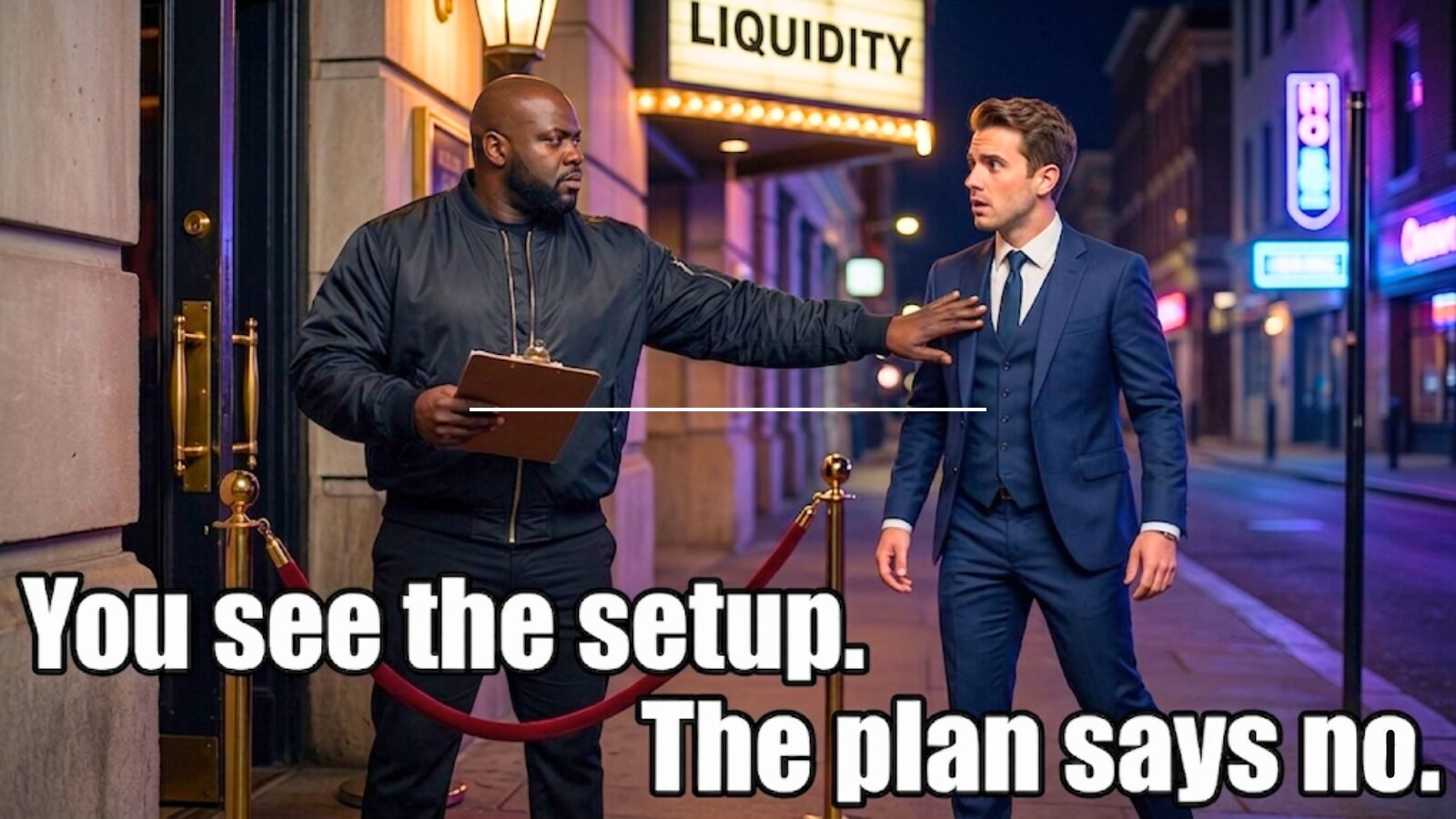
A well-dressed man being stopped by a bouncer at a velvet rope, representing the difference between seeing a trading setup and having permission to act on it. Text reads: "You see the setup. The plan says no."

Awareness Isn’t a Greenlight: Trading What’s in the Plan, Not What You See

Trading is risky! Past performance does not guarantee future results. Click here to read our full Disclaimer

There was a moment in today’s session where a setup printed clean on the chart, and the first thought wasn’t that’s a setup. It was, I didn’t want it to be tradable, but it is.

That sentence stuck with me long after the close. It wasn’t really about the trade. It was about the gap between seeing a thing and being cleared to act on it. That gap is where a lot of trading decisions slip. Not from lack of skill, but from confusing awareness with permission.

This post is about three things that decide what happens inside that gap. The first is psychology. The second is the tools that hold the process up. The third is the testing pipeline that says what is actually allowed in the plan. Pull any one of those out, and the whole thing starts to lean.

Show Up Even When the Feeling Isn't There

Some mornings, staying in bed sounds better than the open. That happened to me on this day. The feeling was, let’s get some more sleep, skip the day. However, I got up anyway. Not because feelings are bad. It’s a perfectly human response to not feel up to it sometimes. The thing is, I love the business of day trading. So I show up.

Trading only when motivation is high can make it harder to build momentum and consistency over time. The market still shows up on the low-energy mornings, so the edge comes from having a routine that is realistic and sustainable, even when the feeling is not there.

Showing up does not mean forcing trades. It means getting to your desk, running the premarket routine, and letting the day decide what it is. If the day has nothing for the system, that’s fine. The win is showing up and getting in your reps. Once that becomes routine, the low-motivation mornings stop feeling like threats. They become just another start to a normal session.

Awareness Isn't a Greenlight

There’s a big difference between seeing a pattern and being allowed to trade it.

A setup printed that I noticed and named, but I did not take. The thinking was simple. That setup is not greenlit yet. It hasn’t been tested through replay or forward testing. It hasn’t been logged across enough sessions. So it stays in what I call the back pocket. It’s awareness, not action.

A lot of traders skip this step. Something looks good, so it gets traded. The problem isn’t that the setup is bad. The problem is that the trader has no way to know yet. Without testing, the next time it shows up the move could play the opposite way, and there’s no rulebook for what to do when it does. That is how an untested setup quietly slips into live execution and starts mixing with the trades that have actually earned their place.

The back pocket protects the plan. It lets the trader stay observant in real time without bending the rules. And it pays off later, because every back pocket observation becomes a candidate for the testing pipeline. Instead of being one-off impulse trades, those observations become future system inputs. The lesson I keep coming back to is this: seeing it is not trading it. Every clean read is a candidate for tomorrow’s plan, not today’s order.

Pull the Trigger: How to Stop Missing the Trades That Pay leans on the same point. The fastest path to confidence is removing as much of the unknown as possible. The back pocket does that one observation at a time.

The Hindsight Capital Trap

Hindsight Capital is the running highlight reel that shows up in real time. It’s the voice that says, I could have done this, that, and the third, right after the chart finishes a move.

That voice is loud. It is also cheap. Hindsight is always free.

The right question to ask when that voice gets loud is this: was there anything that could have been seen in real time, before the move, that would let a repeatable signal get built around it? If the answer is yes, that observation has a future. It goes into the testing pipeline. If the answer is no, it stays a story. A nice story, but a story.

A one-off “look what just happened” doesn’t qualify as a system input. A signal earns its spot only if it survives game film, backtesting, and real-time data in a simulated environment. Skipping that filter is how a trader starts chasing pretty echoes of patterns instead of trading the system that has actually been validated.

Indicators show this in plain sight. There’s a crowd that calls indicators useless. But if a tool reliably points to where activity is concentrating, calling that information useless is a choice. The way I phrased it during the session: how can identifying exactly where an algorithm is executing be useless information? It isn’t. The choice to ignore it is what makes it useless.

Hindsight capital becomes a problem only when it tricks the trader into acting on stories instead of signals. Logged honestly, it becomes raw material. Acted on impulsively, it becomes drawdown.

Confirmation Cuts Both Ways

Most traders worry about looking for confirmation that says yes when they want a trade to be real. That’s the well-known trap.

The version that almost no one talks about is the opposite. Looking for confirmation that says no when the trader doesn’t want the setup to be valid.

That is exactly what happened here. The print showed up, the system said it was tradable, and the immediate reaction was, I didn’t want it to be tradable, but it is. So the trigger got skipped. Then the move went, and the chase started. The retrace got an order placed on it. No fill. Hindsight said the first chance was the only clean one.

The cost of that pattern is not the missed trade. The cost is the next ten missed trades, because once a trader starts hunting for reasons not to take a setup, the brain gets very good at finding them. Engulfing print? Skip. Sitting on the line? Skip. Doesn’t feel right? Skip.

Naming the pattern out loud is half the cure. I’m looking for confirmation that says no. That sentence kills the loop. A pattern can’t be corrected if it isn’t admitted. Verbal journaling during the session catches it in the moment, when it can still be fixed.

Calling an Audible vs. Rationalizing

Sometimes the next trigger gets taken even when the trader doesn’t love the setup, on purpose, to avoid sliding into trigger-shy mode.

Sometimes the position gets closed earlier than the original target, at a logical reference point that already lives in the plan, instead of forcing the full play.

Both can be smart. Both can also be cover stories. The difference matters.

Here’s the litmus test I use: can this decision get tied back to plan logic, or is it getting tied back to a feeling? If it ties back to plan logic, it’s an audible like a quarterback adjusting the play to another play in the playbook by what he reads in the defense. If it ties back to a feeling, it’s rationalizing.

In this session, position two got closed at a known automation point in the area, not the original target. The reason was clear. The area was full of “indecision”. The exit point was already a reference inside the strategy. That made it an audible. The trade can still work, the read can still be wrong, and the decision is still clean.

Compare that to closing because the chart “feels off” with no plan reference. Same exit price, completely different decision. One builds the system. The other slowly tears it down. Both look identical on the trade log. The journal is where the difference lives.

Sponsored Zoi Teli'a
Feel your best. Trade your best. Your mindset is your edge. It starts with how you feel.
Shop Now →

Tools That Earn Their Spot in the Stack

A tool only earns its spot if it actually gets followed.

The indicator debate is a good example. Tools don’t pull the trigger. They sharpen the read. They map out where decisions are likely to get made. That’s their job. Calling that map useless because someone chose not to look at it doesn’t change what it shows.

The supporting tools matter just as much as the chart tools. A short tour of what holds the process up day to day:

  • A live journaling system with templates and shortcuts. Quickly naming the moment with short verbal tags (not explaining it) makes it easier to stay focused while still creating clean labels for journaling and replay.
  • A premarket awareness routine and a checklist that survive a low-motivation day. The checklist doesn’t care how the trader feels. Logging your feeling for the day inside the checklist can be valuable information for future reference.
  • Predetermined hard stops. A visual cue, a timer, anything that ends the trading day for the trader instead of leaving it up to the trader to decide in the moment.

In the session that started this post, the red background warning was that cue. Once it showed up, the day was over. No debate, no extra setup, no “just one more.” That is what a trusted tool looks like. The trader follows it.

The deeper version of this layered approach lives in Pull the Trigger: How to Stop Missing the Trades That Pay, and a lot of what’s covered there came straight out of journaling sessions like this one.

Build, Test, Greenlight

Every greenlit setup walks through the same pipeline.

  1. Observe a pattern in live action.
  2. Name it and log it, with screenshots and game film attached.
  3. Backtest it through replay and historical sessions.
  4. Test it in real-time with simulated orders.
  5. Greenlight it into the plan only if it’s repeatable and rule-based.

That’s it. Until step five, the setup stays out of live execution, even when it looks obvious in the moment. The setup that printed in that session was a clean example. The pattern was real. The observation got logged. But the rules around it were not built yet, so the trade did not get taken. It went into the back pocket.

This loop only runs if there are consistency mechanisms holding it up. Daily review is the first one. Public reps, like livestreaming the session or trading with a partner/group, are another. Streaming forces a level of accountability that’s almost impossible to fake. So does logging every position the same way, every day, even on quiet sessions.

A community that holds the same standard makes the loop stronger. The gap between I think this works and I have proven this works is wide. The pipeline is what closes it.

Trade the Plan That's Already Been Earned

Awareness is not action. Hindsight is not foresight. Feel is not plan.

The cleanest trades come from the patterns that already had permission to be taken. Everything else, the setup that almost qualifies, the move that would have paid, the trigger that probably works, belongs in the back pocket until the testing pipeline says otherwise. That is how a system stays a system instead of slowly becoming a collection of impulses.

For traders working through the same gap between awareness and action, Pull the Trigger: How to Stop Missing the Trades That Pay goes deeper into the routines, the journaling, and the mindset shifts that built this approach over time.

Trade it easy ✌🏾

day-trading-while-traveling-with-a-macbook-pro-and-parallels

Trading on the Go: My Experience Using Sierra Chart with Parallels Software on a MacBook Pro

Trading is risky! Past performance does not guarantee future results. Click here to read our full Disclaimer

In the rapidly evolving world of trading, having a flexible setup is crucial, especially when you find yourself traveling frequently. As someone who actively trades, I’ve developed a system that allows me to efficiently trade while on the move. Here’s a look at how I maintain my trading activities using Sierra Chart with Parallels software on my MacBook Pro.

My Usual Trading Setup

At home, my trading gear includes an affordable HP Pavillion gaming laptop and two external monitors where I meticulously arrange my charts and programs for a custom trade copying system. This setup works perfectly; however, as life sometimes requires travel, carrying my entire workstation becomes impractical. That’s where Parallels Desktop comes into play.

Trading Setup for Traveling

When traveling, portability is key. Instead of lugging around my entire setup, I rely on my MacBook Pro. Although I generally use two monitors at home, I can comfortably manage trading with just one monitor when I’m away. The core of this setup relies on running Sierra Chart via Parallels software on my MacBook.

Why Parallels?

Parallels allows me to run Windows applications on my MacBook seamlessly. There are other virtualization options available, but Parallels is my preferred choice due to its reliability and performance, enabling me to trade efficiently without noticeable lag or system issues while away from my primary trading station.

save-on-paralells-desktop-coupon-deal
Sale ends October 20

Setting Up Parallels

In the video below, I walk through loading up Parallels, showcasing its startup time and functionality. It’s crucial to ensure all my trading settings, charts, and configurations from my desktop are mirrored onto my MacBook Pro for consistency. Using cloud storage services like Google Drive or iCloud to transfer these settings makes the process seamless.

Performance Insights

Running Sierra Chart on the MacBook Pro with the M1 chip through Parallels is extraordinarily efficient. I’ve experienced no significant issues except for a minor lag during the initial startup phase, which quickly resolves as the software stabilizes. To maximize performance, I ensure all unnecessary applications are closed, allowing resources to be dedicated to trading operations. As shown in the video, even with programs like OBS and Discord running in the background, the setup operates smoothly.

Key Considerations and Tips

While Sierra Chart hasn’t released a macOS version yet, using Parallels to run it on a MacBook Pro provides a viable alternative. When setting up, ensure that Sierra Chart’s settings and application version match your primary setup to avoid any technical hiccups. The most efficient practice I’ve found for daily trading on Parallels is to either pause or suspend Parallels at the end of each trading session. This makes it easy to pick up where I left off without the need for lengthy reload processes.

Conclusion

Traveling doesn’t mean halting trading operations, especially with reliable tools like Parallels software and a robust device like a 2020 MacBook Pro. For a more in-depth look and visual walkthrough of my setup, check out the video at the top of this post. You’ll find demonstrations of my setup in action and additional tips that may enhance your mobile trading experience.

If you have questions or need further details, feel free to leave a comment. Until next time, trade easily and efficiently.