In the rapidly evolving world of trading, having a flexible setup is crucial, especially when you find yourself traveling frequently. As someone who actively trades, I’ve developed a system that allows me to efficiently trade while on the move. Here’s a look at how I maintain my trading activities using Sierra Chart with Parallels software on my MacBook Pro.
When traveling, portability is key. Instead of lugging around my entire setup, I rely on my MacBook Pro. Although I generally use two monitors at home, I can comfortably manage trading with just one monitor when I’m away. The core of this setup relies on running Sierra Chart via Parallels software on my MacBook.
Why Parallels?
Parallels allows me to run Windows applications on my MacBook seamlessly. There are other virtualization options available, but Parallels is my preferred choice due to its reliability and performance, enabling me to trade efficiently without noticeable lag or system issues while away from my primary trading station.
In the video below, I walk through loading up Parallels, showcasing its startup time and functionality. It’s crucial to ensure all my trading settings, charts, and configurations from my desktop are mirrored onto my MacBook Pro for consistency. Using cloud storage services like Google Drive or iCloud to transfer these settings makes the process seamless.
Performance Insights
Running Sierra Chart on the MacBook Pro with the M1 chip through Parallels is extraordinarily efficient. I’ve experienced no significant issues except for a minor lag during the initial startup phase, which quickly resolves as the software stabilizes. To maximize performance, I ensure all unnecessary applications are closed, allowing resources to be dedicated to trading operations. As shown in the video, even with programs like OBS and Discord running in the background, the setup operates smoothly.
Key Considerations and Tips
While Sierra Chart hasn’t released a macOS version yet, using Parallels to run it on a MacBook Pro provides a viable alternative. When setting up, ensure that Sierra Chart’s settings and application version match your primary setup to avoid any technical hiccups. The most efficient practice I’ve found for daily trading on Parallels is to either pause or suspend Parallels at the end of each trading session. This makes it easy to pick up where I left off without the need for lengthy reload processes.
Conclusion
Traveling doesn’t mean halting trading operations, especially with reliable tools like Parallels software and a robust device like a 2020 MacBook Pro. For a more in-depth look and visual walkthrough of my setup, check out the video at the top of this post. You’ll find demonstrations of my setup in action and additional tips that may enhance your mobile trading experience.
If you have questions or need further details, feel free to leave a comment. Until next time, trade easily and efficiently.
If you’ve been in the trading world for any length of time, you’ve likely come across the bold claim: “Trading psychology is BS!” and a complete waste of time. Proponents of this view often argue that the real reason over 90% of people fail at day trading isn’t psychological at all – it’s simply a matter of not having a proper strategy. But is this really the case? Let’s dive deep into the truth of this controversial argument.
Is trading psychology irrelevant nonsense or is it just as crucial as any other aspect of trading?
The Myth of the One-Size-Fits-All Approach
First and foremost, it’s essential to understand that this blog post isn’t intended to be all-inclusive. The topic of trading psychology has many layers and could easily fill a series of books (I’m actually curious to know if that’s something you would be interested in. Let me know by commenting below this post!)
The problem with dismissing trading psychology is that it relies on too much “OR” logic. It assumes that if one factor is important, others can’t be. This black-and-white thinking fails to account for the complex reality of trading and human behavior.
We're Not All Cut from the Same Cloth
One of the most significant oversights in the “psychology doesn’t matter” argument is the assumption that all traders take this race from the same starting line. This couldn’t be further from the truth. People discredit the psychology of trading simply because they don’t feel it’s what they needed to overcome. This implies that everyone is the same – that all people have the same upbringing, life experiences, and influences. But let’s consider this for a moment:
Each of us has a unique psychological edge. (What I refer to as your True Edge.)
We all have something that makes us different from the masses.
This uniqueness is what truly makes us special in the trading world.
It might be hard to believe, considering the number of people in the world, but we can confirm that no two people are exactly alike. There’s something unique about each person on this planet, and somewhere in there lies our true edge.
The Power of Individual Experiences
While we do have shared experiences, we have differences that makes our individual experience unique. Let’s take an example of identical twins who spend as much time together as possible:
At some point, they will have time away from each other.
During this time, they will experience something the other twin did not.
They will have interactions with people the other twin doesn’t know.
They will generally have different perspectives, even on shared moments.
Making claims that imply everyone is the same is pure ignorance. Even if you were able to find two people who are completely the same in every way (virtually impossible), that would be 2 out of at least 7 billion people as of 2022 statistics.
For argument’s sake, let’s cut that number in half to 3.5 billion. Two out of 3 billion is too insignificant to consider that no one should be experiencing a certain problem based on your personal truth alone.
The Ego Trap
So why do people make such sweeping claims about trading psychology? Often, it comes off as a form of ego-boosting bragging. It’s as if they’re saying, “Look at me! I don’t have the problem that everyone else claims to have! I’m so special! 😎” If that’s what you’re into, have at it – just do so knowing you’re absolutely wrong.
Factors That Shape Our Trading Psychology
Now that we’ve addressed the misconceptions, let’s look at some of the many factors that can psychologically affect how one trades:
Your level of financial literacy
How you were taught about money: managing, budgeting, what it takes to earn, ”money is the root of all evil”, “money is necessary for your survival”, etc.
Examples you’ve seen of how others treated their finances
How easy or difficult it has been for you to earn money on your own
Actions you needed to take to have money to trade with
The amount of money you have to trade with (one of the most common factors)
Personal fears that were created outside of trading:
Fear of being wrong or right
Fear of social rejection or misunderstanding from friends and family who don’t understand trading
Fear of failure and its consequences
How you typically deal with perceived dangers
Your tendency to self-sabotage in other areas of life
Lack of discipline
Lack of consistency to do simple or complex things
Your general personal confidence
And this is just a short list of the many factors that shape your perspective and attitude towards money. You’re bringing this into a highly competitive field where the overall goal of the environment is to get as much money out of you as possible. Not to mention you were more than likely introduced to this competition concept through short-sighted misinformation that doesn’t make trading any easier. But that’s another topic for another day.
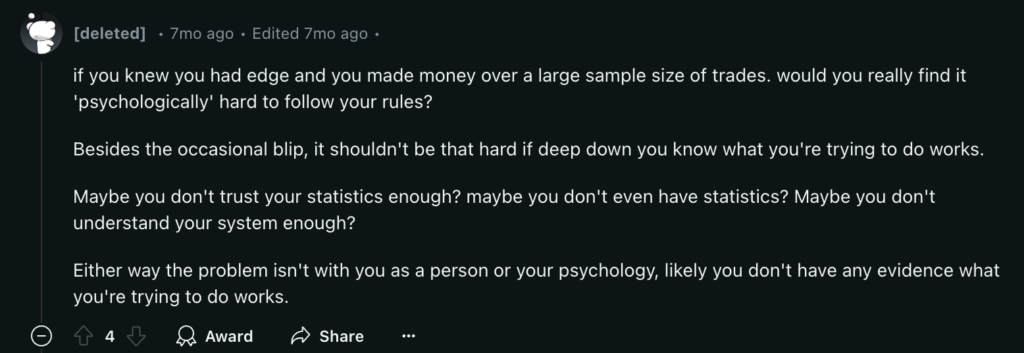
Anonymous Reddit Perspective: ‘ The Problem Is Not Your Psychology’
Let’s delve into a real-world example that illustrates the importance of trading psychology. I recently came across a comment on Reddit that perfectly encapsulates the misconception we’re discussing. The user [deleted account] made a sweeping judgment about all traders based solely on their personal experiences. While it’s natural to view the world through the lens of our own experiences, it’s crucial to recognize that our own perspective is limited.
This type of generalization often triggers me, and for good reason. It fails to account for the infinite diversity of human experiences and psychological backgrounds that traders bring to the market. There’s a significant amount of emotional and psychological baggage around money and finance that many people need to address before they can fully capitalize on the financial market’s opportunities.
Let me share a personal anecdote to illustrate this point. For over a year, I meticulously tracked what my first trading strategy should have achieved. The results were impressive. The data showed that I should have realized substantial gains with only minor periods of drawdown. However, despite having this undeniable evidence of my strategy’s statistical edge, I still struggled to execute it effectively.
It wasn’t until I addressed my habitual issues and mental blocks that I was able to consistently implement my strategy as designed. Now, I can take planned trades regardless of my confidence in the strategy’s statistical edge. This experience taught me that while statistical edge and strategy application are interrelated, they are distinct concepts that both play crucial roles in trading success.
Deleted user states: “Maybe you don’t trust your statistics enough?” While this seems like a reasonable suggestion on the surface, it fails to address the underlying issue. The real question we should be asking is, “Why would someone have trustworthy statistics and not trust them?” Clearly, there’s something deeper at play here, beyond simply analyzing charts or fundamental data.
The answer to this “why” is often the root cause of why many people fail in their attempts to trade successfully long-term. It’s not just about having a good strategy; it’s about having the psychological fortitude to execute that strategy consistently, even in the face of uncertainty and potential loss.
Regardless the depth of our statistics, market conditions change over time. Social media is full of confident predictions on where price is headed, but in reality, the next tick is a constant unknown.
It Probably IS You and That Is Great!
It’s important to note that having psychological hurdles doesn’t make someone a bad trader or a flawed person. Humans are inherently imperfect, and the market has a unique way of highlighting our personal challenges. Recognizing and addressing these issues should be seen as an opportunity for growth, both in trading and in life.
Let’s just say the commenter has not faced any significant mental hurdles in their trading journey, as implied by their statements. Perhaps they were already psychologically prepared for the challenges of the market when they began their trading journey. However, it’s crucial to remember that this won’t be the case for everyone who attempts to trade. Each person brings their own unique set of experiences, fears, and mental blocks to the table, and addressing these is often just as important as developing a solid trading strategy.
There is very little you can do about the entities on the other side of your screen, contributing to the change of price. However, what you do have complete control over yourself. And this is great news for your trading goals.
What has kept me showing up, day after day, throughout the years is undeniable evidence that underneath a solid 99% of my PnL meltdowns were mistakes of my own. The statistics driven by the market was never the core issue.
As a matter of fact, had I kept my discipline and consistency at just 80% the negative impact to my account balance caused by external factors would’ve been much less significant. The psychological gains I have had played a greater role to my trading success than any statistical edge.
How to Leap Over Your Psychological Trading Hurdles
Many of our mental hurdles can be improved by adopting simple personal improvement habits, such as journaling, meditating and maintaining a physical fitness routine. These are great tools to start with because they require no additional cost beyond your time.
I often journal on my phone and laptop. I take at least 5 minutes before every trading session to meditate. I keep an active lifestyle with calisthenics, which can be done anywhere, anytime, without a gym membership, expensive equipment that takes up space, or perfect weather conditions. Even something as simple as going for a walk can make a significant impact on your mental and physical fitness.
But sometimes we need to enlist the expertise of others to help us uncover what we struggle to see on our own. This is where I overcame some of my deepest issues with the help of Bulletproof Entrepreneur.
Bulletproof Entrepreneur offers valuable tools that help you identify the root causes of your psychological struggles and address them head-on, clearing their charge indefinitely.
Thanks to Bulletproof Entrepreneur I’ve learned so much more about myself, the markets and I have developed a deep understanding of the statistics. Now, while most traders are having anxiety attacks during high volatility periods or missing opportunities during “boring” periods of low volatility, I’m calmly executing my plan with nearly 100% accuracy.
Conclusion: Embracing the Psychological Aspect of Trading
Trading is not solely about strategies and market analysis. It’s a complex interplay of knowledge, skill, and mental edge. Dismissing the psychological aspect of trading is not only short-sighted but potentially dangerous to your trading success.
Understanding and managing these psychological factors is crucial for successful trading. Developing a well-defined trading plan, setting clear entry and exit points, and maintaining emotional discipline can help mitigate these challenges. But more importantly, recognizing that each trader’s psychological makeup is unique can lead to more personalized and effective trading approaches.
So the next time someone tells you that trading psychology is BS, remember that they’re likely speaking from their limited perspective. Your journey in trading is uniquely yours, shaped by your experiences, beliefs, and psychological tendencies. Embrace this fact, work on understanding your own psychological strengths and weaknesses, and use this knowledge to become a better trader.
After all, in the complex world of trading, your mind and personality traits are your most valuable assets. This is where you will find your true edge.
The Futures market is a great way to trade because it offers leverage. This means that you can buy or sell larger amounts of an asset than you would be able to with stocks, without the need for more money. Futures are also less volatile than stocks and have lower transaction costs. With these benefits and others, trading Futures may sound like a good idea to help diversify your portfolio!
If you want to start trading in the Futures markets, this post will cover everything from what Futures are all about, how they work, what tools you’ll need to get started for free (including charts), as well as some risks involved when trading them! When you’re done reading this post, you will be confident enough to start trading Futures contracts.
I started my Futures trading journey in August of 2017 and never looked back. Trading Futures just simplified everything. Before that I day traded stocks for a couple months the Summer of that same year, basically breaking even. I also traded options for a short period but didn’t really know what I was doing so I lost most of my options plays.
Around this same time, I was reading the book “Mastering the Trade” by John F. Carter, where he was talking about Forex and Futures, mostly Futures. I explored Forex, but Forex never really resonated with me, so I started looking at the Futures market. At the time I was looking at gold Futures primarily and I noticed the strategy I was using to day trade stocks also fit gold Futures. So, I decided to give trading gold Futures a try and the rest is history.
In the following sections, I will briefly explain what the Futures market is and some key things to know about it. I feel like the Futures market is the “hidden” gem of the financial markets. You’ll hear the media reference the Futures market but rarely anywhere else. Most of the hype is with stocks, forex, and cryptocurrency. Personally I have some experience with all those markets, I crushed it with bitcoin back when it surged in 2018, (100% luck) but I still prefer Futures out of everything else.
What this article will cover:
What is the Futures Market
Why Trade Futures
Key things to know about Futures
What you need to trade successfully
What Is The Futures Market?
“A future market is an auction market in which participants buy and sell commodity and futures contracts for delivery on a specified date. Futures are exchange-traded derivatives contracts that lock in future delivery of a commodity or security at a price set today.” – investopedia.com
I recently watched the movie “Rouge Trader” where the main character gave one of the best definitions I have heard. “A futures contract is an agreement to buy or sell a specified amount of a commodity at a future date for a specified price.” That’s all you really need to know. Honestly, you don’t even really need to know that much to be successful at trading Futures. You only need to speculate if the price of the Futures contract will either go up or down within a given period of time before the expiration.
investopedia.com
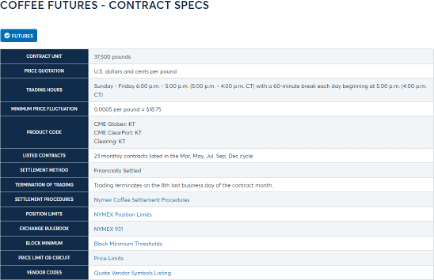
So, let’s say you want to buy a contract of coffee Futures expiring June 2021. Coffee Futures are currently trading at $100 (hypothetically, using arbitrary numbers for simplicity). If by June coffee is trading at $150 when the contract expires, you will have made a $50 profit per contract and the coffee will be delivered to you as agreed upon in the contract at the $100 price you paid for each contract. Again, I’m just using simple numbers for simplicity’s sake to illustrate the basic concept of how trading Futures work. There’s a bit more to it which we will get into later. Alternatively, if you do not want the physical delivery of coffee, you can sell the contract to another trader interested in trading at market value or a price you specify before the contract’s expiration date in June. These days most Futures traders exit their position before the contract expires to avoid an unwanted physical delivery.
cmegroup.com
Why Trade Futures?
Typically, to trade stocks or options you have to scan for the best stocks to trade every day, or every few days if swing trading. There are some stocks that you can trade pretty much every day, but those stocks are usually priced well above $100 a share and require a significant amount of cash to make decent money. Plus, there’s the PDT rule and interest if you are trading on margin. If you’re not familiar with the PDT rule, it basically doesn’t allow you to day trade stocks if you have less than $25k in your account, with the exception of a cash account. You can technically day trade a stock but there’s a limit to how many open and close orders you can have in a single day per week. If you want to know more about the PDT rule investopedia.com is a great source.
Alternatively, you can trade options on stocks which allows you to get around the PDT rule, but there’s a pretty steep learning curve if you’re just getting into trading. With options it no longer becomes about whether the security increases or decreases in value. You also have to understand how the Greeks and implied volatility affect the premium price of the option. Options are beyond the scope of what we’re talking about here, so I won’t be going into the components that affect the price of an options contract here. Just understand that with options, there’s an added layer of information that must be understood thoroughly beyond the value of the underlying security.
So, getting back to the point, many of the major Futures contracts have plenty of volatility and volume that allows you to trade just one thing every single day. And all you need to be aware of to trade Futures is if you believe the price will either go up or down and if there’s enough volume for liquidity. How much money you can make from a single Futures contract is based on how much you’re willing to risk, taking into consideration how much cash you have to trade with.
Now that you only have to worry about trading one thing, this allows you to focus on what’s really going to help you become a successful trader. Making money as a trader really isn’t about what you trade, it’s more about how you trade.
Narrowing your focus to trading one thing allows you to expedite the development of your skills and psychology that’s required for good trading. You can always go back to other areas of the market later once you have mastered the art of trading.
Now there are even more ways to trade the Futures market. Recently, two new exchange products have been introduced into the Futures market, the Small Exchange and FairX. These new marketplaces within the Futures market aim to offer retail traders more ways to get the most out of their investment capital.
Another beauty of the Futures market is the fact that it’s open 23 hours a day, 5 days a week. The hours for the Futures market are from 6pm to 5pm EST the next day, Sunday through Friday. So, after the weekend the first session of the week starts Sunday at 6pm EST and the week ends Friday at 5pm EST. There’s a one hour break each day. Some less popular commodities have slightly different times, but these are the main hours for the Futures market as a whole.
This means that no matter if you have a full-time job, part-time job, or just busy with something else during normal NYSE trading hours, there’s still opportunity for you to trade in the Futures market. Also, some sectors of the Futures market, such as FX Futures and metals, trade better outside of the NYSE hours with plenty of liquidity. You will have plenty of opportunity to trade in the Futures market at a time that fits your schedule.
Low Startup Capital
Previously I mentioned the amount of money you have to trade with. Here’s another beauty of the Futures market. You don’t need a lot of money to get started. In fact, having more money does not make trading easier. If you can’t trade with $10,000 it’s going to be just as hard for you to trade with $10 million, if not harder. Usually, trading with a small amount of money will get you better results over the long term because it forces you to focus on risk management and discipline.
With Futures, now that we have the micros, you can get started with as little as $50, but in all honesty that will not be enough. At the absolute smallest for a new trader, I would say you would need about $1,000. You’re going to make mistakes and lose money in the process of gaining experience. However, there is another way you can get started for less by trading in a funded account, or a prop firm. Basically, if you can prove to them that you know how to trade, they will give you the capital to trade with in exchange for a portion of your profits. I’m currently trading this way with a company by the name of Leeloo. So, if you want more information about that just check out my YouTube channel and my journal. I am documenting the entire process there.
Consistent Trading Is Universal
Once you learn how to trade the Futures product of your choice with consistency over an extended period of time in various market conditions, you will have all the skills and mentality required to trade anything you want. What I’ve learned by starting with Futures can be applied to stocks, options, forex, CFDs, cryptocurrency, long-term investing and anything else. As a matter of fact, what I’ve learned as a trader has made me a much better buy and hold investor. I can better pick my entries with better precision being familiar with how the price of financial instruments typically move. I would just need to be familiar with the language and nuances of the other markets, but the actual act of trading is universal to all markets.
Key Things to Know About Futures
Margin Requirements
So here is how I derive how much money is required to start. Each derivative of the Futures market has its own margin requirement. Futures margin is not the same as margin on stocks where you’re borrowing money from your broker to increase your buying power. Futures margin is the required amount of cash you must have in your brokerage account when you open a position.
There’s the initial margin requirement which is basically the amount you must have to open the position and decreases your buying power. Then there’s the maintenance margin requirement which is the amount of total funds you must have in your account to trade each Futures contract but does not affect your buying power. With many Futures brokers, if you close the position within the same trading day you only have to worry about the initial margin requirement. When you close the position the initial margin requirement is returned to your buying power plus or minus whatever you gained or lost on the position. You can pretty much look at it as an insurance fee for Futures trading.
These margin requirements are regulated by CME Clearing, but your broker can give you a discount on the margin requirement if you are day trading. Also, these margin requirements can fluctuate depending on market conditions and expected volatility.
That’s the basics of how they work. You can get the full scope by checking out cmegroup.com under the education tab.
So how does all this help you trade with a small account? My primary broker for trading Futures is AMP Futures. As of this writing, their initial margin requirement for micro e-mini Futures is as low as about $40. That $40 margin requirement is for the most popular micro E-mini S&P 500 Futures.
I trade the micro E-mini Nasdaq Futures which has an initial margin requirement of $100. So, if you decide to trade the micro S&P Futures with an initial margin requirement of $40 in a trading account with $1,000, that gives you pretty good wiggle room to trade about 1 to 3 contracts at a time depending on your strategy. Of course you will need a solid risk management plan. Some brokers will monitor your orders to make sure you are trading with a stop loss, showing that you are attempting to manage your risk.
ampfutures.com
Contract Months and Expiration Date
Earlier, I briefly mentioned contract expiration. One thing that is important to keep track of is the expiration date of the Futures contract you are trading.
Futures are basically categorized by sector, such as the indices, metals, agriculture, and energy. The expiration date is usually set by the sector. For example, all index Futures usually expire on the same date. The metals have their own contract months and expiration dates collectively. Energy Futures have their contract months and expiration dates… and so on.
If you are day trading Futures you only need to keep track of the expiration date in regard to where the volume is. You want to trade the contract month where most of the volume is to make sure you have plenty of liquidity to get in and out of your positions. If you are swing trading Futures, it’s really important to keep track of the expiration date to make sure you don’t get an unwanted delivery of the commodity you’re trading. So going back to the coffee example, if you are holding contracts of coffee Futures when they expire, you could end up with 37,500 pounds of coffee per contract. I like coffee but not that much. I don’t have personal experience with this, but most brokers today will notify you beforehand that the contracts you are holding are about to expire and close them for you if you don’t roll them over to another contract month or close the position yourself.
There’s one more key thing you need to be aware of with Futures: ticks and points.
Ticks and Points
Basically, these terms are synonymous with pennies and dollars in the sense of how the price of each contract increments. These terms actually apply to stocks as well even though you don’t hear many people using them anymore. As an example, when QQQ (ETF for Nasdaq) changes from 100 to 100.01 that would be a change of 1 tick. QQQ changing from 100 to 101 would be a change of 1 point. It’s basically the same thing with Futures, with the exception that the increment of a Futures contract is not the same and varies based on the Futures contract.
For example, a 1 tick increment of Nasdaq Futures (NQ) is 0.25. A point increment is pretty much the same as the dollar amount of a stock, incrementing by the whole number. However, since a tick for NQ is 0.25, there are 4 ticks in 1 point for NQ, instead of the 100 ticks per point for a stock. Hope you’re still with me. It’s much more simple than it seems written out.
Just as an FYI, for Dow Futures the tick and point are the same. The DOW Futures only increment by the whole number, which is why I believe the media likes to use the DOW Futures whenever they are talking about big swings in “the market”. 500 points is more likely to trigger your emotions than 25 points. (Just a little conspiracy theory side note LOL)
Tick Value
Which takes us to the value of each tick and point. So, where you have a tick of a stock equaling a penny and a point a dollar, a tick for the Nasdaq futures has a value of $5 and a point value of $20 (4 ticks times $5 = $20). So, in terms of your profit and loss (PnL), for every contract you trade on NQ, you earn $5 for every tick that goes in your favor from your entry price. And of course, if the trade goes against you, you lose $5 for every tick that goes against your entry price.
Since we’re talking about the money of your trade, just a quick note on the psychology of trading. You haven’t lost any money until the position is closed. So be patient with your trades. You’re lucky if a trade immediately takes off in your favor after your entry order has been filled.
Alright, so back to ticks and points. To give another example, a gold Futures tick increment is 0.10, giving you 10 ticks in a point. The tick value for gold futures is $10 dollars or $100 dollars for a point.
All you really need to remember is the tick value and how it increments. Basic math can give you the point value.
What You Need to Trade Successfully
Psychology
Your thoughts control everything. What you focus on will become the reality. The reason why I make that point is once you start taking losses, if you spend too much energy focusing on those losses, guess what will follow?.. More losses!
Those losses turn into a losing streak. Most of the time the way out of this losing streak is just to take a break from trading for a while. However long it takes to clear that energy developed once you start to become emotional about taking a loss. If you’re not getting emotionally tied to your losses, and you’re being honest with yourself, you shouldn’t have much of a problem staying consistent to your strategy and getting back into the green.
You must be comfortable with seeing negative numbers in your account. Not all of your trades will work out and you have to be comfortable with that. Not to the point where you’re completely unfazed by a loss, but enough to where you know that your consistency will outweigh the losing side of your trades.
Experience
Much of the fear with trading comes from the unknown. This is what makes experience so important. The more you experience the various market conditions, the ebb and flow of the market, the more confident you are likely to be when you start to notice the trends that repeat themselves. Technical analysis allows you to visually see the trends of the market per the security or derivative you are trading. The experience you gain as you watch and interact in the market from day to day, with your perspective, will help you develop a plan around the trends you recognize most often.
Strategy
Having a strategy helps you develop your skill and execute with consistency. When you are starting, you want to find a strategy that you understand and resonates with your personality. If you are not a patient person, it may not be the best idea to trade with a strategy that requires a lot of patience. Your weaknesses can be improved later.
Your strategy and plan should take into consideration what triggers you to take a trade, how you place your entry order, how you plan on exiting the entry order, and how you will manage the risk of trades that do not work out.
Also, I recommend that your strategy is as simple as you can possibly make it. There’s honestly no need to have dozens of indicators on your chart. Once you develop the skill of reading price structure, price action (the energy of the market), trends and market conditions you will realize indicators are mostly a way of making it easier to see the story that the price is already telling you.
I am not going to go too deep into each of these for this article, but all of these work together towards your journey of trading. Your strategy simplifies trading that allows you to get the experience and work on any psychological blockage you may have. Experience helps you refine your strategy and builds your confidence which positively affects your psychology. Your psychology affects how well you execute your strategy and helps you fill in the holes to see the bigger picture of the market when smaller time frames become irrationally volatile.
Everything I explained here about Futures is only the tip of the iceberg. There’s more to it but it’s honestly not complicated at all. I had to remind myself of some of these terms because it’s not necessary to remember all of this in order to trade Futures well.
All this may seem like a lot to take in when you’re first introduced to the Futures market but it doesn’t take long before it becomes 2nd nature.
Now that you know the basics of trading the Futures market, get in the game. You got this!