Trading is risky! Past performance does not guarantee future results. Click here to read our full Disclaimer

Some trading sessions give a lot. Other sessions barely give anything at all. This week I’ve had plenty of those quiet ones. On this session, only one setup in my entire window met the rules of my plan. That single trigger closed as a small expense. No big win. No hero story. Just one trade and a whole lot of waiting.
The easy thing to do in a session like that is to complain. The harder thing, and the better thing, is to pay attention. Slow sessions have lessons in them that are easy to miss in fast-paced sessions. So this post is a look at what I learned, or re-learned, from a day where the market mostly said no.
Boredom Is the Real Challenge
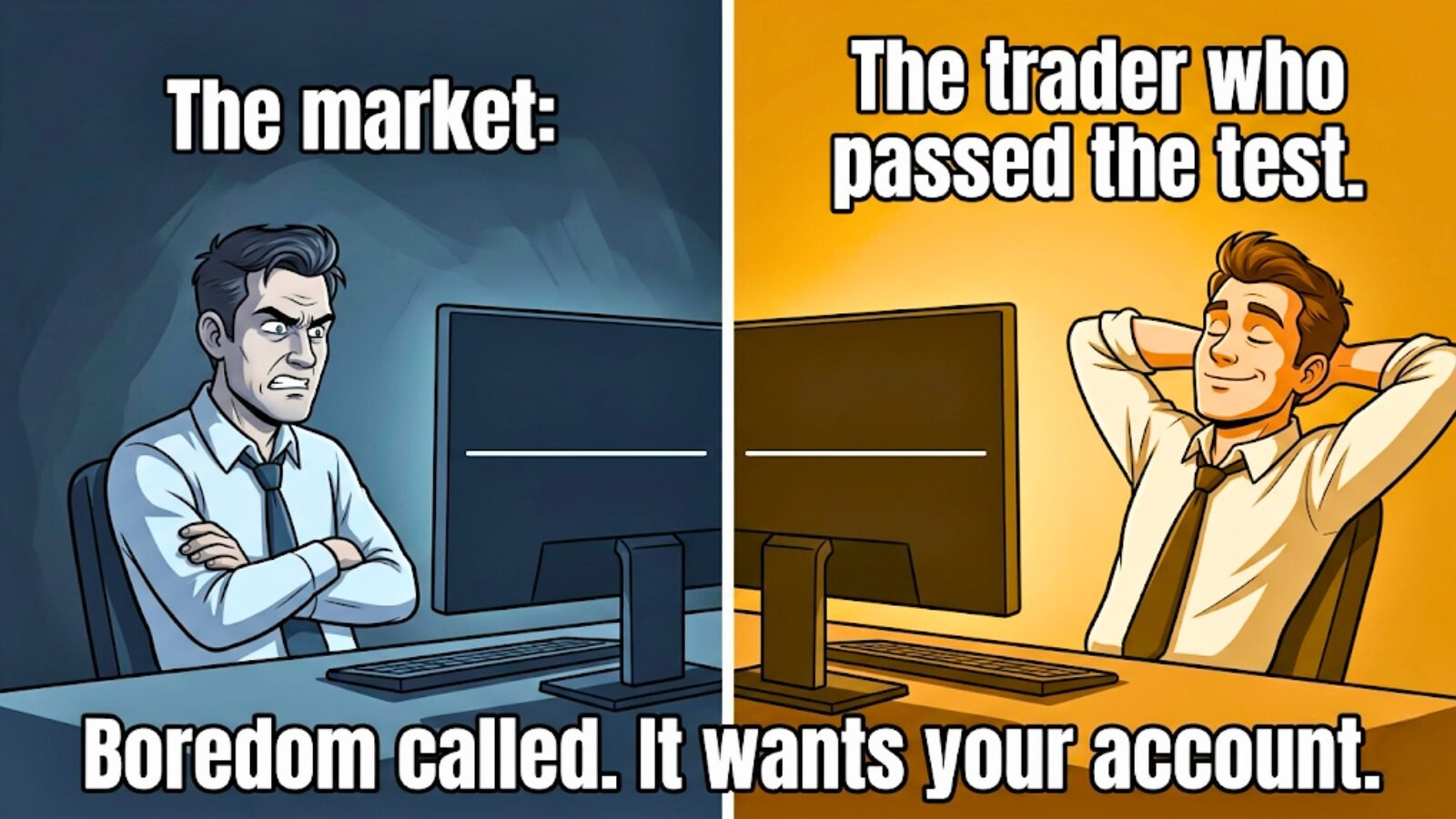
Here is something the trading niche does not talk about enough. Boredom is a setup, just not the kind anyone wants to take.
When price moves slow, the mind starts looking for work. If there is no real trigger, the mind will invent one. It will take a normal wiggle on the chart and dress it up like a valid signal. That is the whole trap. It is not the market that tricks the trader. It is the trader getting impatient with silence.
I have been there. Plenty of times. And the lesson has always been the same. The itch to do something is not information. It is just energy looking for somewhere to go.
One small tool that has helped me a lot was keeping my hands busy. A fidget tool. A hand gripper. A pen that clicks. Anything that gives the body something to do while the mind stays on the chart. That might sound silly, but it works. The body calms down, and the trigger finger stops twitching for no reason.
In my ebook Pull the Trigger: How to Stop Missing the Trades That Pay, I go deeper into this. Fear of missing out and the pain of sitting still are two sides of the same coin. Both of them pull a trader out of the plan. Both of them have to be managed, not ignored.
Consistency Beats Cleverness
When a session is slow, the voice in the head gets loud. That looked like a setup. I could have taken that. The next one is definitely it. That voice is not a friend.
A trader’s job is to match what is on the chart to what is in the plan. If the two do not match, there is no trade. It does not matter how pretty the wiggle looks in the moment. It does not matter how sure the gut feels. The plan wins, or the plan is not really a plan.
In this quiet session, there were a few moves that looked interesting. A trader without rules could have built a story around each one. But stories are not signals. And in my experience, the trades that get taken on stories are the trades that quietly eat the account.
I have learned to treat missed wiggles with a shrug, not a sigh. If something did not meet my criteria, it was not an opportunity. It was a temptation. Those are two different things.
And about the one trade that did meet criteria in this session, it closed for a small expense. That is real life. Discipline does not promise a green result on every trade. Discipline only promises that the trades taken belong to the plan. Over time, that is what builds an account. One small loss on a clean trade is much cheaper than ten clean-looking stories that broke the rules.

News Events Are Liquidity, Not Fortune Tellers
There was a news release during my window. A mild pop in volatility showed up right on the release, then the market went back to its regular rhythm.
A lot of new traders treat economic news like a crystal ball. Good number means up. Bad number means down. Reality rarely cooperates that neatly. The way I have learned to think about news is different. News is a meeting point. It is a spot on the clock where big players can move big size, because lots of eyes are watching and lots of orders are stacking up.
The number is not the driver. The number is the excuse. Liquidity is what actually moves price, and a scheduled release is a reliable place to find liquidity. That is why price sometimes runs one way on a bad number and then quickly flips. It was never really about the number.
When a trader builds a plan with this view, news stops being scary. It becomes a known pocket of volatility to respect, not a guessing game to play.
Tools That Support the Wait
A quiet session shows off the value of the right tools. Not the tools that pick trades. The tools that help a trader stay ready without burning out.
A few categories matter a lot in my setup:
- Charting and analytics that reduce noise. The less the eye has to work, the longer focus lasts. A clean chart is a form of rest.
- Recording tools. Being able to record the session and review it later is huge. Things that fly by in real time become obvious in replay. A session on rewind is a session that keeps teaching.
- Reference docs. Trading methods come with their own language. Acronyms. Short forms. Nicknames for patterns. Without a shared reference, even good explanations sound like noise. This is why I am working on a public page for the terms and acronyms I use on my streams. It is a small thing, but it removes a lot of friction for anyone trying to learn the system. Let me know in the comments below if you’re interested in this doc of my terms and acronyms.
- Journals and checklists. My daily journal and pre-trade checklist are probably the most powerful tools I own, and neither of them costs anything beyond the time it takes to build them.
None of these tools make a trader profitable by themselves. They support the habits that do.
Firsthand Experience Is Undefeated
If I could tattoo one line on a new trader’s brain, it might be this. Firsthand experience is undefeated.
The internet is full of do not do this videos. Do not average down. Do not trade the open. Do not touch news. Some of that advice is solid. Some of it is just one trader’s scar tissue talking. Either way, it tends to bounce off until the person hearing it has felt the thing firsthand.
I learned more about averaging down from doing it than from any warning I ever got about it. Not because I recommend it, but because the lesson did not fully stick until my own results showed up with my name on them. That is how humans seem to be wired. The body learns what the ears only half believe.
So a fair way to treat advice, including the advice in this post, is to test it. Put it through a journal. Put it through replay. Put it through small size. Let the evidence land in personal experience before trusting it fully. Advice is a starting point, not a finish line.
This idea is a big part of why I wrote Pull the Trigger. The book is not a list of rules handed down from a mountain. It is a set of lessons learned through reps, losses, and small wins that piled up over years. The goal is to shorten the road for someone else, not to replace their road entirely.
A Quick Note on Content Creators
This ties into something else I think about a lot. Creators, especially in the trading niche, tend to drift from their original mission once an algorithm starts rewarding them. The content gets louder. The takes get hotter. The thumbnails get wilder. Somewhere in there, the reason the creator started making content in the first place gets blurry.
The traders I respect most, and the creators I come back to, tend to look small from the outside. They are not chasing viral moments. They are just showing up. Slow growth. Steady message. Real reps. It is the same shape as good trading, honestly. The flashy stuff gets attention. The unique, less traveled angles builds a career.
Valuable content finds the right people eventually, even without a massive following. The same is true for valuable trading. A clean plan and a patient operator will find their edge, even without a flashy month.
The Quiet Session Is the Curriculum
Here is the takeaway I keep coming back to. Low-opportunity days are not wasted days. They are the days that build the trader who can handle high-opportunity days.
Anyone can stay disciplined when the market is handing out layups. The real test is staying disciplined when the market is handing out nothing. Sitting still without getting bored. Passing on stories. Respecting the news for what it really is. Trusting the plan even when the plan says not today. Those skills do not get built during the loud sessions. They get built during the quiet ones.
If any of this lands, and the hesitation to pull the trigger on clean setups is a familiar problem, Pull the Trigger: How to Stop Missing the Trades That Pay goes deeper into the mindset shifts and habits that helped me move past it.
One trigger all day is not a small number if it is the right one. And a quiet session is not a lost session if the lessons get logged.
Firsthand experience is undefeated. See you in the next one.
Trade it easy ✌🏾



