Trading is risky! Past performance does not guarantee future results. Click here to read our full Disclaimer

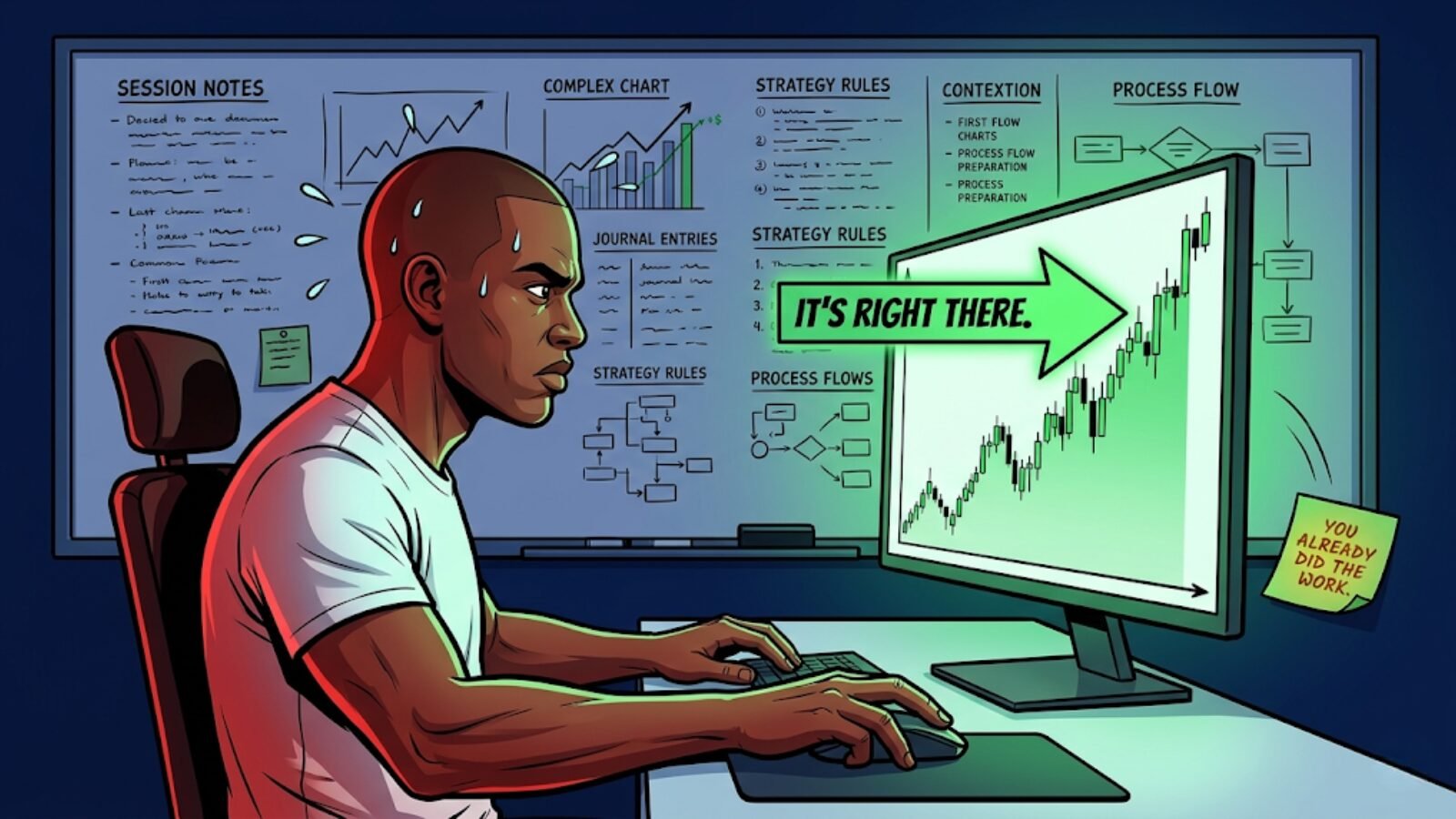
“Hesitation is the tax you pay for not trusting the work you’ve already done.”
That quote set the right tone going into this Friday morning, and it did not let go. Not because it is a motivational phrase to get pumped up before the open. Because it is an accurate description of a real cost that does not show up anywhere in the account statement but gets paid out every single session where a valid setup gets second-guessed into a missed trade.
The session itself was a Friday before a long holiday weekend. Lower volume, slightly more neutral conditions, daily picture shows NQ rotating back toward ATH while potentially trailing ES and RTY through an intraday lens. One position taken. One trigger correctly skipped. A vol spike slippage situation handled without panic. And a conversation worth having about what hesitation actually is and where it actually comes from.
What Is Hesitation Actually Costing You?
Hesitation in trading gets misidentified constantly. It gets called caution. It gets called patience. It gets dressed up in the language of discipline and treated like a virtue.
It is not always those things. A lot of the time it is doubt wearing discipline’s clothing.
Real patience is waiting for the right conditions to arrive. Hesitation is doubting them once they get there. Those two things look almost identical from the outside and feel completely different from the inside. And the cost of confusing them is real. I know this all too well, from first-hand experience.
Every time a valid setup is second-guessed into inaction, a specific message gets sent to the part of the brain managing trading decisions: the preparation was not enough, the plan is not reliable, the system should not be trusted here. That message does not stay contained to the one skipped trade. It compounds. The next valid setup carries the weight of the previous hesitation. The one after that carries both. Before long, hesitation has become the default response to any trigger that involves even a small amount of uncertainty.
And uncertainty is always present in trading. Every single setup involves uncertainty. The plan accounts for that uncertainty through defined risk and tested criteria. Hesitation second-guesses the plan anyway.
The tax gets paid in missed trades, in partial participation, in the emotional cost of watching a setup work without being in it. That cost is real even when it does not show up in the account.
How Do You Know When to Skip a Trigger vs. When You're Just Hesitating?
This is one of the more practical questions in trading and one worth answering directly.
The test is rule-based, not feeling-based. Does the setup fully meet the criteria or not? That is the whole question.
Today’s skipped trigger is a clean example of this working correctly. A potential setup appeared during the session. It did not fully qualify under the current criteria. The decision to stay out was not hesitation. It was execution in the opposite direction: the plan said the conditions were not met, so participation did not happen. No second-guessing, no internal argument. Just a read that came back incomplete and a discipline to leave it alone.
That decision avoided what would have been an unnecessary expense. In hindsight, the right call was obvious. But the more important point is that the call was not made in hindsight. It was made in real time, against the criteria, without emotional override in either direction.
Being on A game does not mean taking the most trades or finding the best setups. It means the accuracy of every decision made during the session is high. A session where one position is taken correctly and one trigger is correctly skipped at criteria is a high-accuracy session regardless of what the P&L looks like. That is the standard worth keeping.
Hesitation is not a skipped trigger. Hesitation is a valid trigger that met all the criteria and still did not get taken because doubt showed up at the moment of execution.

What Happens When Slippage Hits During a Live Position?
The position taken today entered off a valid trigger and the plan called for an exit at a specific front-run level. The exit happened. But the fill was not what the plan anticipated.
A vol spike hit at the B-period transition at the same moment as the planned exit. The slippage was significant relative to the intended fill. The result was still positive, just considerably smaller than what a clean fill at the intended level would have produced.
What did not happen is worth noting. There was no panic. No second-guessing of the exit after the fact. No impulse to hold longer to try to make up for the slippage. The read was confirmed, the exit was executed per plan, and the result got accepted for what it was.
Slippage is part of live trading. It is not a malfunction. It is the natural consequence of trying to exit a position at a specific price during a moment of sudden boost in volatility when everyone else is also trying to do something. The fill reflects the conditions. The plan called for the exit at that level regardless of what the fill ended up being. Those are two separate things.
The response to unexpected conditions during a live position is more important than the fill itself. A trader who panics during slippage and makes a reactive decision to hold or re-enter based on the poor fill has compounded the problem. The composure to confirm the read, execute the plan, and accept the result cleans the slate and preserves the foundation for the next session.
How Does Creative Energy Affect Trading Performance?
This came up during the session in a way that felt worth sharing because it is not something trading education usually addresses directly.
These days, my time is filled with multiple active projects in motion at any given time beyond the trading itself. Content creation, writing books, trading tool development, the blog pipeline, assisting clients with their projects, all of it running alongside the daily trading routine. The natural instinct when things feel scattered is to force focus onto one thing at a time. Finish that before touching this. Clear the plate before adding more.
The experience has been that this approach creates more internal resistance than it resolves. When several creative ideas are fully formed and ready to be worked on, trying to hold all of them back while forcing attention onto just one creates a kind of mental pressure that does not stay contained. It shows up as brain fog. As restlessness. As a low-level background noise that is hard to name but very easy to feel during a session that requires full attention.
The approach that has worked better is distributing energy across several active projects rather than bottling it all into one. Letting each idea get some forward motion, even in small increments, keeps the creative system running without the pressure that builds from suppression. That clarity carries into the trading window.
This is not a productivity framework. It is a personal observation about how mental load affects the quality of focus available during a live session. The state carried into the desk is shaped by everything happening away from it.
Having multiple active interests at once is not a problem. Contrary to what gets repeated in the make money online space, it is not a lack of focus either. How those interests get managed is what makes the difference between distraction and productive creative expression. As traders, our interests almost always extend beyond the charts. And spending time away from trading on other things is not just acceptable. It is healthy.
Does Every Tool in Your Trading Workspace Earn Its Place?
The Delta board came up during this session as a point of analysis that has been present in the workspace for a few years without actually being used during live trading. It exists on screen, takes up visual space, and adds to the overall cognitive load of the environment without contributing to any actual decision.
The evaluation is straightforward: if a tool is not actively influencing decisions during live sessions, it is adding friction rather than removing it. The workspace is not a display case. It is an execution environment. Everything in it should either serve the process or get cleared out.
This principle applies beyond charting tools. Any element in the trading workflow, indicators on the chart, windows open on the screen, platforms running in the background, should pass the same test. Does it contribute to cleaner decision-making or does it add noise?
Streamlining the workspace is a practical form of psychological preparation. A cluttered environment produces a cluttered focus. Removing what does not serve the process is not a minor housekeeping task. It is a real input into execution quality.
The Work Has Already Been Done
The trust required to pull the trigger on a valid setup without hesitation is not blind confidence. It is earned confidence, built through preparation, documentation, honest session reviews, and the accumulated evidence of a process that has been followed consistently over time.
Hesitation is what happens when that evidence has not been collected, or when it exists but has not been fully internalized. It is the gap between what the preparation says and what the emotional brain is willing to believe in the moment.
The way to close that gap is not to try harder to feel confident. It is to build more evidence. More sessions documented. More criteria reviewed before the open. More honest post-session evaluations. More repetitions of following the plan correctly and recording what happened. Whatever helps you build an undeniable trust in your system. A system you cannot fully trust is a breeding ground for endless mistakes.
This is a theme that runs directly through Pull the Trigger: How to Stop Missing the Trades That Pay. The execution confidence that makes clean trigger-pulling possible is not a personality trait. It is a skill built through a specific kind of preparation, and it shows up most clearly in the moments where hesitation used to live.
Today’s session closed with a modest profit, inching the month slightly further into the green. Not a landmark result by any measure. But the execution accuracy was high, the slippage situation was handled with composure, the skipped trigger was a correct read, and the decision to stop trading 12 minutes into B-period on a Friday before a long weekend was the right call given the conditions.
The work was done this week. Not just today. All week. The quiet sessions, the no-trigger days, the documentation that happened in the margins of choppy markets that did not cooperate. All of that is part of the preparation that makes a session like today’s possible.
Hesitation is the tax. Building evidence is how it gets reduced.
Trade it easy ✌🏾



