Trading is risky! Past performance does not guarantee future results. Click here to read our full Disclaimer

The market opened this morning with momentum. NQ was pushing toward new all-time highs. Volume was building. The conditions on paper said something could happen.
But the rules said “not for you, buddy”.
Margin requirements had increased ahead of expected volatility and were not restored by the time the first half of my morning routine was complete. That triggers a no-trade day. No exceptions, no “maybe just one,” no rationalizing around it. The rule exists so that decision does not have to be made in real time under pressure, optimizing focus energy to get the most out of that time of the day.
What happened next is the part worth writing about.
What Is a No-Trade Day and Why Does It Matter?
A no-trade day (NTD) is not a passive thing. It is a rule-based decision that removes trading from the session before the session begins, based on a predetermined condition being met.
The value of having that kind of rule is not just capital protection. It is mental clarity. When the decision to sit out is made by the system rather than in the moment, there is no second-guessing, no watching the market move and wondering if the right call was made, no drift toward “well maybe just this one setup.” The question was answered before it was even asked.
What the rule also does is create something most traders never think to plan for: intentional time during a live session window to do work that usually gets pushed aside. Backtesting. Journal review. Strategy analysis. The stuff that compounds over time but almost never gets done during active sessions because the market deserves as much of the attention as possible in that space.
Discipline does not just show up in trades. It shows up in how the time the market gives back gets used.
How Should Backtesting Actually Work?
This session went straight into a backtesting review of a prior session that had been flagged for a closer look. What came out of it was something valuable and uncomfortable at the same time: two positions from that session that violated rules got identified, documented, and marked as mistakes in the journal.
Not mistakes in the sense of “I feel bad about these.” Mistakes in the sense of “the system shows clearly that the entry criteria were not met and the positions should not have been taken.”
One was taken against momentum without the predetermined signs of a potential change of direction as described in the plan. The other triggered on criteria that looked close to a tradable setup but did not fully qualify. Both went into the journal with detailed notes. Both are now on record.
This is what backtesting inside a structured journal actually produces. The mistakes do not disappear into memory where they can be softened over time. They get documented, reviewed, and integrated into the understanding of how the system is supposed to work. A trader cannot hide from a journal that is being used honestly.
The psychological shift that makes this work is moving away from “I was wrong” and toward “my system showed me something.” The mistake is not a character judgment. It is data. And data is how the system gets refined.

Why Does a High Win Rate Still Require Discipline?
During this session, time went into backtesting a specific method with a historically strong win rate. Not a small sample. A genuinely high win rate, the kind that makes a method look almost too good to be true on paper.
And here is the thing about methods like that: the win rate is only real when the trigger rules are followed without exception. The moment discipline slips, even slightly, and a position gets taken on criteria that are close but not quite there, the entire statistical foundation starts to erode.
This is something that shows up clearly during backtesting when it is done honestly. The winning setups almost always have specific, identifiable characteristics that were present. The losing setups often involved some form of criteria drift. The strategy was not the problem. The application was.
Testing with current tools, current calculations, and current market behavior matters too. A method that was backtested in a different market environment with a different version of the setup criteria is not the same as testing it now. The work has to be done fresh against the actual conditions being traded. There are no shortcuts that hold up over time.
The Emotional Layer Nobody Talks About
This one comes directly from a personal reflection shared during this session, and it is included here because it’s impact is significant enough to be the difference between account growth and a complete blow up.
There was a period where unresolved grief from losing a parent was quietly affecting decision-making at the desk. It was not obvious at the time. It did not show up as a dramatic breakdown or an obvious emotional reaction. It showed up as blown accounts and trading mistakes that did not make sense when reviewed in hindsight. The emotional weight was there. It just was not being recognized or named.
Emotional awareness is a trading tool. That is not a soft claim. The state carried into a session influences every decision made during it, including decisions that feel purely analytical in the moment. A trader who has not processed what is happening in their personal life is not operating with clean inputs.
This is something addressed directly in Pull the Trigger: How to Stop Missing the Trades That Pay. The psychological layer of trading is not separate from the technical layer. They run together, in every session, whether that is acknowledged or not. Being on game mentally is part of the job even with the simplest strategy in the world.
What Did Kobe Bryant Understand That Most Traders Miss?
The genuine excitement that comes from deep strategy development work, the kind that happens on a no-trade day when there is nothing else to pull attention, is something that does not get talked about enough in trading circles.
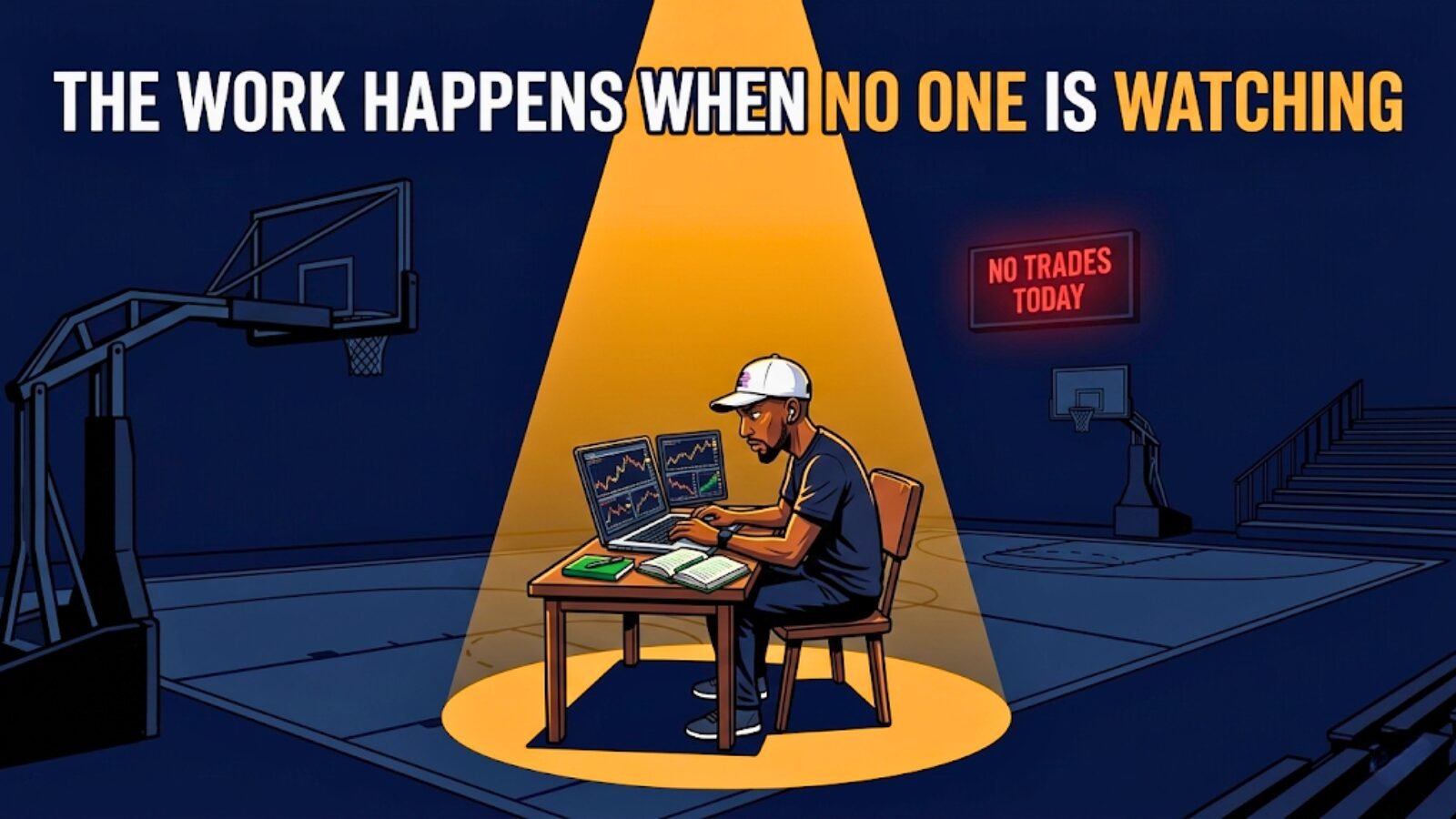
Kobe Bryant’s mamba mentality was not about talent. It was about showing up to do the work when nobody was watching, when there was no game to perform in, when the only audience was the process itself. Showing up at 4 AM to shoot thousands of free throws before anyone else was in the building. Not because a game was that day. Because the work itself was the point.
That same mentality applies directly to trading development. The study sessions, the backtesting runs, the journal reviews, all of it is training that happens away from the live performance. And just like in sports, the live performance eventually reflects the quality of the training that happened when no one was watching.
The mamba mentality in trading is this: the session that produces no trades is still a session. The development work done on a no-trade day is still development work. The trader who grinds through the research and the backtesting and the honest journal reviews, on the days when it would be easy to just close the laptop and go back to sleep, is the trader who shows up to the live session with a sharper system and a more grounded process. Focused and locked-in on the moment, confident in your ability to perform because of the work that was put in when there was no immediate financial payoff to gain.
There is a real connection here to what gets covered in Pull the Trigger as well. Building the confidence to execute is not something that happens only during live sessions. It is built in the preparation, the repetition, and the honest review of what the system is actually doing. Kobe did not trust his jumper because he felt confident. He felt confident because he had taken that shot ten thousand times in practice. The confidence was earned through the work, not the other way around.
Strategy Development Is a Process, Not a Project
One thing that came into focus during this session is that strategy development never really ends. It evolves.
Testing a method with the current version of the tools and calculations being used, rather than assumptions based on how things worked before, is not optional. A strategy that was backtested years ago with older data and different reference points is a different strategy than the one being run today. The validation work has to be ongoing.
What curiosity-driven development (the “what if I tested this slightly differently” sessions) actually does is keep the analytical mind engaged without breaking the live rules. The exploration stays in the lab. The live trading stays on the plan. Both serve the process without contaminating each other.
A method with a strong historical win rate is still just a starting point. Understanding when and why it works, under what specific conditions it performs and under what conditions it does not, is what makes it usable with real confidence. That understanding only comes from doing the work.
The Session That Did Not Trade Still Moved the Needle
No trades were taken today. The scoreboard is empty. By the most obvious measure, nothing happened.
But a prior session got reviewed and two rule violations got documented and logged. A method got backtested against current tools and current market behavior. A personal reflection surfaced that is worth carrying into future sessions as a reminder of how emotional state intersects with trading performance. And the development work that tends to get pushed aside during active sessions got a full morning of focused attention.
That is a return. It just does not show up in the P&L.
What a trader does with the time the market gives back says a great deal about where the process is headed. The ones who treat NTDs as lost days stay in the same place. The ones who treat them as lab time move forward.
Mamba mentality in trading means the work happens whether the market cooperates or not.
Trade it easy ✌🏾



