Trading is risky! Past performance does not guarantee future results. Click here to read our full Disclaimer

There are sessions where everything clicks. The market moves with intention, the triggers appear on schedule, and the execution is clean from open to close. Those sessions are satisfying in a way that is easy to measure.
And then there are sessions like this one.
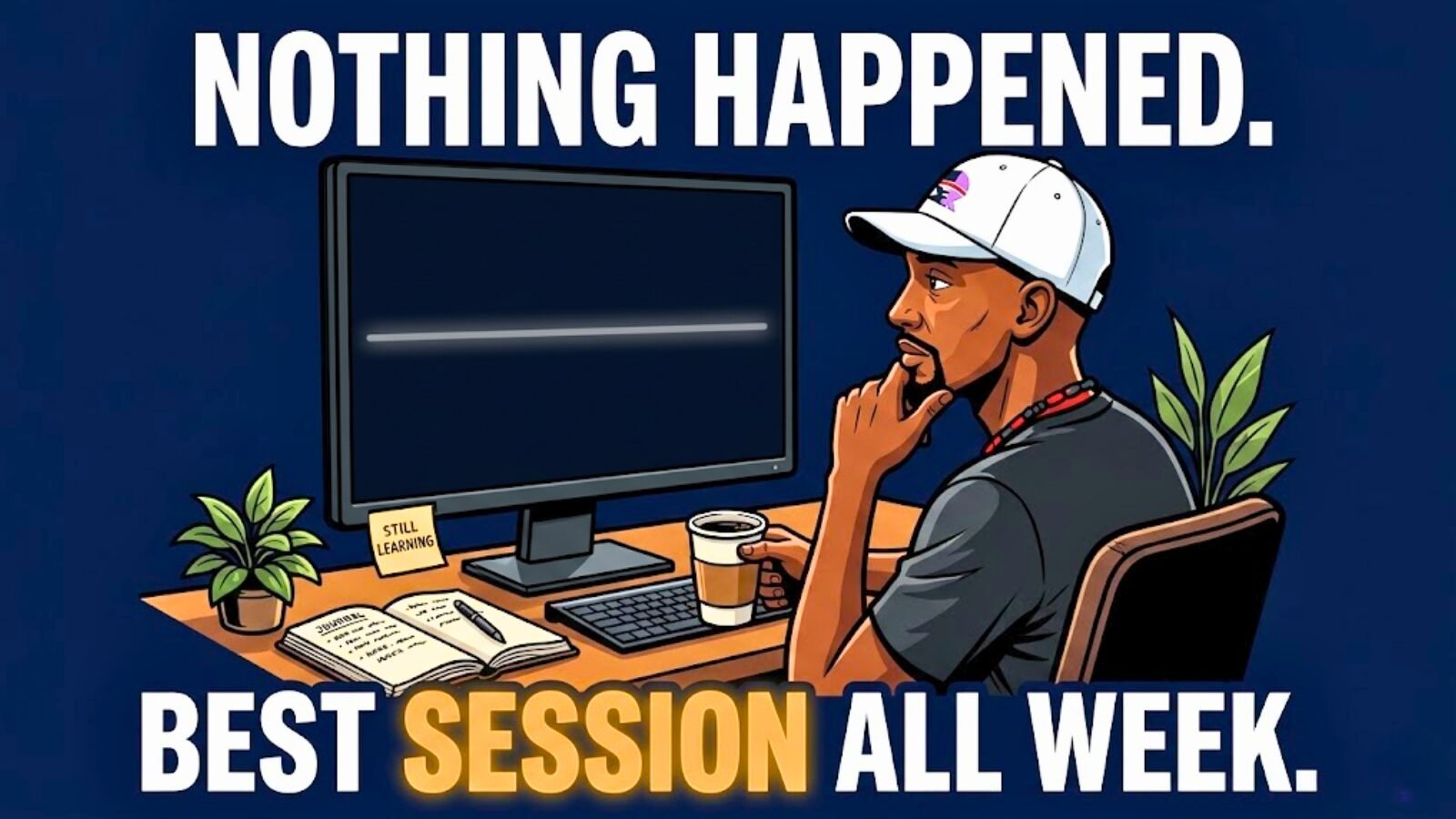
No filled trades. One trigger missed while drawing levels. One trigger that did not get filled. A slow, grinding market rotating inside a defined range with no clear momentum in either direction. By the most obvious measure, nothing happened.
But here is what actually happened: observation, strategy thinking, screen time, and a reinforced understanding of how markets move mechanically regardless of whether a position is on. None of that shows up in a trade log. All of it compounds over time.
Confidence is refined through persistent repetition. That includes the sessions where the market gives nothing to work with.
Why Showing Up Matters More Than Feeling Ready
There was no strong motivation to be at the desk this particular morning. That is worth saying out loud because the trading community does not talk about it enough.
Not every session starts with energy and clarity. Some mornings the drive just is not there. And the temptation in those moments is to wait until it comes back. To take the day off. To tell yourself that trading without the right mindset is more dangerous than not trading at all.
There is some truth to that last part. But there is a difference between protecting the account from emotional decision-making and avoiding the screen because showing up feels hard.
Passion is not the same thing as motivation. Motivation is a feeling that comes and goes. Passion is what gets a person to the desk even on the days when the feeling is not there. After nine and a half years of trading through unprofitable stretches, slow markets, and sessions that produced nothing, the one constant has been showing up. Not because every day felt exciting, but because the process itself holds enough genuine interest to make presence the default.
That distinction matters. Waiting to feel ready before engaging the market is a habit that trains the a counterproductive response. The market does not wait for readiness. The plan does not care about your energy levels being perfectly aligned with your trading goals. Execution and readiness are not emotional states. They are practiced behaviors, and practicing them on low-energy days is part of what makes them reliable on high-stakes ones.
What Is the Market Actually Teaching When Nothing Is Happening?
Markets are mechanical. They follow patterns because the participants who move them are operating from similar logic, similar reference points, and similar risk parameters. And the ‘man-in-the-middle” mechanically coordinates their similarities. Session after session, price responds to the same levels in the same general ways. Not identically, but consistently enough that a trader who accumulates enough screen time starts to see the repetition clearly.
That repetition is one of the most underrated confidence builders in trading.
Fear in trading (as in all other areas of life) lives in the unknown. When a setup forms and there is uncertainty about whether it is real, whether the level will hold, whether the signal is valid, the hesitation that follows is not really about the trade. It is about the gap between what is seen and what is trusted. Screen time closes that gap. Not because more watching magically produces certainty, but because enough observation of mechanical market behavior makes the patterns feel familiar rather than threatening.
This session was a clear example. The price action throughout the window was slow and grinding, rotating around key levels without producing the conditions the strategy requires. Observing that without forcing trades is its own form of execution. Knowing when the system is not in play and staying out is a skill that takes repetition to build. The sessions that look like nothing are often the ones doing the most work.

The Hidden Benefits of Trading That Have Nothing to Do With Results
This came up directly during this session and it is something worth capturing.
Trading is commonly framed as a path to financial independence. And it can be. But reducing it to that framing misses most of what the practice actually develops in a person.
Here is what years of active market participation has built for me that has nothing to do with the account balance:
A better relationship with risk. The ability to take calculated chances without paralysis or recklessness is a skill that transfers into every area of life. Business decisions, investment choices, personal changes. Risk tolerance developed at a trading desk shows up everywhere.
Patience that is not passive. Waiting for the right trigger, session after session, trains a specific kind of patience. Not the kind that just waits and hopes, but the kind that knows exactly what it is waiting for and does not move until it arrives. That discipline is rare and it compounds.
Consistency as a daily practice. Showing up to the same routine, reviewing the same plan, applying the same criteria regardless of how the previous session went. That habit, built over years of trading, becomes a foundation for consistency in other pursuits too.
Consumer behavior and economic awareness. Following markets actively builds a working understanding of how capital flows, how sentiment shifts, how macroeconomic events translate into price movement. That awareness changes how decisions get made well outside the trading window.
Clarity about personal decision-making patterns. The market gives immediate feedback on how decisions are made under pressure. Over time, a trader learns exactly where their judgment is sharp and where it tends to drift. That self-knowledge is genuinely hard to acquire anywhere else. This coming from a veteran that had to make real life-threatening decisions over the span of 48 months. As illogical as it may be, nothing else compares to making decisions under the pressure of market behavior.
Trading as a long-term personal development vehicle is not a soft claim. It is what the experience of doing it seriously over time actually produces.
How Should New Strategy Ideas Be Tested Without Derailing the Process?
This session included some exploration of how a different method might be applied using existing reference levels for a prop firm environment. No trades were taken on it. No real capital was at risk. But the thinking was happening in real time during a live session.
That kind of exploration is valuable, and it also carries risk if it is not kept inside clear boundaries.
Here is the approach that has held up over time: observe a potential method across a meaningful range of sessions before drawing any conclusions about it. Not two days. Not a week. Long enough to see it in different market conditions, with different levels of volatility, across multiple session types. The challenge with testing a new approach is that a short sample in favorable conditions can look like a working system when it is really just a coincidence of timing.
The other piece worth addressing is what happens when back-to-back unfavorable outcomes occur during testing. This is where most traders either abandon a method too early or start tinkering with the rules mid-test, which defeats the entire purpose of testing. Having predetermined criteria for what constitutes a valid test, and knowing in advance what the data needs to show before making a judgment, keeps the process grounded in structure rather than reaction.
Exploration is a healthy and necessary part of systems development. It just has to live inside a framework, not outside of it.
Does What You Eat Actually Affect How You Trade?
The short answer is yes, and it is more direct than most traders want to admit.
This came up during the session because the energy going into it was low, and part of that was traced back to food choices made the night before. That connection is real. Mental clarity during screen time, the ability to stay focused through a slow grinding session, the emotional steadiness required to pass on a trigger that does not fully meet criteria, all of it is influenced by physical state.
Pre-session preparation is part of the trading system. Not optional, not a lifestyle bonus, but a real variable that affects execution quality. Sleep, nutrition, physical movement, stress management. These are inputs into every session whether they are acknowledged or not.
The trader who treats physical health as separate from trading performance will eventually encounter evidence that it is not. Building awareness of that connection early, and treating pre-session physical preparation with the same seriousness as pre-session chart analysis, is a compounding investment in long-term performance.
Zero Trades, Full Value
This session produced no filled trades. By the account balance measure, nothing changed. But by every other measure that matters for long-term development, the session delivered.
Screen time was accumulated. A new method was explored within appropriate boundaries. Mechanical market behavior was observed and reinforced. The discipline to pass on triggers that did not fully qualify was practiced. And a real conversation happened about what trading actually builds in a person beyond the results.
The long game in trading is built on sessions exactly like this one. Not every day will produce a trade. Not every trade will produce a win. What compounds over time is the practice of showing up, observing clearly, executing when the plan calls for it, and staying out when it does not.
As detailed in Pull the Trigger: How to Stop Missing the Trades That Pay, the psychological work of building execution confidence is not separate from the technical work of learning markets. It runs alongside it, session by session, until the two become the same thing.
Trade it easy ✌🏾



