Trading is risky! Past performance does not guarantee future results. Click here to read our full Disclaimer

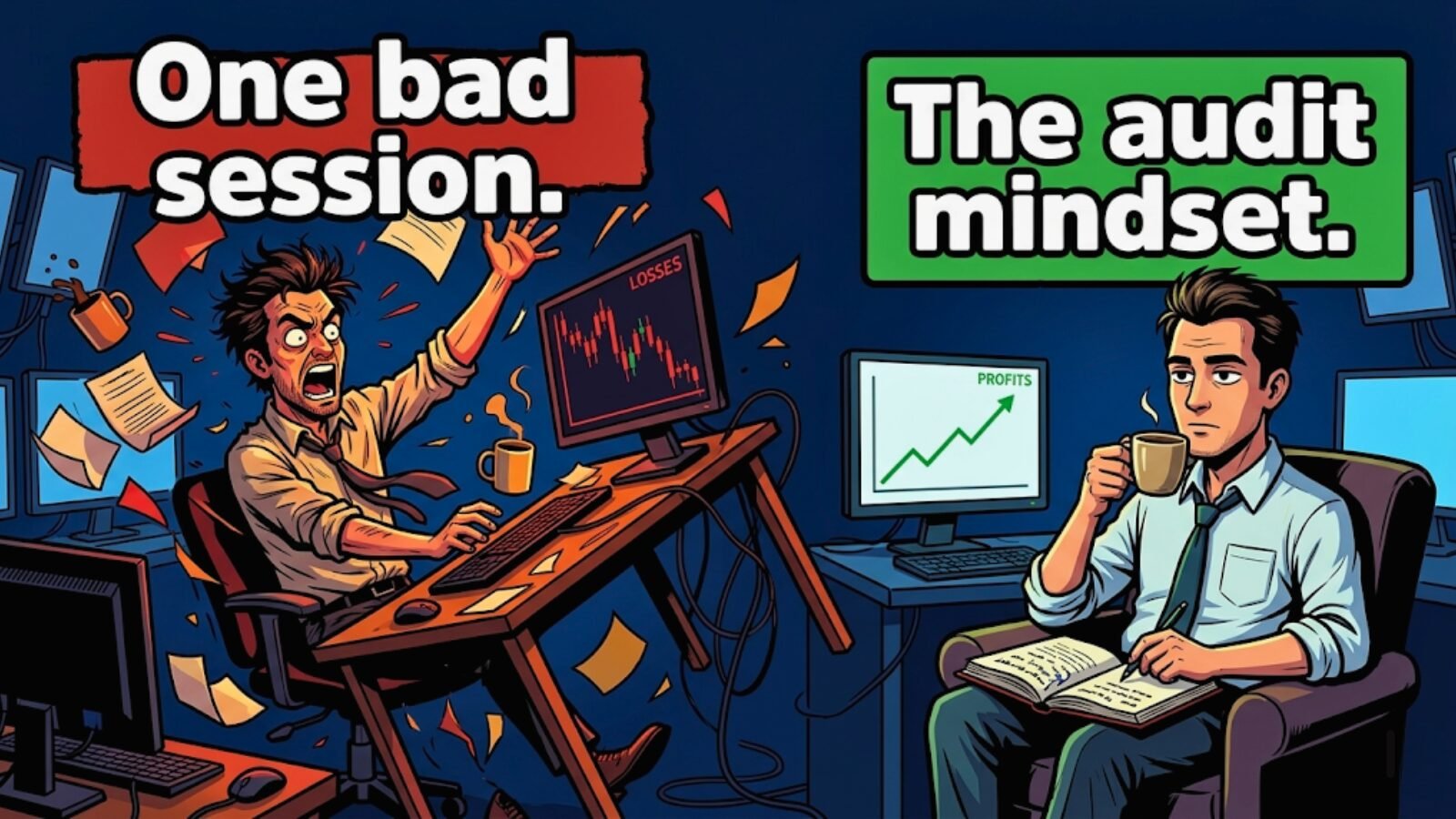
Not every session goes as planned. That is just part of trading. Some days the market cooperates. Some days it does not. And on the days it does not, most traders start to question everything. The strategy. The process. Themselves.
That is the trap.
What separates traders who stay consistent from those who spiral after a rough day is not a better strategy or a better read on the market. It is discipline in the process, and a long enough view to understand that one session, or even one rough week, does not define the career.
The Audit Mindset: Why Regular Strategy Reviews Are Non-Negotiable
Most traders only sit down to seriously review their strategy when something goes wrong. A bad stretch happens, the losses stack up, and then suddenly it is time to figure out what is broken. That is reactive thinking, and reactive thinking leads to reactive changes that are almost never the right call.
A better approach is to schedule strategy audits before anything feels broken.
The difference between a daily review and a strategy audit is important. A daily review reminder for that session of what criteria to focus on, what signals to be aware of, how to stay locked in to the plan no matter how the market moves. That is something that should happen every single day. But an audit is deeper. It looks at the strategy itself over a longer stretch, ideally a month or a quarter, to assess overall health.
A real audit should include:
- Best performing sessions
- Worst performing sessions
- Performance metrics across a meaningful sample of trades
- Documentation through screen recordings and journal notes
What this process does is take the “when should I change something?” question off the table. Instead of constantly second-guessing whether the strategy needs adjusting, that question gets answered at a scheduled time, with real data, not emotion.
Audits also do something else that does not get talked about enough. They keep a trader sharp on the details of their own system. Over time, even the most disciplined traders can let the smaller nuances of a strategy drift into the background. The audit brings it all back into focus.
When to Modify Your Strategy (And How to Know)
Changing a strategy in the middle of a rough stretch is one of the fastest ways to make things worse. There are similarities, but the market does not print the same way twice, and when the pressure is on, it is easy to convince yourself that the strategy is broken when it is not.
The smarter move is to let the data do the talking.
After collecting weeks or months of session logs, there is something to actually work with. Patterns start to emerge. Certain trigger types may show consistent underperformance. Some setups may need sharper criteria. Others may need to be removed altogether. But that decision should come from looking at the historical record, not from how the last few sessions felt.
There is a meaningful difference between sharpening trigger criteria and removing a trigger entirely. Sharpening means the setup still has merit, but the certian conditions need to be more specific. Removing means the data is pointing to something that is just not producing results across a wide enough sample. Both are valid. But neither should be done in the heat of a bad stretch.
Patience is the skill here. And patience is hard when money is on the line. That is exactly why having a scheduled audit removes so much of that pressure. The question is no longer “should I change this now?” It is “I will assess this on the first Saturday of the month, and then I will know.”

Documentation as a Confidence Tool
One of the most underrated tools in a trader’s process is documentation. Not just journaling trades, but documenting the actual setup. Chart configurations. Platform settings. The reasoning behind why things are built the way they are.
In this session a small moment of doubt crept in about whether a signal was being read correctly. It happens. But because the strategy had been reviewed that morning, as it is every morning, the doubt was resolved quickly. The reference was right there. The analysis was confirmed, and the session moved forward.
That is the real value of documentation. Not as a compliance exercise. Not just to have records. But as a confidence tool that kicks in exactly when it is needed most.
Screenshots and screen recordings are simple and practical for this. When a chart setup or platform configuration is dialed in, record it. It takes a few minutes and can save hours of trying to reconstruct something that worked but got lost in an update or a reset.
Pull the Trigger: How to Stop Missing the Trades That Pay speaks directly to this kind of internal alignment. Knowing the system. Trusting the system. And having the documentation to back up that trust when doubt shows up uninvited.
Attention Is the Real Value
Markets move to the places where attention is concentrated. That is not a theory. That is just how markets works.
When a significant portion of participants have built strategies around the same reference points, those areas will naturally attract orders. The chart tools, the indicators, the automation levels, the VWAP, all of it carries value. Not because of the math behind it, but because people pay attention to it. And where attention goes, orders follow.
A lot of retail traders understand this conceptually but struggle to trust it when it matters. Instead of staying anchored to the process and the analysis, they start looking outward. Checking what others are saying. Seeking confirmation from outside sources. Waiting for permission to act on what their own system is telling them.
That habit erodes confidence faster than any losing trade ever could.
The shift from seeking external validation to trusting an internally documented process is one of the biggest steps any trader can take. It is not about being arrogant about the analysis. It is about doing the work, building the records, and then having the discipline to lean on what has been built.
Attention is the real currency in this business. And building a process around where that attention concentrates is where the edge actually lives.
Staying in the Long Game
Short-term performance is not a reliable measure of strategy health. That might be obvious when said out loud, but it is easy to forget when in the middle of a rough stretch.
A few weeks or even a few months of underperformance does not mean a strategy is broken. Markets go through different phases of volatility shifts and varied conditions. A strategy that is built around sound logic and consistently applied will go through periods where results feel frustrating. That is normal.
What is not normal, and what tends to create the most damage, is abandoning something too early because of short-term noise. The discipline required to hold a long view while staying fully present in each session is one of the harder things to develop. But it is also one of the most valuable.
Staying consistent with your routine and approach over a longer period matters more than any single session outcome. One expense for the day does not change the trajectory of a well-built process. What matters is that the process stays intact, that the decisions being made are grounded in the system, and that the daily review routine continues without interruption.
That routine is the anchor. When markets get uncertain, the routine brings everything back to center.
Tools That Support the Process (Not Replace It)
Charting tools, automation levels, journaling platforms, footprint charts, all of it can be incredibly useful. But tools only work as well as the system built around them.
One of the more practical lessons learned over time is that documenting how tools are configured is just as important as using them correctly. It is easy to forget the specific settings on a chart that took a long time to dial in. When a platform resets or a workspace gets rebuilt, those settings do not come back automatically. Screenshots and screen recordings solve that problem simply and directly.
More broadly, tools should be used intentionally. The value is not in having access to the most sophisticated setups. The value is in understanding exactly what each tool is showing, why it matters, and how it fits into the overall strategy. That depth of understanding only comes from time with the system, consistent use, and yes, documentation.
The Discipline Behind Consistency
Discipline in this business is not about being perfect. It is not about never having an expense or always knowing exactly what the market is going to do. It is about building a process that holds up across all kinds of market conditions, reviewing that process consistently, and trusting the work that has been put into it.
The audit mindset is part of that. Documentation is part of that. A daily review routine is part of that. And so is the long view: understanding that this is not a short game, and that the goal is not to judge an entire strategy off of what happened on any given Tuesday.
For traders still working through the mental side of executing a system, Pull the Trigger: How to Stop Missing the Trades That Pay is a resource built around exactly those challenges. The psychological barriers that keep traders from acting on what they know, and how to move through them.
The tools and the strategy matter. But the mindset holds everything together.
Trade it easy ✌🏾



