Trading is risky! Past performance does not guarantee future results. Click here to read our full Disclaimer

Every trader has a session they will remember. Not because of money made or money lost, but because of what the market taught them in the quiet spaces between signals. I had one of those sessions recently, and the word that kept circling in my head was bedazzled.
Not the costume jewelry kind. The 1590s definition. Looking at the etymology of the word, bedazzled meant to be blinded by too much light, or to be overpowered by brilliance. When I looked that up after the session, it hit different. That old meaning is exactly what a certain kind of trading day feels like. You give your take on what you would like to happen. The auction (oddly) responds by printing exactly to your desires. And still, nothing about the moment gives permission to pull the trigger without breaking the rules of your plan.
This post is about that kind of day, and the lessons I have picked up from living through a lot of them.
Reading the Room Before the Bell
Before the regular session opens, I like to get a read on what the environment is offering. Overnight range. Which side of value the market is sitting on. How volatility is behaving. How volume is posturing. A quick look at the interest meter I use to gauge how active the crowd feels.
None of that tells me what the market is going to do. I have learned not to even try to predict that. What the pre-session read does is give me a framework for recognizing whether my conditions are showing up or not. The plan is not a prediction. The plan is a filter.
On the session I am reflecting on, the interest meter started up in the nines, then slid down into the sevens before the open. That alone did not say anything definitive. It just said the energy was possibly cooling off before the RTH crowd even got to the table.
When the Market Shows Up Fast
Inside the first few minutes of the regular session, the meter dropped from the nines all the way to the threes. Seeing numbers transition that quickly could feel like something was wrong, leading to a spur of the moment reaction to that feeling.
What I have learned is that a fast-moving early session is not an emergency. It is information. The market is telling a story about participation, and a trader’s job is to listen, not argue.
Sessions like that are where a trader finds out whether the process is built on feel or on real criteria. Feel-based trading starts reaching for trades that match the energy of the moment. Criteria-based trading waits, even when the screen is screaming for attention.

The Bedazzled Trade
Here is the part that inspired the whole reflection.
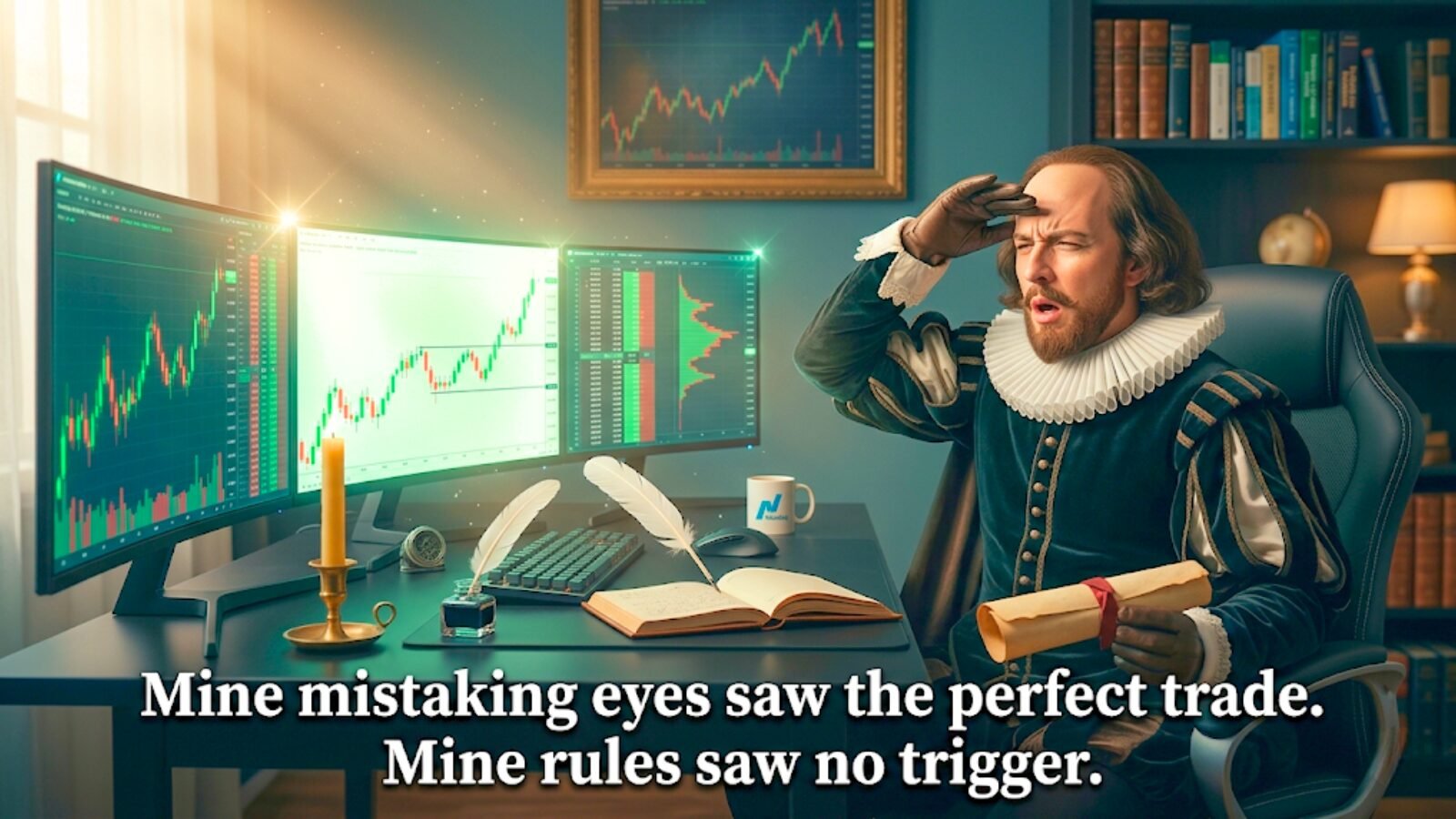
The market did exactly what I was looking for. There was a retrace to a spot I had been watching. Then price pushed right back up to a new all-time high. On paper, the move played out the way I hoped it would.
But the entry trigger I require never actually printed. The setup looked favorable. The movement was cooperative. Still, the specific conditions that would have told me this is a take did not line up.
That is what I now call a bedazzled trade. The market shows all the shine and sparkle of the exact move a trader has been waiting for, without the detail that actually validates the entry. The wish gets granted, sort of, but the fine print is missing.
It’s key to remember that this could’ve just as easily played out differently. I’ve seen these “missed opportunities” result in what would’ve been an expense had I pulled the trigger without the appropriate criteria.
In the moment, a trader feels torn between two truths. The move was right. The trigger was not. For a long time I would have forced the trade anyway, because the move should have been mine. Now I see it differently. Being right on direction and uninvolved on execution is not a failure. It is a sign that the rules are doing their job.
"No Trigger" Is a Complete Answer
One of the biggest mindset shifts I have made over the years is accepting that no trigger is a full sentence. It does not need a justification. It does not need a workaround. When the criteria are not met, standing aside is the play.
In the book I put together on this topic, Pull the Trigger: How to Stop Missing the Trades That Pay, I talk a lot about the opposite problem, which is hesitation when the trigger does show up. These two problems sound like they cancel each other out, but they do not. They both come from the same place. A trader who has not fully committed to the rules will sometimes force trades that are not there, and also skip trades that are. The cure for both is the same. Trust the criteria. Log what shows up. Respect the no.
Patterns Are Tendencies, Not Promises
Another thing that jumped out in this session was how the market kept giving an immediate response every time a new high printed. That is a pattern worth noticing. At some point, though, that same pattern started being used as liquidity. What had been a reliable behavior became a trap.
Markets do this all the time. A behavior works until it does not. Supply pockets stack up. Zones that used to bounce price start absorbing it instead. A trader who treats patterns as guarantees will be the last one to notice the regime has shifted.
Treating patterns as tendencies keeps the mindset flexible. The market is allowed to surprise. The rules are allowed to be the rules. Both can be true at the same time.
Tools Are Infrastructure, Psychology Is the Operator
A lot of traders spend more time thinking about tools than thinking about themselves. I have been that trader. Over time I have learned that tools only matter to the degree that they support the human using them.
The tools that have earned a permanent spot on my desk all do one of two things. They either help me see the market clearly, or they help me execute cleanly once I have made a decision. Charting platforms, data feeds, clearing setups, automation layers, and recording tools all fall into one of those buckets. The tool is never the edge. The operator is.
That is why I lean into treating trading like a business. A business owner does not fall in love with the cash register. They fall in love with the process that turns inputs into outcomes. Tools are the cash register. Psychology and process are the business.
Every Session Is a Test
One of the quiet benefits of a day like this is how much it teaches about system development. Live trading is the realest form of testing there is. Every session either confirms a rule, refines a rule, or challenges a rule.
The part most traders skip is logging the no-takes. The trades that looked close but did not qualify. Those non-trades carry as much information as the ones that filled. They show whether the criteria are strict enough, whether the filters are doing real work, and whether the trader is actually following the plan under pressure.
I also pay close attention to language. There are words I refuse to use at the trade station because they smuggle in bad habits. Confirmation is one of them. The market does not confirm anything. It prints. The trader’s job is to have criteria that already account for that, not to wait for a feeling of certainty that is never coming.
Fun Is a Discipline Tool
This might sound backwards, but one of the biggest lessons I took from this session is that fun is a performance input.
When a trader is having fun, emotions settle down, and counterproductive guards drop, no matter what the tape is doing. Discipline stops feeling like punishment. Staying locked in becomes enjoyable instead of exhausting. The trader shows up the next day wanting to do the work, instead of dragging themselves to the screen.
Discipline and fun are not opposites. They are partners. In Pull the Trigger I talk about how shifting emotional energy, instead of trying to suppress it, is one of the most powerful things a trader can do. Fun is one of the cleanest ways to make that shift. It turns the internal reward system into a teammate instead of a saboteur.
Design the Environment for the Job
One other observation from the session was how different a private trade looks compared to a live-streamed one. When I am recording privately, I am quieter, more focused on the full landscape of my layout, and better at catching subtle shifts in the auction. When I am streaming, more of my attention goes to mindset and narration, and less of it goes to the finer details.
Neither version is wrong. They serve different jobs. The lesson is to design the environment for the primary job first. If the primary job is execution, execution gets the best seat in the house. If the primary job is teaching or sharing, the setup should support that. Problems show up when a trader tries to do both at the same time without deciding which one wins when they compete.
What the Session Actually Paid Me
The session did not pay me in a big number. It paid me in clarity. I left the screen with a sharper sense of what my triggers actually require, a reminder that patterns are tendencies, and a fresh respect for the bedazzled trade. I also left with a cleaner definition of fun at work, which is something I never want to take for granted.
If there is one takeaway worth carrying, it is this. Setup does not equal entry. The market will keep offering almost-trades, and the edge lives in the detail work. A trader who respects the details stays in the game long enough for the real trades to show up, over and over.
The Bottom Line
The word bedazzled used to mean being blinded by too much brilliance. That is exactly what the market tries to do every session. The shine is meant to pull the eye away from the fine print. The brilliance is meant to overpower the rules.
The traders who last are the ones who keep reading the fine print anyway.
If closing the gap between seeing a trade and taking it is the piece that keeps tripping up a trader’s results, that is the whole reason I wrote Pull the Trigger: How to Stop Missing the Trades That Pay. The book is linked above. It is the system I wish someone had handed me years ago.



