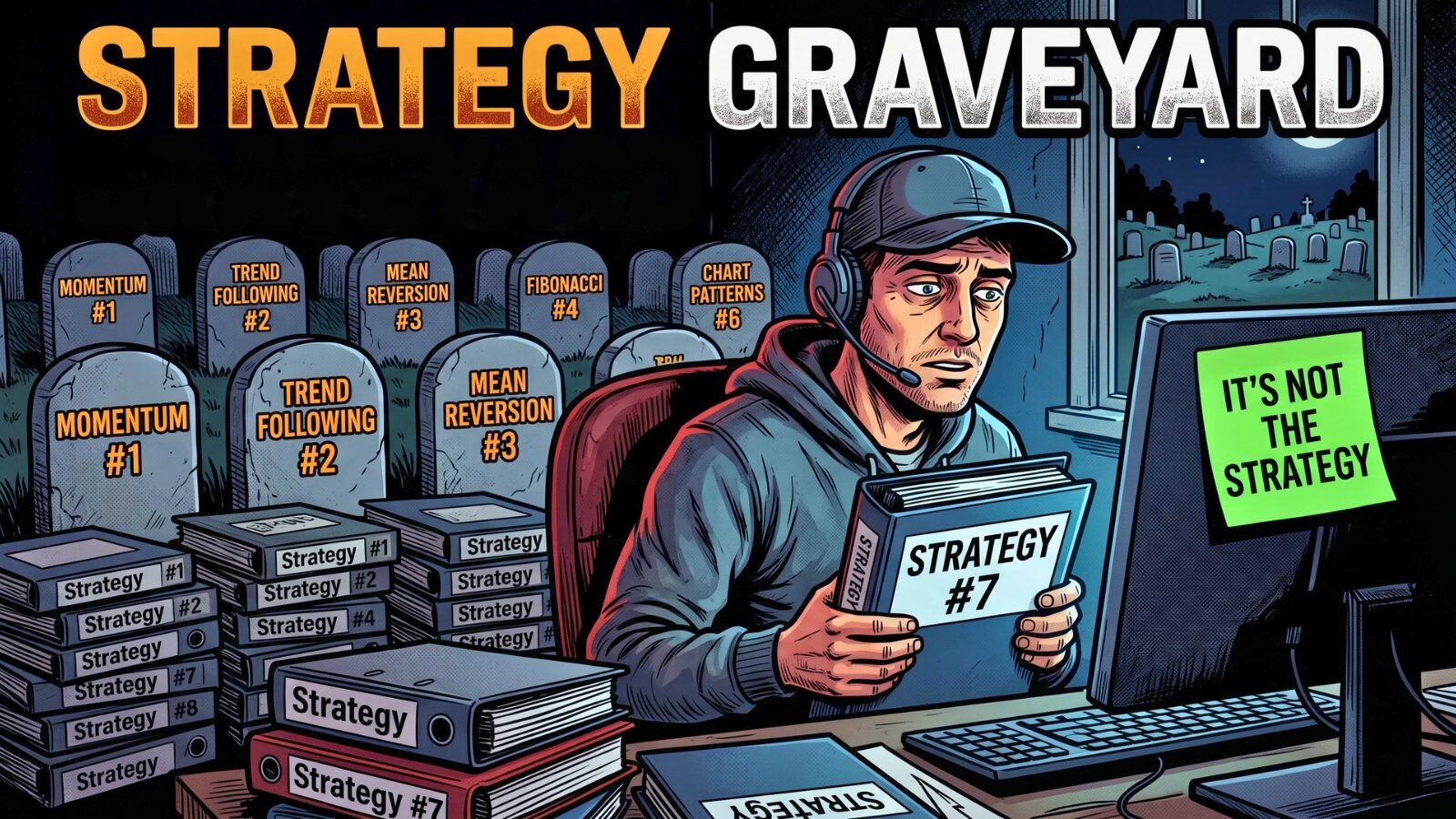
Meme illustration of a devastated trader with their head down on their keyboard after a loss, while a neon sign hanging above them reads "This Is Temporary" and a cat sits unbothered on the desk, representing the core message that every trading loss is recoupable and setbacks are not permanent outcomes.

The Real Reason Losses Destroy Your Trading Psychology (And How to Fix It)

Trading is risky! Past performance does not guarantee future results. Click here to read our full Disclaimer

“Unlike combat, every risk you take as a trader is recoupable.”

That quote did not come from a book or a motivational post. It came from a real comparison that carries real weight. In combat, the risks taken can be irreversible. The consequences can be permanent. There is no “making it back” from what can happen in that environment, such as losing a body part, a bodily function, or ultimately your life.

Trading is not that. Not even close.

And yet the emotional weight that gets placed on a losing trade, the shame, the frustration, the spiral that follows, often looks like a response to something permanent and catastrophic rather than something that is, at its core, fully recoverable. That disconnect is where most of the psychological damage in trading actually comes from.

Why Does Losing Money Feel So Much Worse Than It Actually Is?

Loss aversion is not a character flaw. It is a deeply wired psychological default that research has shown causes losses to feel roughly twice as painful as equivalent gains feel good. That is not unique to traders. It is human.

The problem is what happens when that default runs unchecked in a trading environment.

The validation research behind this is striking in how consistent the language is. Traders across experience levels and markets describe losses in identity-level terms: “sick,” “like an idiot,” “my own worst enemy,” “genuinely worried about my mental health.” A single losing trade or a rough stretch does not just register as a financial event. It registers as evidence of personal failure.

That framing is doing enormous damage to execution quality, and it is almost never examined directly.

Here is the reframe that changes everything: a monetary loss in trading is not permanent, not irreversible, and not life-threatening. The money can be made back. The account can be rebuilt. The path forward exists regardless of how bad the current stretch feels.

Losses hurt more than they should because they are being treated as something they are not.

Where the Fear Actually Comes From

When I started day trading, there was very little fear around losing money. Financial security from a steady job meant that the capital being traded felt like practice capital. A losing session might have stung a little and that was about it. The execution was cleaner, the decisions were more grounded, and the process felt more sustainable than it did later (although there were plenty newbie mistakes).

I developed fear after I shifted away from my initial strategy and decided to make the transition to full-time trading. The stakes changed. What had been discretionary capital became survival capital, at least emotionally. Every losing trade now carried the weight of the question: can this actually work? Is this going to cost me the life I am trying to build?

That shift in emotional framing changed everything about how the sessions ran. Not because the strategy was different or the market had changed. Because the meaning attached to the monetary outcome had been elevated to a level where clean execution was almost impossible.

Survival capital and practice capital look identical in the account. The psychological difference between them is enormous.

When the financial pressure of full-time trading elevated the stakes on every single position, the fear that had not been present before showed up, and it affected everything. Hesitation on valid setups. Early exits to protect gains that the plan called for holding. Frustration after losses that bled into the next session. The exact sequence the validation research describes as the most common path to blown accounts and broken systems.

This is something that we walk-through directly in Pull the Trigger: How to Stop Missing the Trades That Pay. The fear that breaks execution is almost never about the trade itself. It is about what the outcome of that trade represents emotionally. And until that representation gets examined and corrected, no amount of strategy improvement will fix the execution problem.

What "Recoupable Risk" Actually Means in Practice

Even significant losses, the kind that feel catastrophic when they happen, are recoverable in the environment that exists today.

The internet has created more pathways to income generation than at any point in history. AI tools have lowered the barrier to building something new. The skills developed through years of active market participation, risk assessment, pattern recognition, systematic thinking, transfer to other contexts. The path back from a significant trading loss is not easy, but it exists, and it is more accessible now than it has ever been.

Sometimes recovery requires doing things that feel like steps backward. Returning to a 9-5 to rebuild the financial foundation. Stepping back to a smaller account to rebuild the process without survival pressure. Those moves feel like retreat. They are not. They are strategic resets that remove the emotional weight of survival capital from the execution environment.

Before I knew it, I had to face with the decision of returning to work. It was not because of trading losses specifically, but the lesson about the relationship between financial pressure and execution quality was real regardless of the cause. The time away from full-time trading was not wasted. It was part of the longer arc.

The distinction that matters most is between a setback and a permanent outcome. They are not the same thing. Treating them as equivalent is the psychological error that causes the most damage.

How Putting Too Much Weight on Monetary Risk Breaks Execution

Deep research and time spent across trading communities maps the same sequence repeatedly, with almost identical language regardless of the market or the experience level of the trader.

It starts with the fear of losing. That fear generates hesitation on valid setups. The hesitation produces a missed trade. Watching that trade hit the target without participation generates frustration. The frustration drives a chase entry outside the plan. That entry loses. The loss amplifies the original fear. The spiral accelerates.

Every step in that sequence flows directly from the original overweighting of the monetary risk. The fear was the fuel. Everything else was the combustion.

The practical fix is not to eliminate the fear, which is neither realistic nor necessary. It is to redirect the emotional energy toward what is actually within control.

  • Entry criteria
  • Position sizing
  • Exit rules
  • Plan adherence

The monetary outcome of any single trade is not fully within a trader’s control. The quality of the execution is. When the emotional investment shifts from the outcome to the process, the fear loses most of its leverage. A loss on a correctly executed trade is not the same experience as a loss on a panic entry made outside the plan. One is data. The other is damage.

The traders who execute cleanly are not fearless. They have recalibrated what the loss actually means. Money lost on a well-executed trade is the cost of doing business in a probabilistic environment. It is not evidence of failure. It is not a verdict on the trader’s ability. It is just a trade that did not work, inside a process that still does.

Losses destroy psychology when they are treated as more than that. Recoupable risk is the reframe that changes the relationship.

A Note on Strategy Development: Price Action vs. Structure

One of the more interesting observations from this session involved the distinction between live price action and historical bar structure, and how that distinction shapes the rules a strategy can actually use.

Price action is what is happening right now, in real time, as the market moves. Structure is the historical record of closed bars, the reference framework built from what has already happened. Both are useful. They are not the same thing, and confusing them creates a specific kind of execution problem.

If a strategy is built purely from historical closed bar information, the rules for that strategy must align with how that information is generated. That means closing positions after bars close, not making decisions mid-bar based on live price movement that has not yet resolved into structure. A strategy built on structure but executed against live price action is essentially testing two different things at once and attributing the results to the wrong variable.

The language used to narrate what the market is doing during a live session also matters more than most traders realize. Neutral, descriptive language around supply and demand, rather than emotionally charged or directionally biased language, helps preserve the emotional neutrality required for clean decision-making.

Think “inventory low” instead of “buyers stepped in” or “demand zone”. Price drifting lower with constant swing low pivot points from a “buyers” may mask the actions of a seller collecting profits. For your strategy, either perspective is likely irrelevant until you start emotionally investing your attention in favor of one side over the other.

The words chosen in the moment shape the quality of the read in that same moment. That connection is subtle and real.

Sponsored Zoi Teli'a
Feel your best. Trade your best. Your mindset is your edge. It starts with how you feel.
Shop Now →

You Can Make It Back

This session ran in a volatile environment, with heavy swings and a bearish primary posture throughout. One trigger appeared, one position was taken, and it exited at the front run target area fully per plan. The session closed with a positive result and well before the window ended due to a scheduled meeting.

By the scoreboard, a clean morning.

But the more important work happened in the session notes before a single candle printed. The reminder that every risk taken as a trader is recoupable. That the emotional weight being placed on monetary losses is almost always disproportionate to what those losses actually represent. That the path back exists, regardless of the size of the setback.

The traders who survive drawdowns and come back from them are not the ones who never lose. They are the ones who never let a monetary loss become an identity loss.

Money is recoupable. The confidence that gets eroded by treating every losing trade as a catastrophe is a much harder thing to rebuild.

That distinction is the fix. Not a better strategy, not tighter risk parameters, not a different setup. The fix is in understanding what a loss actually is, and refusing to let it be anything more than that.

Trade it easy ✌🏾

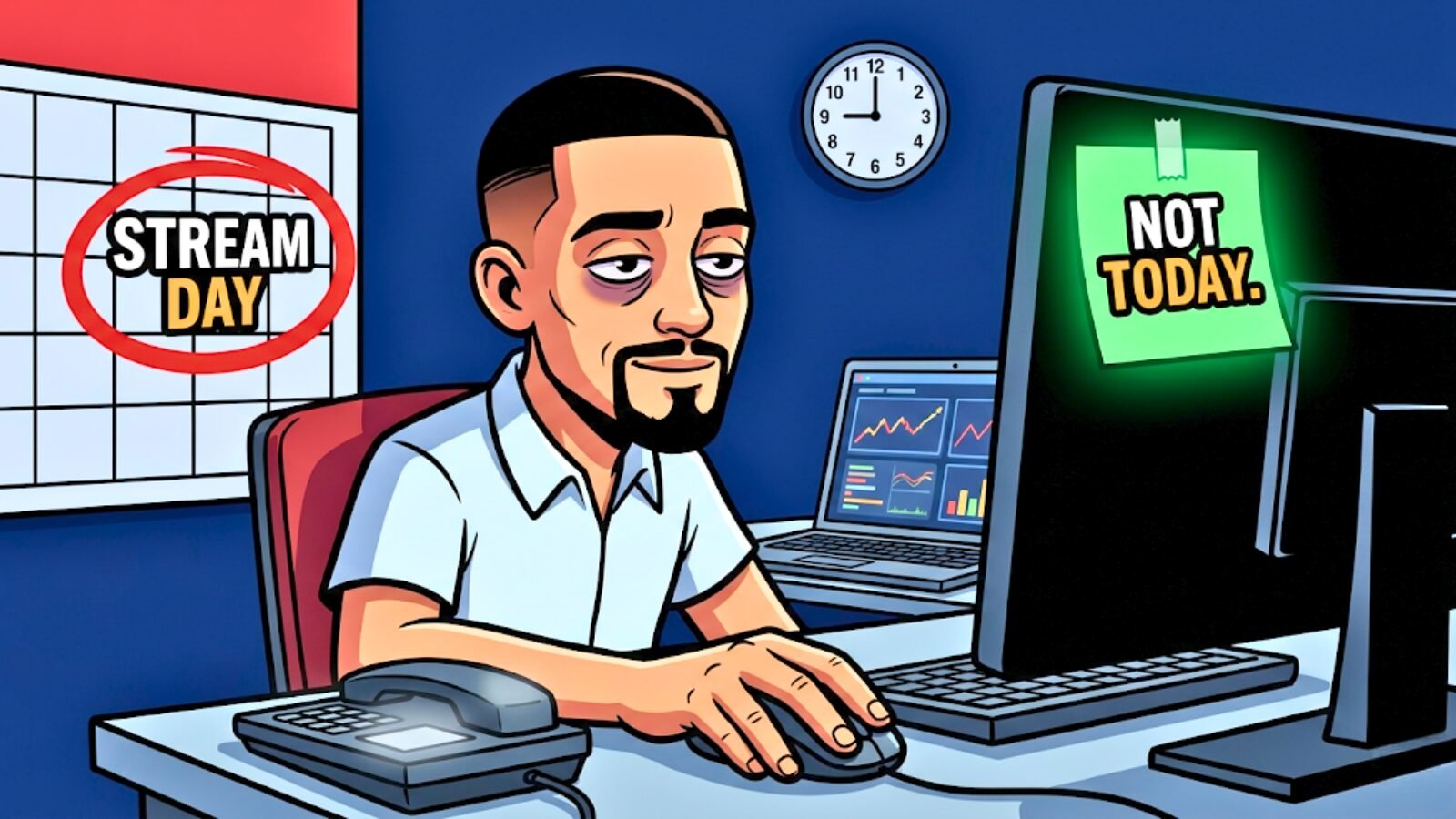
Meme illustration of an overwhelmed trader surrounded by a connection error on their monitor, an unopened package at the door, and a half-finished checklist, looking resolved as they write "Not Today" in their open trading journal, representing the disciplined decision to declare a no-trade day when compounding frustrations compromise the pre-session baseline.

Why Declaring a No-Trade Day Is Sometimes the Most Profitable Decision a Trader Can Make

Trading is risky! Past performance does not guarantee future results. Click here to read our full Disclaimer

Some mornings the market is not the problem.

This session opened with a connection issue on the trading platform that delayed the pre-market routine significantly. The breathwork and checklist, which are supposed to happen before the open, ended up happening after. A package delivery situation added an external irritation on top of the technical one. And somewhere in the middle of trying to catch up and get everything in order, the honest assessment was this: the emotional irritation is too high and focus is scattered. The baseline had already shifted and the stage was set for failure before a single position was considered.

The decision made was a no-trade day.

No positions or attempts to salvage the morning by rushing into something. Just a clean step back, a journal entry to process what had happened, and the recognition that protecting the process on this particular morning was worth more than any single trade the session might have offered.

That decision was the most profitable thing that happened all day.

What Does Compounding Frustration Actually Look Like in Real Time?

Each individual disruption on this morning was manageable on its own.

A connection issue that delays the setup is annoying, but it is fixable. A package that does not get delivered properly is a minor inconvenience. A routine that starts late because of a technical problem is a recoverable situation.

The problem is not any single one of those things. The problem is what happens when they stack.

Frustration compounds the same way risk compounds. One small irritation gets added to another, and then another, and by the time the third or fourth one lands, the emotional environment is completely different from what it would have been after just one. The attention is already partially occupied managing the irritation from the previous disruption when the next one arrives. Focus narrows. Patience thins. The internal baseline that clean execution requires gets quietly replaced by something more reactive.

This particular morning moved through that sequence in real time. By the time the market opened and the routine finally complete 45 minutes into RTH, the pre-session note at the top of the awareness section said it clearly: “Patience, resilience, and internal clarity are an absolute necessity.” All three of those had taken hits before the first candle of the regular session had even printed.

Why Venting Into the Journal Is a Trading Tool, Not a Weakness

The instinct in that kind of morning is to push through it quietly. Mask the frustration. Get the routine done, get to the screen, get focused, and act like nothing happened. That instinct is understandable and it is also one of the more expensive habits a developing trader can build. This is where new traders are typically guided with the “trade without emotions” narrative scattered all across the internet.

Unacknowledged emotional energy does not disappear. It gets redirected, and in trading, it almost always gets redirected into negative trading decisions. It shows up as a position taken on marginal criteria because there is a need to recover the morning. It shows up as a stop that gets adjusted slightly because the emotional energy behind the trade is higher than usual. It shows up as frustration-based aggression disguised as conviction.

The journal entry during this session did something different. Rather than trying to contain the frustration or pretend it was not there, the energy went onto the page. The irritations were named. The compound effect was acknowledged. And then, with some of that energy released, the honest assessment of the trading state was made: I’m not ready for my 100% accuracy goal today.

There is a meaningful difference between venting to release and venting to spiral. The goal is not to amplify the frustration by narrating it in circles. It is to surface it, name it clearly, and give it somewhere to go that is not a live trading decision. That is a real psychological tool, and it is underutilized in most trading communities because it does not look like trading. It looks like journaling. Those are not the same category for most people, but in practice they are inseparable.

This territory is covered directly in Pull the Trigger: How to Stop Missing the Trades That Pay. The emotional state carried into a session shapes every decision made during it, including the decisions that feel analytical. Releasing that energy before it reaches the decision-making layer is not soft psychology. It is a practical execution tool.

What Is the Real Cost of Trading While Irritated?

After the session was declared a no-trade day and the dust settled, the review revealed two triggers that had appeared during the disrupted setup period. Both were at valid levels. Both would have been profitable based on how price moved.

However, they were missed.

Logically, that should sting a little, triggered by resurfacing thoughts: if the routine had been completed on time, if the connection issue had not happened, those triggers would have been taken.

But here is the reframe worth sitting with: those triggers appeared while the setup was still in catch-up mode, while the focus was divided between fixing the technical issue and trying to get the morning routine back on track. Taking a trade in that state, even a trade that would have worked out, is not the same as taking the same trade with full attention and a complete pre-session process behind it.

Trading while irritated does not just affect the quality of one decision. It affects the baseline from which every subsequent decision gets made for the rest of the session. An early win taken while the focus is scattered does not necessarily reset the emotional baseline. It can actually inflate it, creating a false sense that the state was fine all along and making the next marginal decision even easier to rationalize.

The missed triggers are data. They are not evidence that stepping back was the wrong call.

How Do You Know When to Declare a No-Trade Day?

The pre-session checklist is not just a routine. It is a diagnostic.

When the checklist runs in the right order, at the right time, with the right level of attention, it produces a specific internal state that is recognizable after enough sessions of doing it consistently. That state is the baseline from which clean execution is possible. When the checklist gets disrupted, compressed, or skipped, the baseline does not get established. And without the baseline, the session is already starting from a compromised position.

The signal that a no-trade day is the right call is not always dramatic. It does not have to be a full emotional breakdown or an obvious crisis. Sometimes it is quieter than that. It is the honest recognition that the focus is scattered, that the internal environment is noisier than usual, that patience and clarity are not available at the level the plan requires.

On this morning, that recognition came through clearly. The breath work happened late. The checklist ran after the open. The connection issue had consumed attention that should have been on the market. The package situation had added an external irritation on top of all of it. None of those individually would have been enough to call the day. Together, they were.

Patience, resilience, and internal clarity are not optional inputs on a trading day. They are the foundation the plan runs on. When that foundation is not available, the responsible move is to stop building on it.

What Does Protecting the Process Actually Look Like on a Hard Morning?

Stepping back from trading on a disrupted morning is not passive. It is not giving up or taking the easy road. It is applying the same plan-based discipline to self-management that gets applied to position management during a live session.

Think about how position sizing works. When conditions are unfavorable, risk gets reduced. When volatility spikes outside of expected parameters, participation gets pulled back. When the setup does not fully meet the criteria, the trigger does not get pulled. The same logic applies to personal state. When the mental and emotional conditions are unfavorable, participation gets reduced. When the pre-session baseline has been disrupted, the threshold for taking any position gets higher. When internal clarity is not available at the required level, the trigger does not get pulled.

Capital preservation is not just a monetary outcome. It also applies to the psychological capital that gets spent every time a trading decision is made under compromised conditions. Every session where a frustrated trader forces themselves through a disrupted morning and then executes poorly is a session that costs more than the P&L reflects. The confidence, the relationship with the plan, and the habit of trusting the process all takes a hit.

Protecting the process on hard mornings is what makes the consistent mornings possible. The session value on a no-trade day that was handled well is not zero. It is the preserved capital, the protected confidence, and the reinforced habit of not letting a bad start become a bad session.

Sponsored Zoi Teli'a
Feel your best. Trade your best. Your mindset is your edge. It starts with how you feel.
Shop Now →

Discipline Shows Up Before the First Trade

The most important execution of this session happened before the market opened.

Recognizing the state, naming it in the journal, using the written word to release what needed to be released, and making the disciplined call to step back: that sequence is a complete process. It does not show up in the trade log. It does not produce a green row in the journal. But it preserved the account, protected the confidence, and reinforced the habit of treating self-management as part of the system rather than separate from it.

The traders who handle disrupted mornings this way are the ones who show up to the clean sessions ready to execute. The ones who push through the disrupted mornings trying to prove something tend to carry the damage of those sessions into the next ones.

Declaring a no-trade day when the conditions warrant it is not a concession. It is a decision made from the plan, applied to the self, executed without hesitation.

That is what discipline looks like before the first trade.

Trade it easy ✌🏾

Meme illustration of a calm trader holding a single USB cable next to a green chart, with a sticky note reading "Check the Basics First" and a pile of discarded overcomplicated troubleshooting equipment on the floor, representing the physical layer principle of always checking the simplest solution before assuming a complex problem.

What Should You Do When a Technical Issue Happens Right Before a Trade?

Trading is risky! Past performance does not guarantee future results. Click here to read our full Disclaimer

The setup was there. The conditions lined up. And the rule said wait.

Not because the trade was not valid. Not because the market was unclear. But because there was an unresolved technical issue sitting between the current moment and any position being placed, and the rule on that is not ambiguous: fix the problem first, trade second.

So the setup was skipped to resolve the audio clipping issue. And of course the skipped setup turned out to be one of the cleanest I have seen in a while.

Welcome to HINDSIGHT CAPITAL, LLC (fictional entity)! 100% success. Zero percent real-time. 🤝

This session was a green day with one trade taken cleanly and one setup correctly skipped. By execution standards, 100% accuracy was achieved for this session. That is the result worth focusing on, not the setup that looked good after the rule was appropriately followed.

What Should You Do When a Technical Issue Happens Right Before a Trade?

The answer is built into the rule: resolve the issue before placing any trade. No exceptions, no “I’ll just take this one and fix it after.”

Here is why that rule exists.

A technical issue during a live session is a variable that sits outside the plan, taking up mental space. An open position with an unresolved technical issue introduces a split-focus problem at exactly the moment when full attention is required. If the issue affects the platform, the audio, the recording, or the ability to monitor the position clearly, the risk being taken on is no longer just the defined risk of the trade. It is the defined risk plus whatever the technical problem might create at the worst possible moment.

The rule removes that compounding risk, even if the current instance appears minor. Resolve the problem first. Trade after.

What the rule also produces, and this is the part that is harder to sit with, is the occasional missed setup. This session was a direct example. The audio troubleshooting was happening during the RTH open. Although a possible clean setup was in sight, the rule said the troubleshooting had to be completed first. By the time it was resolved, the moment had passed.

In hindsight, that was the perfect setup where momentum carried to a quick target hit. But hindsight is not a trading tool. Hindsight does not know what the audio issue would have done mid-position. Hindsight does not carry the weight of the decision. The rule was right at the time it was applied, regardless of what the chart looked like afterward.

Execution accuracy is not measured by what the market did after a rule was followed. It is measured by whether the rule was followed at all.

Why 100% Accuracy Does Not Always Mean Maximum Trades

This session produced one trade following the skipped trade for troubleshooting. Both of those outcomes were correct.

That framing matters because there is a version of trading that evaluates sessions purely by opportunity captured. How many setups were available, how many were taken, and what was left on the table. That framing quietly redefines success as maximizing trades rather than maximizing plan adherence, and those two things are not the same.

The long-term objective is plan adherence. Every session.

Accepting planned risk is the only way to win. That line from the session notes going into this morning is worth sitting with because it contains more than it appears to on the surface. Planned risk includes the risk of missing a setup when the rules say conditions are not right for a trade. That is a real cost. It shows up as a missed opportunity in the session log. And it is still the correct decision.

A trader who bends these seemingly minor rules to avoid missing a setup is not maximizing opportunity. They are accepting unplanned risk, which is a different category entirely. The plan accounts for missing setups. It does not account for what happens when a technical problem intersects with an open position and there is no bandwidth to manage both.

One rule-based skipped trade, followed by a perfectly executed trade per the predefined rules, makes for a good trading day with 100% accuracy.

There Is Nothing Genius About a Good Exit

The trade that was taken today exited at the point of rotation into the opposite direction. The decision to take profit at the peak of the move was fully guided by the plan. Nothing more.

There is nothing genius about that.

That is worth saying directly because trading has a subtle trap built into good outcomes: the tendency to attribute smart results to instinct, feel, or exceptional reads rather than to the system that produced them. When a position closes at a clean level and the chart goes on to confirm that the exit was well-timed, it is easy to take that as evidence of sharp judgment. What it is actually evidence of is a well-designed plan being followed.

The problem with confusing the two is that instinct is not repeatable. A system is.

Keeping execution separate from outcome is one of the more important habits to build in trading. The exit today was correct because the plan said to exit there, not because of some “smart” read on current conditions. If the market had kept going after the exit, the exit would still have been correct. The trades are not evaluated by what the chart does after the position is closed. It gets evaluated by whether the rules were followed while the position was open.

This is a principle that runs through Pull the Trigger: How to Stop Missing the Trades That Pay. The confidence that makes clean execution possible is not built from feeling smart about good outcomes. It is built from the documented evidence of a process that has been followed consistently over time. That is a very different foundation, and it holds up under conditions that feel-based confidence cannot.

What Does Past Documentation Reveal About Where the Process Is Now?

Something unexpected came out of this session: a collection of historical game film and screenshots from 2023, found stored in a browser extension that had not been checked in a while. Real session footage from a few years ago, sitting in a forgotten corner of the workflow.

Looking back at that material was useful and humbling at the same time.

What seemed like adequate documentation at the time lacks the detail that would make it genuinely useful now. The notes are thinner. The context is missing. The level of specificity that the current process requires is just not there in the older records. Not because the effort was not real at the time, but because what is known now about what good documentation looks like is different from what was known then.

What a trader does not know changes over time. And old records reflect the knowledge level of the person who made them.

This is actually an encouraging observation once the initial frustration passes. The gap between what the 2023 documentation captured and what would be captured today is evidence of real development. The standard for what constitutes useful data got higher because the understanding of the process got deeper.

The practical application is to use that old footage as backtesting material. Test current strategy assumptions against historical setups from a few years back to see how the current rules would have applied to those conditions. That is a legitimate data source that was almost overlooked entirely.

How Should a Trader Evaluate New Journaling and Documentation Tools?

The documentation workflow question is ongoing. A new local-hosted trading journal tool called Aurafy came up this session as worth evaluating. The session also surfaced the question of whether the Awesome Screenshot extension, where the 2023 footage was discovered, might still serve a purpose in the current workflow or whether it is time to consolidate.

The criteria for adding any new tool to a trading operation is straightforward: does it reduce friction in the documentation process without introducing new friction somewhere else?

A tool that makes screenshot capture faster but requires a separate workflow to get those screenshots into the central journal is not necessarily a net improvement. A tool that integrates directly with the journaling process and captures the right data at the right level of detail is worth the time to evaluate properly.

Aurafy is on the testing list. The evaluation criteria are already in place. That is the right order: define what the tool needs to do, then test it against those criteria, rather than adopting it because it looks impressive and figuring out what problem it solves later.

The broader principle is the same one that applies to strategy tools, automation, and anything else that gets added to the trading operation: the tool serves the process, not the other way around.

Sponsored Zoi Teli'a
Feel your best. Trade your best. Your mindset is your edge. It starts with how you feel.
Shop Now →

The Physical Layer Principle: A Troubleshooting Lesson That Goes Beyond Tech

The audio issue got resolved this session through a principle borrowed directly from professional IT troubleshooting: always check the physical layer first.

Before assuming a software problem, a configuration issue, or a settings conflict, check the physical connections. Reseat the cables. Check the port. Verify the hardware is actually communicating before digging into the software stack. In this case, reseating the USB connection on the audio interface resolved a clipping issue that had been causing problems across multiple sessions.

That principle is worth carrying beyond technology.

In trading, the equivalent of the physical layer is the basics: is the plan being followed? Are the criteria actually being met before a trigger is taken? Is the documentation happening consistently? Before assuming that the strategy has a deeper problem, verify the fundamentals are intact. Most of the time, when something is not working in a trading operation, the answer is at the physical layer: a rule that has quietly drifted from its original criteria, a documentation habit that has gotten inconsistent, a pre-session routine that has been shortcut.

Check the physical layer first. The complex explanation is rarely the right one when the simple one has not been ruled out.

This applies to strategy troubleshooting as I’ve documented in my journal process: before concluding the system is broken, confirm the system is actually being applied as designed. That question alone resolves more apparent strategy problems than any technical adjustment ever has.

The Plan Worked Because It Was Followed, Not Because the Market Cooperated

Green session thanks to clean execution.

  • One setup correctly skipped under active troubleshooting.
  • Audio issue resolved with a documented solution that will hold up the next time the same problem appears.
  • One trade taken on valid criteria.

Hindsight does not get to rewrite any of those decisions. The rule was followed at the time it needed to be followed, based on the information available at that moment. What the market did after the setup was skipped is interesting but not relevant to whether the decision was correct.

Discipline is not just about following the plan when it’s easy. It’s about following the plan no matter how good (or bad) the results may look in the rearview, or if the internal argument for bending the rule just this once is genuinely convincing.

The traders who build something durable are the ones who follow the plan on exactly those days. Not because the outcome will always validate the decision, but because the process only works if it is actually followed.

Accepting planned risk is the only way to win. Even when planned risk looks like a missed trade in the session log.

Trade it easy ✌🏾