Trading is risky! Past performance does not guarantee future results. Click here to read our full Disclaimer

“Belief is your primary source of fuel.”
No trades were taken today. The market moved through the window without producing an official trigger, and the discipline to stay out held clean throughout. But some of the more useful thinking of the week happened in the space that a quiet session creates. Specifically, a conversation that has been circling for a while surfaced through today’s narrative: why are traders so secretive about their strategies?
The answer is more honest than most people want to admit.
The Real Reason Traders Don't Share Their Edge
The easy answer is selfishness. Traders guard their edge because they do not want competition, because they are gatekeeping knowledge to maintain an advantage, because they are protecting something that makes them money and do not want to give it away.
That answer is not wrong. But it is incomplete.
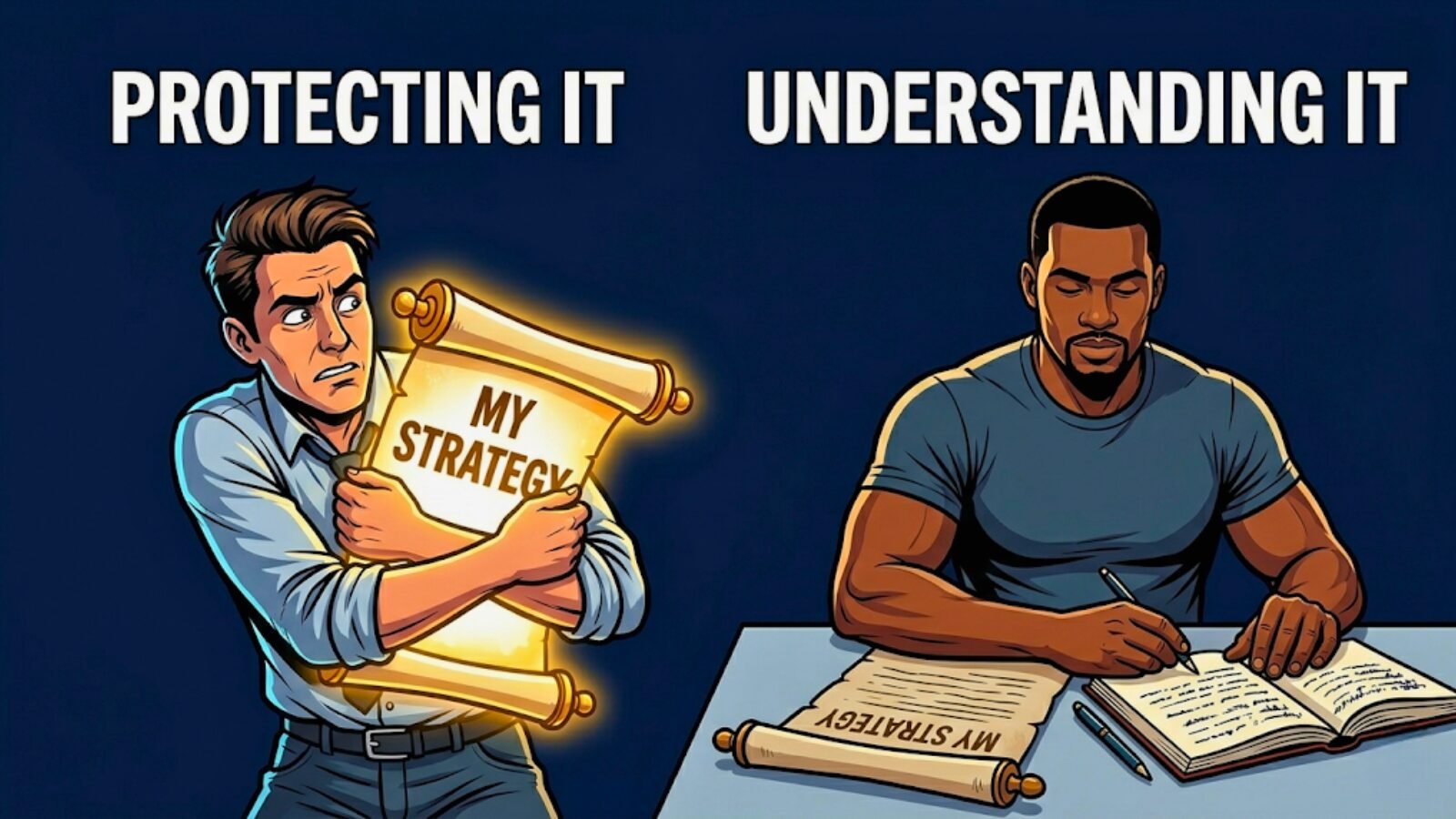
The deeper answer is fear. Specifically, the fear of losing something that took real effort, real pain, and real time to build. When a trader has spent months or years developing an approach, grinding through losing stretches, documenting sessions, adjusting criteria, and finally arriving at something that produces consistent results, the instinct to protect that is not greed. It is survival.
And if they acquired the strategy from somewhere else, they probably don’t have the foundational knowledge to pass the information along effectively.
Selfishness, from a motivational lens, is a survival mechanism. It is the internal system doing its job: preserve what sustains you. That drive is not unique to trading. It shows up anywhere people have invested deeply in something and face the possibility of losing it.
Understanding that reframe matters because it changes how the secrecy gets interpreted. When another trader does not want to share their approach, the instinct is to assume arrogance or greed. The more likely reality is that they are protecting something they are genuinely afraid of losing. That fear is worth having some empathy for, even when it is frustrating from the outside.
Does Sharing a Strategy Actually Destroy Its Edge?
Here is where it gets interesting, because the data does not fully support the fear.
ICT has shared an enormous amount of technical material publicly. The concepts are widely studied, widely discussed, and widely applied across trading communities. And yet the framework continues to work for traders who put in the real effort to understand and apply it in a manner that best fits their personal situation. The edge did not evaporate because the information became public.
That observation points to something important: an indicator or a shared framework does not lose its value simply because more people know about it. What creates the edge is never the raw information. It is the personal application of that information, built through study, testing, documentation, and execution across real sessions. All sponsored by self-awareness.
Indicators are not strategies. That line deserves its own space because it resolves a lot of the confusion around sharing.
An indicator shows a mathematical relationship in the price data. It has no opinion about when to enter, what size to use, how long to hold, or when the setup no longer qualifies. All of those decisions belong to the strategy, and the strategy belongs to the trader who built it. Sharing the indicator changes nothing about the edge because the indicator was never the edge to begin with.
The edge lives in the personal understanding of how and when that tool fits into a specific, tested, rule-based system. That understanding cannot be copied and pasted.

Why the Best Strategy Is Always the One Built for You
This is the piece that most developing traders underestimate, and it is where the secrecy question connects to something more practical.
Copying someone else’s approach, even a legitimate and profitable one, creates a specific kind of problem that does not show up immediately. The setup looks right. The entries make sense on paper. But when the market is moving and a decision has to be made in real time, the internal confidence required to pull the trigger does not come from recognizing a pattern someone else taught. It comes from understanding why the pattern works, what it means in context, and what the rules say to do about it.
That understanding only exists when the strategy was built by the person trading it. Not to continue promoting ICT (I don’t use it, by the way), but this is why there are still so many questions about the ICT concept. Many videos have been produced from the creator and others that have used it. Countless discussions have been had on the concept and how to apply it. Yet the only person that fully understands it without question is the guy that created it.
This is one of the core themes in Pull the Trigger: How to Stop Missing the Trades That Pay. The hesitation that keeps traders from executing is almost always rooted in a distrust of the system. And the system only gets fully trusted when it is genuinely understood from the inside, not borrowed from the outside.
Building a strategy from scratch is harder. It takes longer. It costs more in the early stages. And it is the only version that holds up under pressure because it is the only version the trader fully believes in.
Belief is the fuel. A system that was copied does not generate the same belief as one that was earned.
What Happens When You Lose Documentation of a Working System?
There was a strategy early in my trading journey that doubled the account in about two weeks. By the standards of that period, it was working. The approach was producing results that felt meaningful and repeatable.
And the details of how it worked were never fully documented.
Over time, and through testing other theories, the specifics faded. The exact criteria became unknowns. The understanding of why certain setups qualified and others did not became less precise. Eventually the strategy that had worked stopped being applied with the same fidelity it had been applied with when it was producing those results. Not because the market changed, but because the knowledge that made it executable had not been preserved.
That loss is a specific kind of expensive that does not show up in the P&L directly. The cost was not a losing trade. It was a working system that could not be reliably reconstructed because the documentation was not there to begin with.
Documentation is not just record-keeping. It is the preservation of knowledge that took real cost to acquire. The session notes, the criteria written out in detail, the screenshots of the setups that qualified and the ones that did not, all of that is how the understanding gets locked in at a level that survives time away, market changes, and the natural drift that happens when something is not being actively reviewed.
A strategy that is not documented is a strategy that is bound to be forgotten.
Watching a Pattern Before Trading It
Today’s session produced no official triggers across the entire window. The market opened into the premarket awareness levels, moved through areas identified as primary value area, and never generated the conditions the system requires for a valid entry.
What it did produce was multiple observations of a specific pattern appearing throughout the session. The same concept that had surfaced most clearly during the pre-trade routine review came up live in the market more than once, including stacked versions of the pattern appearing back to back. Whether that was coincidence or some form of pattern recognition developing from consistent preparation is genuinely interesting to consider.
The discipline in those moments was to observe and document, not to act. A pattern that has not been fully validated through study and backtesting does not earn real capital regardless of how compelling it looks in a single session. Watching it across multiple occurrences in a live environment is valuable data. Trading it before that work is done is chasing potential gains with unproven logic.
Capital preservation over chasing what looks interesting is a principle that applies to new patterns the same way it applies to any other marginal setup. The patience required to watch and wait, rather than act on something unproven, is the same discipline that keeps the trading window clean on days when the official triggers are not there.
Belief Drives Everything
A session with no trades is still a full session when the time is used honestly.
Today produced documentation of pattern observations that will feed future study. It produced a worked-through perspective on why strategy secrecy exists and what it actually means for developing traders. It produced a reinforced reminder that the edge lives in personal understanding, not in borrowed frameworks. And it opened up a longer-term question about how to eventually share a proven approach in a way that serves the community without giving away the personalized application that makes it actually work.
The session quote from this morning keeps coming back: belief is your primary source of fuel.
Without belief in the system being traded, hesitation fills the gap. Not the hesitation of a bad trader, but the entirely rational hesitation of a trader operating a system they do not fully trust. The fix for that hesitation is not more information. It is more understanding, built through documentation, observation, testing, and the honest work of developing something that belongs to the trader running it.
The quiet days are where that belief gets built. Not in the trades themselves, but in the preparation that makes the trades possible.
Trade it easy ✌🏾



