Trading is risky! Past performance does not guarantee future results. Click here to read our full Disclaimer

Some mornings the market is not the problem.
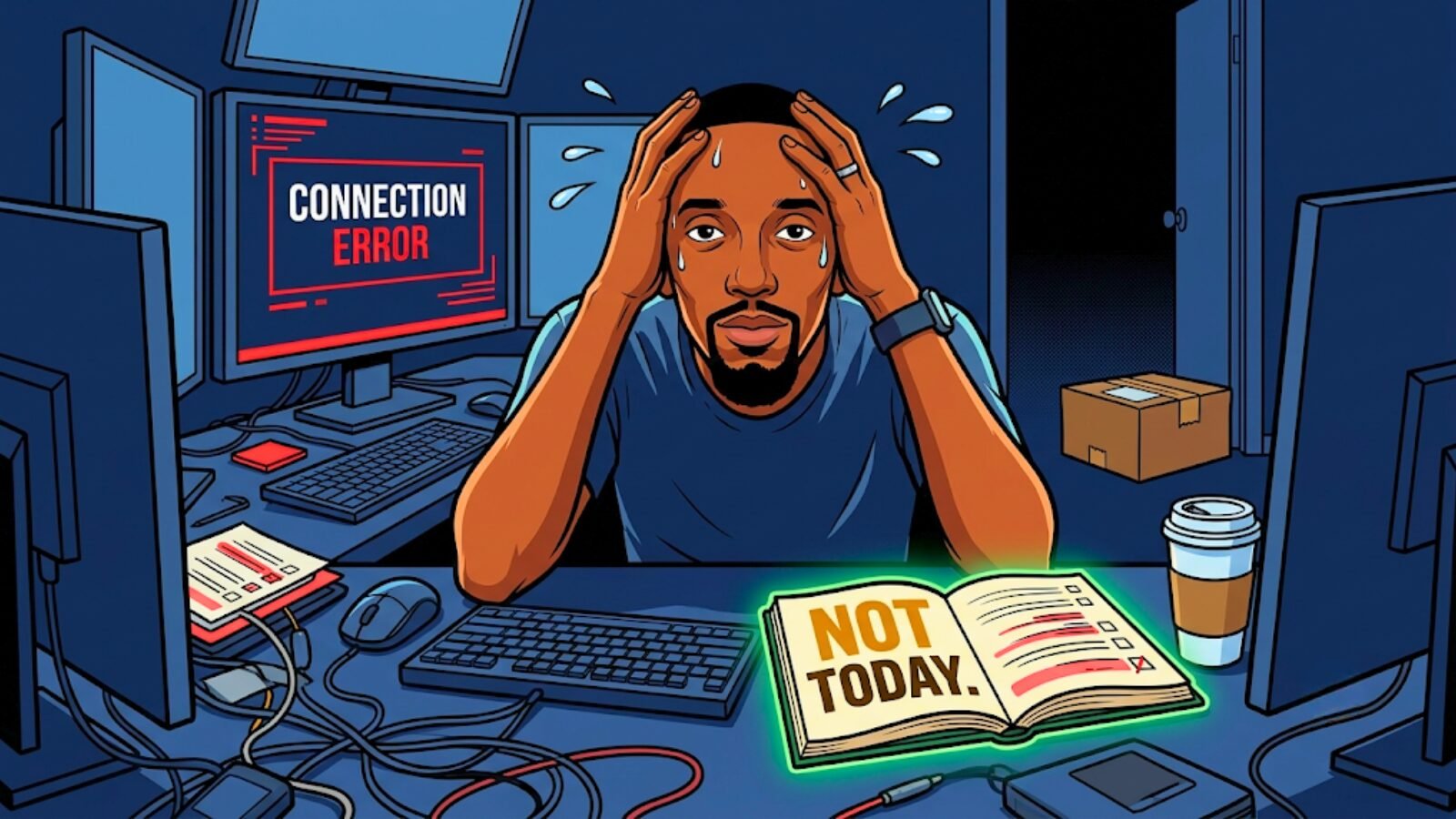
This session opened with a connection issue on the trading platform that delayed the pre-market routine significantly. The breathwork and checklist, which are supposed to happen before the open, ended up happening after. A package delivery situation added an external irritation on top of the technical one. And somewhere in the middle of trying to catch up and get everything in order, the honest assessment was this: the emotional irritation is too high and focus is scattered. The baseline had already shifted and the stage was set for failure before a single position was considered.
The decision made was a no-trade day.
No positions or attempts to salvage the morning by rushing into something. Just a clean step back, a journal entry to process what had happened, and the recognition that protecting the process on this particular morning was worth more than any single trade the session might have offered.
That decision was the most profitable thing that happened all day.
What Does Compounding Frustration Actually Look Like in Real Time?
Each individual disruption on this morning was manageable on its own.
A connection issue that delays the setup is annoying, but it is fixable. A package that does not get delivered properly is a minor inconvenience. A routine that starts late because of a technical problem is a recoverable situation.
The problem is not any single one of those things. The problem is what happens when they stack.
Frustration compounds the same way risk compounds. One small irritation gets added to another, and then another, and by the time the third or fourth one lands, the emotional environment is completely different from what it would have been after just one. The attention is already partially occupied managing the irritation from the previous disruption when the next one arrives. Focus narrows. Patience thins. The internal baseline that clean execution requires gets quietly replaced by something more reactive.
This particular morning moved through that sequence in real time. By the time the market opened and the routine finally complete 45 minutes into RTH, the pre-session note at the top of the awareness section said it clearly: “Patience, resilience, and internal clarity are an absolute necessity.” All three of those had taken hits before the first candle of the regular session had even printed.
Why Venting Into the Journal Is a Trading Tool, Not a Weakness
The instinct in that kind of morning is to push through it quietly. Mask the frustration. Get the routine done, get to the screen, get focused, and act like nothing happened. That instinct is understandable and it is also one of the more expensive habits a developing trader can build. This is where new traders are typically guided with the “trade without emotions” narrative scattered all across the internet.
Unacknowledged emotional energy does not disappear. It gets redirected, and in trading, it almost always gets redirected into negative trading decisions. It shows up as a position taken on marginal criteria because there is a need to recover the morning. It shows up as a stop that gets adjusted slightly because the emotional energy behind the trade is higher than usual. It shows up as frustration-based aggression disguised as conviction.
The journal entry during this session did something different. Rather than trying to contain the frustration or pretend it was not there, the energy went onto the page. The irritations were named. The compound effect was acknowledged. And then, with some of that energy released, the honest assessment of the trading state was made: I’m not ready for my 100% accuracy goal today.
There is a meaningful difference between venting to release and venting to spiral. The goal is not to amplify the frustration by narrating it in circles. It is to surface it, name it clearly, and give it somewhere to go that is not a live trading decision. That is a real psychological tool, and it is underutilized in most trading communities because it does not look like trading. It looks like journaling. Those are not the same category for most people, but in practice they are inseparable.
This territory is covered directly in Pull the Trigger: How to Stop Missing the Trades That Pay. The emotional state carried into a session shapes every decision made during it, including the decisions that feel analytical. Releasing that energy before it reaches the decision-making layer is not soft psychology. It is a practical execution tool.

What Is the Real Cost of Trading While Irritated?
After the session was declared a no-trade day and the dust settled, the review revealed two triggers that had appeared during the disrupted setup period. Both were at valid levels. Both would have been profitable based on how price moved.
However, they were missed.
Logically, that should sting a little, triggered by resurfacing thoughts: if the routine had been completed on time, if the connection issue had not happened, those triggers would have been taken.
But here is the reframe worth sitting with: those triggers appeared while the setup was still in catch-up mode, while the focus was divided between fixing the technical issue and trying to get the morning routine back on track. Taking a trade in that state, even a trade that would have worked out, is not the same as taking the same trade with full attention and a complete pre-session process behind it.
Trading while irritated does not just affect the quality of one decision. It affects the baseline from which every subsequent decision gets made for the rest of the session. An early win taken while the focus is scattered does not necessarily reset the emotional baseline. It can actually inflate it, creating a false sense that the state was fine all along and making the next marginal decision even easier to rationalize.
The missed triggers are data. They are not evidence that stepping back was the wrong call.
How Do You Know When to Declare a No-Trade Day?
The pre-session checklist is not just a routine. It is a diagnostic.
When the checklist runs in the right order, at the right time, with the right level of attention, it produces a specific internal state that is recognizable after enough sessions of doing it consistently. That state is the baseline from which clean execution is possible. When the checklist gets disrupted, compressed, or skipped, the baseline does not get established. And without the baseline, the session is already starting from a compromised position.
The signal that a no-trade day is the right call is not always dramatic. It does not have to be a full emotional breakdown or an obvious crisis. Sometimes it is quieter than that. It is the honest recognition that the focus is scattered, that the internal environment is noisier than usual, that patience and clarity are not available at the level the plan requires.
On this morning, that recognition came through clearly. The breath work happened late. The checklist ran after the open. The connection issue had consumed attention that should have been on the market. The package situation had added an external irritation on top of all of it. None of those individually would have been enough to call the day. Together, they were.
Patience, resilience, and internal clarity are not optional inputs on a trading day. They are the foundation the plan runs on. When that foundation is not available, the responsible move is to stop building on it.
What Does Protecting the Process Actually Look Like on a Hard Morning?
Stepping back from trading on a disrupted morning is not passive. It is not giving up or taking the easy road. It is applying the same plan-based discipline to self-management that gets applied to position management during a live session.
Think about how position sizing works. When conditions are unfavorable, risk gets reduced. When volatility spikes outside of expected parameters, participation gets pulled back. When the setup does not fully meet the criteria, the trigger does not get pulled. The same logic applies to personal state. When the mental and emotional conditions are unfavorable, participation gets reduced. When the pre-session baseline has been disrupted, the threshold for taking any position gets higher. When internal clarity is not available at the required level, the trigger does not get pulled.
Capital preservation is not just a monetary outcome. It also applies to the psychological capital that gets spent every time a trading decision is made under compromised conditions. Every session where a frustrated trader forces themselves through a disrupted morning and then executes poorly is a session that costs more than the P&L reflects. The confidence, the relationship with the plan, and the habit of trusting the process all takes a hit.
Protecting the process on hard mornings is what makes the consistent mornings possible. The session value on a no-trade day that was handled well is not zero. It is the preserved capital, the protected confidence, and the reinforced habit of not letting a bad start become a bad session.
Discipline Shows Up Before the First Trade
The most important execution of this session happened before the market opened.
Recognizing the state, naming it in the journal, using the written word to release what needed to be released, and making the disciplined call to step back: that sequence is a complete process. It does not show up in the trade log. It does not produce a green row in the journal. But it preserved the account, protected the confidence, and reinforced the habit of treating self-management as part of the system rather than separate from it.
The traders who handle disrupted mornings this way are the ones who show up to the clean sessions ready to execute. The ones who push through the disrupted mornings trying to prove something tend to carry the damage of those sessions into the next ones.
Declaring a no-trade day when the conditions warrant it is not a concession. It is a decision made from the plan, applied to the self, executed without hesitation.
That is what discipline looks like before the first trade.
Trade it easy ✌🏾



