Trading is risky! Past performance does not guarantee future results. Click here to read our full Disclaimer

Some sessions produce trades. Some produce something else entirely.
This one had no tradable triggers from open to close. The market moved, conditions shifted, setups came close but never fully qualified. The plan said stay out, so staying out is exactly what happened. No positions, no expenses, no results on the scoreboard.
And it was still a full session.
What filled the space was observation, refinement, and a few conversations worth having about the longer arc of this work. The decisions made away from live positions, the labels created, the perspectives refined, the tools evaluated, are often the ones that shape future execution the most. This session was a clear example of that.
Does the Language You Use in Trading Actually Matter?
This question came up in a very practical way during this session, and the answer is yes. More than most traders think about it.
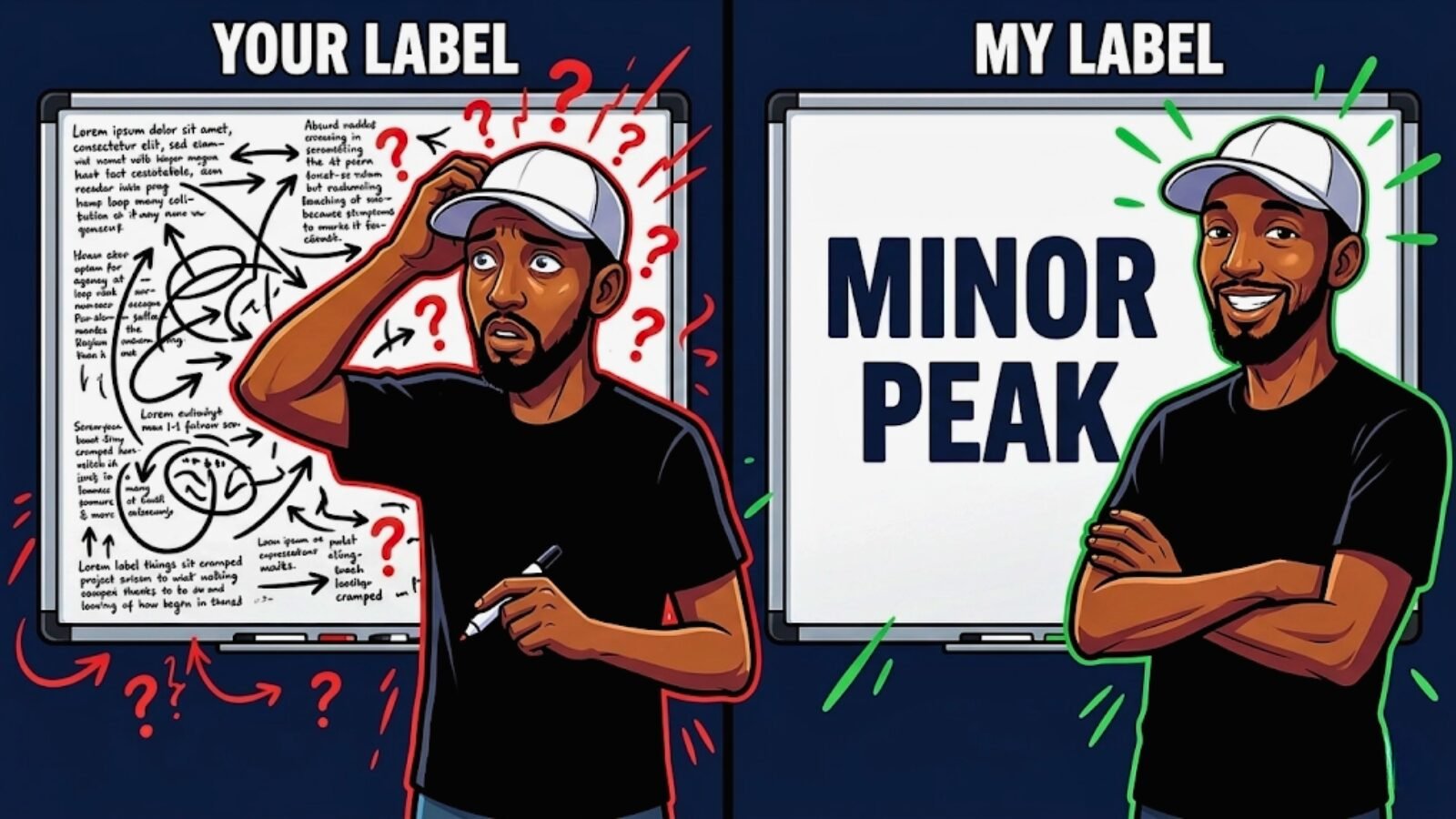
When building a personal system from scratch, labels get created for what is being observed. Reference points, market behaviors, setup conditions. All of it needs a name that can be returned to days, weeks, or months later and still carry its original meaning without needing to reconstruct the context around it.
The problem with overly complex or creative terminology is that it decays. A label that felt clever at the moment of creation becomes confusing after a few weeks away from it. The energy behind the term gets lost. And confusion in one area of focus has a way of becoming contagious to other areas. Clarity is fragile enough during a live session without the vocabulary working against it.
The standard worth keeping is simple and descriptive. The term should say exactly what it is, nothing more. If it can be picked up cold after a long break and immediately understood in context, it earned its place in the system. If it requires remembering the story behind it to make sense, it is too complicated.
A label created during this session is a practical example of that principle at work. A certain type of supply interest was observed that did not protrude noticeably from the broader supply zone within the visible range. Rather than reaching for something elaborate, the label “minor peak” was used. In relation to “supply floor,” which describes the visible area of supply, “minor supply interest peak” describes exactly what it is and nothing else. Return to it in three months without context, and the meaning is still intact.
That kind of clarity is built one term at a time. And interestingly, the process of creating these labels became noticeably sharper in writing than in real-time verbal communication. Some thinking is better suited to the written word. That is not a limitation. It is useful self-knowledge about how clarity actually gets produced.
Why Following the Rules on a No-Trigger Day Is Still a Win
There is a version of a quiet session that is genuinely productive and a version that is just inertia dressed up as discipline. The difference is whether the read on the market was active and engaged or whether the system just sat on autopilot waiting for something to force a decision.
This session was the first kind. The triggers were observed closely. A few setups came close enough to pull attention. The discipline to not rush into those near-miss situations stayed intact. The unwritten rule that has been referenced in previous sessions came back here: if a setup almost triggers and the attention was not fully locked in at the moment it formed, it does not get rushed into after the fact.
Recognizing early that no fully qualifying triggers existed and holding that read across the entire session is its own form of execution. Capital preservation is a legitimate outcome. Not exciting, not rewarding in the immediate sense, but meaningful in the context of a longer process where avoiding unnecessary expenses is part of how the overall picture stays manageable.
The emotional shift that makes this possible is moving the focus away from monetary outcome and toward accuracy. A session where the plan was followed with 100% accuracy and no trades were taken is a better result than a session where two trades were forced on marginal setups and both happened to work out. One of those reinforces the right habits. The other does not.

What Does Exploring the Wrong Way to Trade Actually Teach You?
There is a category of trading advice that essentially amounts to: ‘do not do that, it never works, you will blow your account.’ And some of it is genuinely useful. But taken without personal examination produces a different kind of problem.
A trader who has only ever followed the prescribed rules and avoided everything labeled as dangerous has a surface-level understanding of those concepts. They know what they were told. They do not know what they experienced, nor why that concept came to be.
My clearest understanding of risk, position sizing, and market behavior came from periods of directly engaging with approaches that were taught as things to avoid. Not recklessly. Not ignorantly. But with real attention and genuine curiosity about what was actually happening rather than what was supposed to happen.
That kind of firsthand exploration produces a depth of understanding that instruction alone cannot provide. It builds the ability to evaluate advice objectively rather than just accepting or rejecting it based on who said it. Not blindly ignoring conventional wisdom, but not blindly following it either. Taking it in, testing it against real experience, and deciding what actually fits the personal approach being developed.
Clarity about what works personally came from being willing to explore, including the parts of the market that were labeled off-limits. Taking time to do that exploration rather than rushing toward income changed the quality of everything that came after it.
How Do You Keep the Long View During a Drawdown?
So far, this year has been challenging in terms of monetary reward. Several months of results that have not financially reflected the work being put in. That is real, and pretending otherwise would not serve anyone reading this.
But here is the reframe that keeps coming back: a multi-month drawdown on a 10-year timeline is a small mark. Not invisible, not irrelevant, but proportionally small when the full picture is in view. The weight carried by a rough stretch in the moment almost never matches the weight it will carry when looked back on from a distance.
A drawdown viewed on a 10-year timeline is data, not a verdict.
What makes that reframe difficult to hold is comparison. When the focus drifts toward what other traders are doing, what their timelines look like, what their results suggest about where the process should be by now, the proportional weight of the current stretch gets distorted. Someone else’s highlight is not a benchmark. It is a snapshot with no context. Understanding how others think and operate is useful. Being controlled by it is not.
The practical response is to keep the scope of the comparison internal. Is the current process more refined than it was six months ago? Is the system being followed with more accuracy than it was a year ago? Those are the questions worth asking. Those answers are actually accessible.
Staying inside the plan during a drawdown is easier when the long view is genuinely held. The emotional spiral that leads to trading outside the system almost always starts with a loss of perspective about how big this moment actually is relative to the full journey.
When One Tool Fails, What's the Backup Plan?
During this morning’s livestream, some time went into recapping what happened the previous session with a screen recording tool that caused an unexpected system conflict. The reason for bringing it up was simple: I like to share my real world experiences as they may be helpful to others.
But the more useful conversation that came out of it was about contingency thinking. A single tool failure should not cascade into a documentation problem or a disrupted workflow. Testing new tools in isolation, away from live session windows, is the standard that prevents that. A tool that breaks something upstream of the trading process is not just an inconvenience. It is a focus drain during a window where focus is the primary resource.
The prop firm acquisition situation that also came up this week reinforces the same idea. Vendor changes happen outside of anyone’s control. What is within control is how quickly alternatives get identified and how cleanly the transition happens. A new journaling tool with a built-in screen recorder has been queued for testing. That kind of contingency thinking is part of running a trading operation, not just placing trades.
Trading as a Lifelong Practice, Not Just an Income Source
There was a moment in this session worth noting directly: if trading could not generate income, it would still be something worth doing. The interest in the activity itself, the daily puzzle of reading market structure and managing execution, plus keeping interpersonal skills sharp is genuine enough to exist independent of the financial outcome.
That relationship with the practice changes everything about how difficult periods get navigated. A trader who is purely outcome-focused experiences a drawdown as a threat to the entire endeavor. A trader who is genuinely interested in the work experiences it as a rough patch in something that is going to continue regardless.
This is not a motivational framing. It is a practical one. The emotional bandwidth required to stay inside the plan during a difficult stretch is much lower when the activity itself holds real interest. There is less desperation, less urgency to force results, less willingness to abandon the process because the current chapter is not going the way it should.
This connects directly to what gets covered in Pull the Trigger: How to Stop Missing the Trades That Pay. The psychological barriers that keep traders from executing consistently are almost always amplified by outcome pressure. I know because I experienced this first hand. It’s the reason I stayed stuck, mentally and financially, for years. The more the financial result feels like the only thing that matters, the harder clean execution becomes. Building a genuine relationship with the practice itself is one of the more durable solutions to that problem.
The session note going into this morning carried a line worth keeping: “Understanding how others think doesn’t mean you should be concerned about their thoughts and opinions.” That applies to the comparison trap during drawdowns. It applies to evaluating outside advice. It applies to the whole project of building something personal rather than borrowing someone else’s approach and hoping it fits.
Quiet Sessions Still Move the Needle
No trades, so no changes to the P&L. A tool that broke the documentation workflow. A market that offered close calls but nothing that fully qualified.
And still: a new label created that will hold its meaning months from now. A read held accurately across the entire session. A perspective on the current drawdown that puts it in its right proportion. A new tool identified and queued for testing. A clearer understanding of what this practice actually is and why it continues regardless of what the scoreboard says.
The habits built on quiet days are the foundation the active ones run on. The work that does not show up in the statement balance is still work. And the long game, the one that actually produces the kind of consistency worth having, is built exactly in sessions like this one.
Trade it easy ✌🏾



