behind-great-trader-is-great-strategy

Behind Every Great Trader is a Great Trading Strategy


Trading can be fun and profitable. When done well, it may even change your life. But, before you become totally obsessed with rewriting your own Cinderella story, keep in mind, once the novelty has worn off you will encounter highs and lows. When you’re frustrated or bored, you may be tempted to take short cuts and skip important steps. How you navigate these moments will make the difference in your trading trajectory.

Think of trading as a business. The market doesn’t owe you anything; and you are responsible for your own success. You can grow your account by incredible margins by honoring your trading technique and continuously improving your skill set. Here’s where a solid strategy can focus your trading, accelerate the learning curve, and keep you making money reliably.

What is a trading strategy?

A trading strategy is your personal guide for how you’re making decisions on when to buy and sell in the market. It provides clarity on why you’re trading, your goals and rules of engagement.

Do you prefer to trade in the morning, mid-day or late afternoon? The time of day you trade will impact the types of trades you take and indicators you’ll use.

Will you swing trade or day trade? Holding stocks overnight greatly increases your overall risk. You need a plan for getting in and getting out.

Are you a pre-market or after-hours trader? Will you go long, short or both? Brokers have various rules and regulations that dictate when, how and how often you trade.

Will you trade cryptocurrencies, forex, futures or penny stocks? Each stock exchange varies in lliquidity, volatility, cost and risk.

The most important component of a trading strategy is your risk management plan. By clearly defining how you will manage your trades, you can easily spot points of weakness in your routine and make adjustments along the way to improve your risk-reward ratio.

Why a trading strategy?

Trades in high-volatility stocks require quick thinking on-the-go. You can lose money within minutes by getting stuck in a loop of analysis paralysis. A trading strategy can supercharge your execution by doing the hard work up-front. Maximize your risk and minimize losses by creating a consistent approach that reduces the amount of time it takes to get in and out of trades.

At some point along your journey, you may hit a plateau in your growth. By benchmarking your goals and keeping track of your progress, you’ll have a historical record of what is working well and where you can improve.

Having a clear formula for your trading also boosts your confidence so you can rely on your own gut instincts without following the crowd or falling victim to bad trading habits.

What goes into a trading strategy?

Consider these components when building your trading strategy:

Set your intentions: Take a moment to reflect on why you’re trading. Think about what attracts you to the stock market and what personal qualities make you a good candidate for success as a trader. Evaluate your lifestyle and how trading blends into your daily routine. Imagine the lifestyle you aspire to achieve and how trading can help you get there.

Objectives: Think about what you want to get out of trading, whether it’s personal development, financial stability, professional growth or sheer enjoyment.

Goals: Benchmark your progress by defining measurable milestones — what you will do and by when. Set short-term (a few months to a year), mid-term (2-5 years) and long-term (5+ years) goals. Your goals should be specific, time-bound, actionable and rewarding.

Begin with your current account size. How much will you grow your account and by what date? It may be helpful to set quarterly targets that coincide with market earnings seasons, in addition to a year-end goal.

Don’t forget to set goals for your learning. Define exactly what you want to learn and how you will get there. How many charts will you study each day? How many books will you read and by when?

Approach: Now that you have clearly defined goals, outline the actions you’ll take to achieve them. For each goal, explain how you will get there. For example, if your goal is to read 12 books by the end-of-year, start by identifying the best trading books to read. Then, purchase one book. You may decide to purchase 12 books right away! There is no right or wrong answer. The point is to be intentional about your goals and specific about how you will achieve them.

Learning: Make a plan for how you will continue to invest in your learning, whether it’s joining a bootcamp, finding a mentor or listening to your favorite podcasts.

Aspects directly related to your PnL

Trading style: Here, you’ll define your unique trading style. There are f our main styles to choose from:

  1. Scalping: quick trading happens within seconds and requires fast decision making.
  2. Day trading: momentum trading takes advantage of uptrends and down trends to make quick profits. You may hold a stock for a few minutes to a few hours.
  3. Swing trading: mid-term trading with positions over days or months. This type of trading requires patience since you’ll be holding over night.
  4. Position trading: long-term investments that move over the course of several years. Think: “Warren Buffet method.” This option foregoes short-term profit for long-term wealth.

You may choose one or more of these trading styles depending on your personality, risk tolerance and financial goals.

Risk management: The most important part of your strategy. Start by determining how much of your account you will risk per trade. It may be helpful to pick a range of stock prices you will target and a set number of shares you’ll execute with each trade. Identify how many trades you’ll take per day, per week, per month and per year. Then, detail how you will manage getting in and out of trades; your target risk-to-reward ratio; how much you’re willing to lose; and how you will use stop losses to stay accountable.

Trading rules: Create a set of rules or a checklist to guide your trades. Consistency in your trading routine can help you spot weaknesses early on; course correct; and create new, winning habits. Your rules may include: 1) use stop losses on every trade; 2) always buy (x) amount of shares; 3) never purchase shares below (x) price point; and 4) never trade on an empty stomach.

Your rules will be unique to your goals and trading style.

Trading routine: Now that your rules are defined, it’s time to create a routine around how you’ll execute your trades. Organize the day to accommodate your trading cycle. When will you do research and scan for stocks? At what times will you begin and end your trading? How often will you journal and review your trades?

Be disciplined!

Trading community: List the names of people you know who can serve as mentors and study partners. Identify close friends and allies who are supportive and can provide encouragement when you encounter challenges. How will you ask for help? Who will you reach out to for help? Sometimes, you just need one or two people you can safely vent to about your performance.

Evaluation: Detail how you’ll evaluate your trades. Set dates for how often you’ll revisit your goals; and make a plan for how you’ll adjust when you get off track.

Where to go from here?

Choose your medium. Journaling platforms like Tradervue allow you to track, analyze and share your progress with others. Google Docs or Sheets is a free and simple way to outline your trading plan.

The bottom-line

Your trading strategy offers clear guidelines for how you engage with the market. It will be unique to you and evolve over time as you learn and grow. Building a strategy takes time, but it’s an important first step toward winning results.

Get out there and crush it!

For real-time insight follow me on Twitter! @Mv3Trader

Comment below with your opinions and questions.

7 Ways to Accelerate Your Stock Market Trading Success


Anyone can join a broker, click a few buttons and start trading stocks. They might even make a few bucks here and there, but inevitably this approach to trading is not sustainable. If it were, we’d all be throwing rockstar parties on our private Hawaiian islands and hanging Leonardo Da Vinci diagrams in our bathrooms by now.

95% of all traders will never see their mega millionaire dreams come true. What sets the remaining 5% apart is their disciplined approach to trading as a life-long learning process.

Whether you’re a beginner just getting started with trading, or have hit a rut and are getting back to the basics, here are some helpful tips to set you up for success:

1. Do your homework

Like any skill, becoming an expert trader takes time and repetition. You may be tempted to get into explosive stocks on earnings news without doing your homework first, ignoring position size and failing to set stop losses; but this risky type of trading can lead to disaster. Becoming a winning trader is about increasing your probability of success by improving your win ratio and minimizing your losses.

Build your watchlists, set your targets and calculate your risk on every trade. Journal about your trades, paying special attention to how well you’re managing risk. Take note of any gaps in your learning and document bad trading habits that are costing you money.

The great news is there are tons of free tools and resources to help you. Most brokers offer free charting tools. Platforms like TradingView allow you to analyze and replay stocks in real-time.

2. Study, study, study

Start small and scale up by choosing 3-4 types of stocks and patterns you like to trade. Get to know the ins and outs of those trades by studying chart patterns every single day. Familiarize yourself with how market indexes, sectors and stocks influence each other; and then watch the market move.

Studying chart pattern flashcards can be a great way to build the muscle memory necessary to spot patterns on the fly and greatly reduce the amount of time it takes to get in and out of trades. Read books to supercharge your learning. Long-time swing trader Paul Singh has an extensive list of 21 books that taught him how to trade.

Podcasts like Chat with Traders is a great way to hear from experts and become familiar with proven trading strategies.

3. Pick a learning strategy and stick to it

The world of trading is vast, from cryptocurrencies to forex, scalping, earnings, biotechs, micro futures, technical analysis, longing and shorting; the list goes on and on. With so many different types of stocks and trading methodologies available, finding your own rhythm can feel overwhelming. This is where a strategy comes into play.

Your approach to trading will be personal, depending on your lifestyle and goals. Whether you’re seeking instant gratification and income with day trading, or building long-term wealth with an IRA, a trading strategy can help you navigate the noise. Your trading plan should include your goals and objectives; approach to risk management; personal trading rules; and a routine for getting in and out of trades. The key is to create consistency in your learning by following a specific methodology and sticking to it.

4. Form a study group

Trading can be much more fun and rewarding with others. Form a study group of 3-4 serious traders to exchange learnings and share best practices. Find a partner to help keep you accountable to your trading strategy.

Follow your favorite traders on Twitter, or join a trading community, like StockTwits, to stay in-the-know of trending stocks. Be cautious about getting trapped into stocks that are hyped up in trading chat rooms. Rely on your own research and gut instinct to make trading decisions.

5. Work hard, play harder

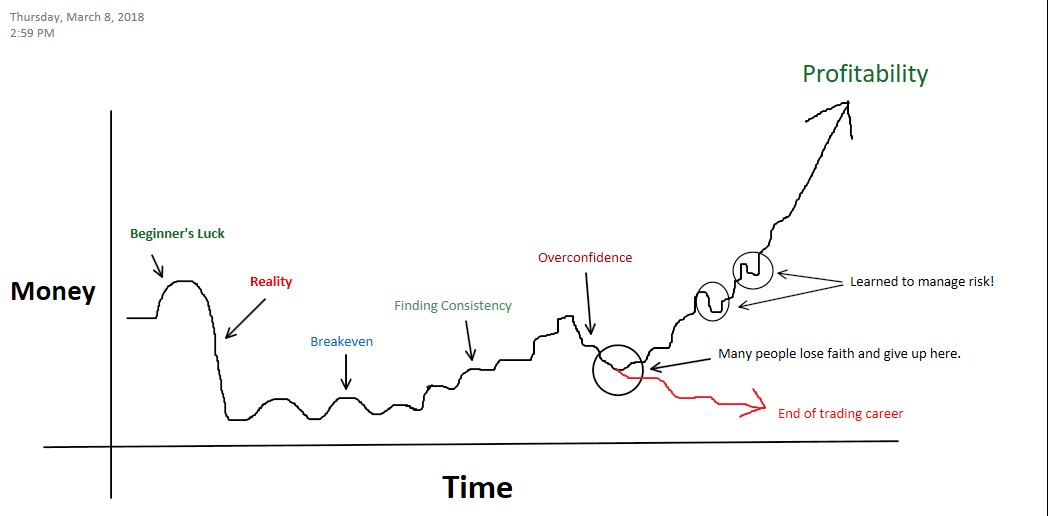
There are no shortcuts to becoming a successful trader. You may become an overnight sensation by luck of the draw; but you can just as easily blow up an account by not learning and practicing the fundamentals. You have to put in the hard work; and sometimes that means staying up late at night to build your watchlists; waking up early in the morning to watch premarket action; or spending your weekend charting patterns. The more prepared you are, the faster you’ll be able to make decisions, and the more confident you’ll be with managing your trades.

6. Practice makes perfect

Now that you’ve studied your charts, done your homework and built your trading

strategy, you’re ready to start trading. Keep practicing winning habits to increase your probability of success.

Sign up for a trading simulator. This will allow you to make mistakes and adjust your

strategy without the emotions that come along with having real money on the line. Remember, there is no rush to lose money. It’s better to be out of a stock and wishing you were in, than in a stock wishing you were out.

7. Drop outs don’t get the degree

No successful trader has won 100% of their trades. You will win some, and you will lose some. Stick with it! Take note of your wins and why they were successful. Journal your losses and how you can mitigate them. Manage your risk so you can stay in the game. Persevere through the downside until you see the upside. Never, ever give up.

The bottom line

If you want to make money as a trader, it’s going to take hard work and perseverance. As the stock market evolves with time, there are always new trends emerging. COVID-19 has brought with it a wave of volatility in the stock market that’s now being dubbed “The Kangaroo Market,” where stocks hop up and down between uptrends and downtrends over a period of time. You want to understand the fundamentals of how the market works so you can quickly adjust your trading strategy to take advantage of these new opportunities to make money.

With the right approach to learning, continuous study and consistent risk management, trading can be fun and profitable.

Get out there and crush it!

For real-time insight follow me on Twitter! @Mv3Trader

Comment below with your opinions and questions.

Going Live: Transition to Real Money

At this point you have learned a ton about the market, created your very own strategy, and discovered the power of your winning strategy through back-testing and paper trading. Now you are ready to start earning real cash from all your hard work!


Photo by David Travis on Unsplash

You have made a great deal of progress but your journey as a trader is just beginning. As you start trading with real money your focus should now be narrowed down to two vital areas. First and foremost is your discipline for trading your strategy as designed. The second is executing your strategy to perfection.


By this point you should have become fairly comfortable with your strategy and have more than likely made a couple tweaks. As you paper traded your confidence, discipline, and execution should have also progressed.


However, switching over to real money in a live account is a completely different ballgame which can result in wild swings of your account balance. It doesn’t really matter how much money you are trading with that will spell the difference between success and failure. Keep in mind, losing on a trade is not failure. Losing on several trades is not failure. As long as you are trading your strategy consistently with discipline, you will be a successful trader. It’s really that simple.


You’re Wired to Lose

The difficult part is not allowing your basic human response to “danger” get the best of you. As humans, protecting ourselves at all costs is hardwired in us for the benefit of our survival. However, this works against us in the stock market.


For instance, going flat on an order when you see it start to eat away at those profits you gained on the first pop only to watch it bounce and return to where you exited as it continues to soar to the moon. Or hesitating to hit the buy button because you feel uneasy that the trade will work out.


Even for someone like myself who never really had any emotional ties to money throughout my life, still couldn’t avoid the emotional rollercoaster of trading real money. For me, it was more about being wrong with real money that allowed the emotions to creep in and make themselves comfortable in my trading home.


In this phase, don’t be shy to make some further adjustments as needed, but I warn you, DO NOT change your strategy here. I cannot stress that enough. If you have not mastered discipline and consistent execution, you are not ready to go to another strategy. Even if that strategy looks like the best thing since sliced bread. It doesn’t matter how much potential you see in this newly discovered strategy. If you are not disciplined enough to trade your original strategy consistently, win or lose, without letting your emotions take over, that “better” strategy will not make any long-term difference in your profit/loss column.


Just remember, there’s a reason you decided to take the strategy you created live. So, just stick with it until you are a trading machine reaping the benefits of consistent profits from your mastery of the art of disciplined trading.


The Cold Streak

Also, an important muscle to build is noticing when your strategy is just not working out that day, week, or month. Even strategies with the highest accuracy rating, fine-tuned to perfection, will have days where it just does not work. The market is the most dynamic environment for making money. Every single strategy will have days or periods of time when it just will not work.


Plus, there will be days where your strategy is fine, but you are just off your game. The best athletes in their respective sport has had games where their performance was far from their potential. Trading is no different and every trader goes through this regardless of their experience level.


You will need to develop rules to protect yourself during these unavoidable periods of struggle. For example, I have a protective rule I call “three strikes”. Typically, there’s only two futures contracts that I trade daily. If I’m wrong on a contract three times, rather I made a mistake, or the strategy just didn’t work, I’m not allowed to take anymore trades on that contract for the rest of the day. This rule has saved me from blowing out my account many times when the market had no life or was just doing its own thing, trading irrationally.


Contrarily, I’ve had days like August 3, 2018 where I broke my protective rule (see screenshot of Tradervue entry below) (Include link for journal entry aug 3, 2018) and paid dearly. There will also be times where this rule was triggered just to watch the move I was looking for finally present itself after taking the third loss. All I could do was watch the profits I could have had run away from me. But I can tell you with certainty that it’s better to follow your protective rules and start fresh the next day. Remember, the market isn’t going to shut down any time soon. It’s a marathon, not a sprint.

Click image to see my trades on Tradervue.

Startup Capital

So how much of your hard-earned money should you start trading with? That is completely up to your comfort level. Conventional wisdom says you only want to start trading with money you’re okay with never seeing again. You definitely do not want to lose any of your money. However, as simple as trading can be, not everyone can do it with consistent success. Some people just cannot get over the emotional mountain of trading with real money.


The stock market has one certified guarantee for all participants, which is you WILL lose money. There’s absolutely no way to get around it. If you just can’t separate yourself from your bottom line, maybe more passive long-term investing is a better fit for you, where you can just set it and forget it.


If you feel discipline is more of a struggle for you than the emotions, I would recommend starting with a small amount that will force you to make good decisions as you will have less of a cushion to fall back on. Once you have mastered being disciplined you can always add more funds to your account later. If you can grow a small account, you should have no problem growing a larger account. Just maintain the same disciplined strategy that helped you grow that small account. The only thing that would change is your account balance.


Go Forth and Crush!

Photo by Miguel Bruna on Unsplash

Congratulations, you have learned all the essentials to building your very own trading strategy and you should be well on your way to major gains! Now, all you need is the experience to go along with everything you have learned. Don’t get discouraged if you get off to a rough start. Even if you do like me a get off to a bang followed by a series of rough patches, remember it’s all part of the process. Manage your risk and stay disciplined with patience and you will have a long career as a trader. Just like with everything else in life, the more you do it the more you will improve. The challenge is lasting long enough to make it through the rollercoaster phase. Remember, it’s a marathon not a sprint.