Trading is risky! Past performance does not guarantee future results. Click here to read our full Disclaimer

Some sessions are easy to sit through. The setup forms, the trigger fires, price moves toward the target with reasonable directness, and the position closes cleanly. Those sessions build confidence in an almost effortless way.
And then there are sessions like this one.
Volatile conditions, heavy price swings, back-and-forth movement that makes every open position feel like it is one candle away from going wrong. The kind of session where the plan is clearly right but the market seems determined to make holding it as uncomfortable as possible before proving it.
This session produced one of the better performance days for the current strategy in recent months. Three positions, all taken on rule-based criteria, all profitable. And it was also one of the harder sessions to sit through mentally. Those two things are not a contradiction. They are directly connected.
What Should You Do When the Market Tests Your Patience Mid-Position?
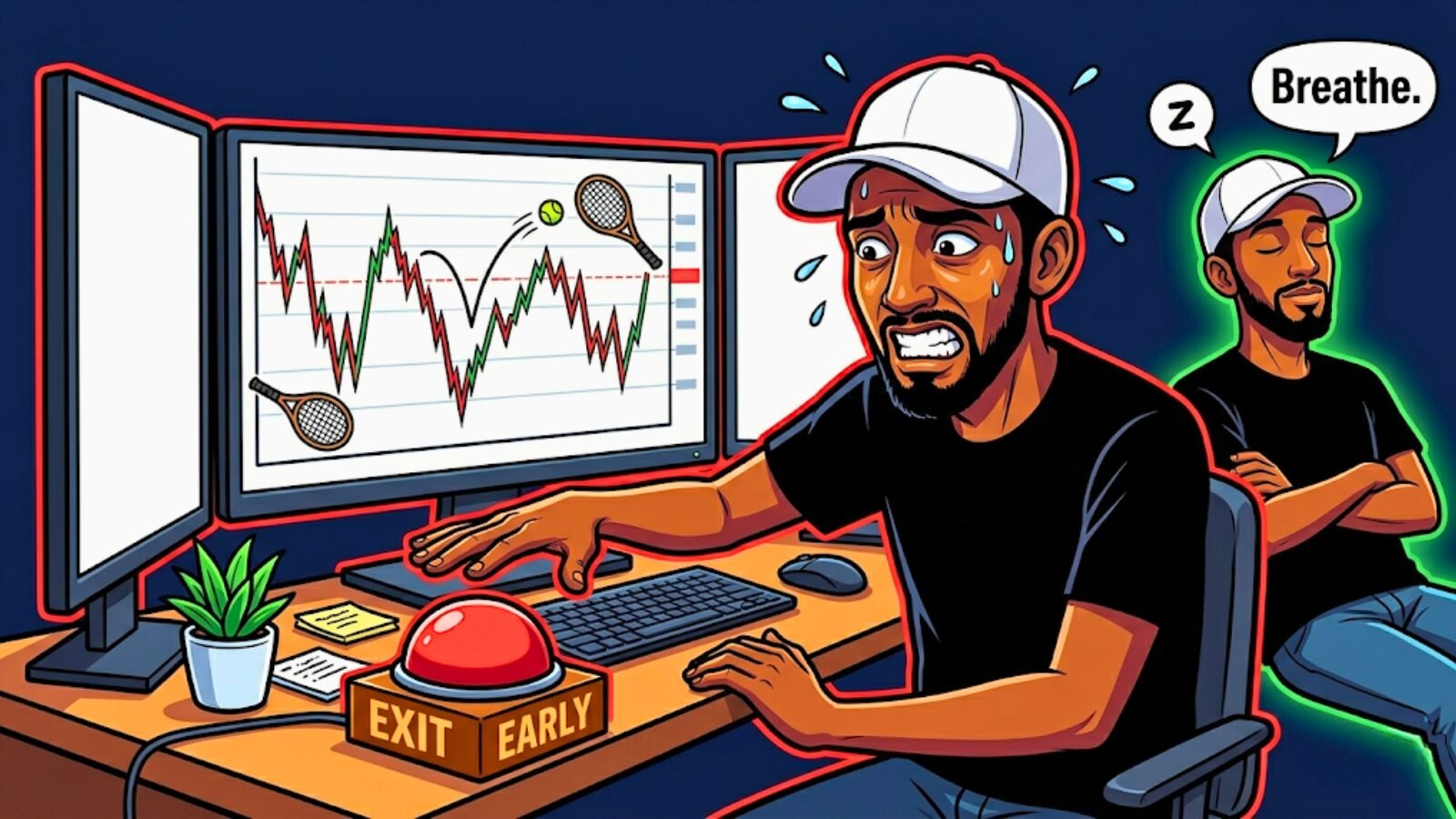
There is a specific kind of price action that creates the most psychological pressure for a trader holding an open position. Not a clean move against the trade, which is easier to process because at least something clear is happening. The harder pattern is what I call the tennis match (most people call chop): price swinging back and forth, testing both sides of the position, never quite picking a side to continue or reverse the trend. Just grinding.
That pattern is not random and it is not personal. Wholesale participants are facilitating the orders sitting on their books, managing their own inventory against a budget, and working toward exits that match the positions they accepted as they keep the market efficient for everyone involved. An individual stop is not on their radar. They are focused on finding the other side of their own position at a price that respects the spread between where they took on the risk and where they can profitably exit it. The back-and-forth movement that feels like a test is just what that process looks like from inside a retail position. Understanding that context does not make the discomfort disappear, but it removes the emotional charge that comes from feeling targeted.
What does help in the moment is breath.
Not as a motivational ritual, or as something to do while waiting passively, but as an active redirection of the physical energy that builds during choppy conditions. The impulse to exit early, to adjust the stop, to do something that the plan does not call for, that impulse has a physical component. Redirecting focus into breath interrupts the cycle before it produces a decision. The position stays open. The plan stays intact. The discomfort gets processed without being acted on.
This is a core principle in Pull the Trigger: How to Stop Missing the Trades That Pay. The psychological interference that breaks execution is almost always physical before it becomes a decision. Breath work is not a soft skill. It is a real-time execution tool.
Is the One Trade Per Day Approach Actually Better?
This question came up during this session and it is worth addressing directly because the one-trade-per-day framework has a genuine appeal that deserves an honest examination rather than a quick dismissal.
The math sounds clean on the surface. Take one high-quality trade per day, hit a consistent target, and the results over a month should be solid. Less screen time, less decision fatigue, fewer opportunities to make mistakes.
The problem is in the application. Limiting to a single daily trade requires narrowing the criteria to only the absolute highest-quality setups, which in practice means passing on valid, rule-based triggers that do not reach that subjective threshold. Over time, that habit of passing on valid triggers is exactly the kind of pattern that bleeds into the rest of the trading process. The hesitation built from constant selective restraint does not stay contained to the “not quite A+” setups. It starts showing up on the ones that clearly qualify, resulting in fomo, overtrading, chasing trades, and compounding mistakes that deteriorate the account balance.
There is also the data problem. A one-trade-per-day approach generates a much smaller sample of execution data over time. The statistical foundation for evaluating whether the system is working becomes thinner. It takes much longer to accumulate the kind of evidence that makes informed adjustments possible.
For me, the approach that fits better, and what this session demonstrated clearly, is an accuracy-focused system with multiple rule-based triggers. Not trading more for the sake of activity. Taking every trigger that meets the full criteria, following the rules completely, and letting the results accumulate across a meaningful sample. Today that produced three positions. All three were taken cleanly. All three were profitable.

What Does 100% Rule-Based Execution Actually Produce?
The session note going into this morning carried a line worth sitting with: “Allow your imagination to do its job of ruining the surprise.”
That line is about anticipation. Imagination does not stop at realistic scenarios. It runs to best and worst-case outcomes with full commitment, especially when the market is being choppy and the position is not moving cleanly toward the target. Imagining an array of scenarios helps you plan for a response, mitigating impulse decisions in the moment that drives early exits, adjusted stops, and rule violations that feel smart in the moment and costly in hindsight.
Use data to support the plan your imagination produced. Zooming out across sessions, the pattern is clear: taking small early wins to avoid a potential loss your ego is forecasting as a protection mechanism actually leaves more on the table over time than holding the plan would have. The system was built around specific target levels for a reason. Those levels reflect real market behavior and real historical data.
This session produced one of the better performance days for the current strategy in recent months. Every position was 100% rule-based. No discretionary decisions, no finessing, no adjustments made because a position felt uncomfortable. Each target was patiently hit without stepping in to intervene because “something doesn’t feel right” or “I’ve seen this not work out before”. All of those voices were very real in the moment (more on that later), but preparation and keeping the bigger picture in mind allowed them to be silenced before hijacking the moment.
Not trying to finesse trades and following the system completely produces better results in the long run. That is not a belief. It is what the data shows.
How Does Ego Show Up in a Live Position?
Ego gets discussed a lot in trading circles, usually as something to eliminate. The framing here is different. Ego is not the enemy. It is a protection mechanism that is trying to do its job, just pointed at the wrong target.
When a position is open and price is swinging back and forth in tennis match fashion, ego reads the situation as a threat. The rationalization it produces sounds reasonable: take the small win now, protect the capital, be smart about risk. What it is actually doing is protecting self-image from the discomfort of a potential loss, not protecting the trading operation from a genuine risk that the plan has not already accounted for.
The reframe that works is redirecting what ego is protecting. Being right in trading does not mean the position goes where you want it to go. Being right means the plan was followed. A position that gets held through choppy conditions, hits the stop, and closes as an expense is still a correct execution if every decision along the way was inside the plan. A position that closes early because ego manufactured a justification for bailing is a mistake even if it happens to be profitable.
That distinction, between being right for the money and being right for the plan, is one of the more important things to internalize in trading. Once it lands, the whole relationship with individual position outcomes changes. The emotional investment shifts from whether the trade wins to whether the execution was clean.
Even a position that would have resulted in an expense can be a good trade. That is not a rationalization. That is how a rule-based process actually works.
What Does Self-Experimentation Teach That Following Others Cannot?
There is a version of trading education that is essentially: here is what works, here is what does not, follow the rules and avoid the mistakes. That framework has value. But it also has a ceiling.
A trader who has only ever followed prescribed rules has a borrowed understanding of those rules. They know what they were told. They do not know why the rule exists from the inside, what it feels like to break it, what the market actually does when the boundary gets crossed. That surface-level understanding tends to crack under the conditions that matter most: volatile sessions, live positions, real money on the line.
Personal exploration builds a different quality of understanding. Not reckless exploration, not ignoring risk, but genuine curiosity-driven engagement with concepts that are typically taught as things to avoid. That kind of firsthand experience produces clarity that instruction alone cannot. It also eliminates a specific kind of anxiety: the anxiety that comes from wondering whether the person teaching the rule is being honest about their own results.
When the knowledge comes from direct experience rather than someone else’s account, that question simply does not come up. The understanding is grounded in what actually happened rather than what was claimed to happen. And if your experience tells a different story than their teachings, it does not mean they are wrong. It’s just evidence to the difference in your perspectives. Nothing wrong with that.
This approach to learning also builds the confidence to evaluate outside advice objectively rather than accepting or rejecting it completely. Not dismissing conventional wisdom, but not deferring to it without examination either. That kind of independent judgment, developed through personal exploration and honest documentation, is where genuine trading confidence actually comes from.
The Session That Required the Most Patience Produced the Best Results
The final position of this session required the most patience of the three. Price worked its way through the tennis match pattern for an extended period before finally breaking in the direction the plan called for and hitting the target. Every moment of that process produced the same set of impulses: exit now, no need to take a full loss, do something!
Nothing was done to the position. The breath stayed the focus. The plan stayed intact.
The position hit the target.
There is a relationship between staying in the discomfort and the outcome that follows. Not in a mystical sense, but in a practical one. The trades that require the most patience to hold through are often the ones that hit full targets because the choppy price action that makes them uncomfortable is the same action that builds the energy for the eventual move. Exiting early to escape the discomfort means exiting right before the reason the trade was taken in the first place shows up. I have made this decision so many times in the past, which often ended in regret as I watching the breakout shoot to where my planned target was.
Patience in trading is not passive waiting. It is active discipline applied to what can be controlled: breathing, staying focused, and committing to the plan, while letting go of what cannot be controlled, like price, timing, and the path the market takes to get where the system hopes it will going.
Three rule-based, profitable positions. One of the better strategy performance days in recent months.
The plan did exactly what it was designed to do. The only job was to follow it.
Trade it easy ✌🏾



