Trading is risky! Past performance does not guarantee future results. Click here to read our full Disclaimer

The setup was there. The conditions lined up. And the rule said wait.
Not because the trade was not valid. Not because the market was unclear. But because there was an unresolved technical issue sitting between the current moment and any position being placed, and the rule on that is not ambiguous: fix the problem first, trade second.
So the setup was skipped to resolve the audio clipping issue. And of course the skipped setup turned out to be one of the cleanest I have seen in a while.
Welcome to HINDSIGHT CAPITAL, LLC (fictional entity)! 100% success. Zero percent real-time. 🤝
This session was a green day with one trade taken cleanly and one setup correctly skipped. By execution standards, 100% accuracy was achieved for this session. That is the result worth focusing on, not the setup that looked good after the rule was appropriately followed.
What Should You Do When a Technical Issue Happens Right Before a Trade?
The answer is built into the rule: resolve the issue before placing any trade. No exceptions, no “I’ll just take this one and fix it after.”
Here is why that rule exists.
A technical issue during a live session is a variable that sits outside the plan, taking up mental space. An open position with an unresolved technical issue introduces a split-focus problem at exactly the moment when full attention is required. If the issue affects the platform, the audio, the recording, or the ability to monitor the position clearly, the risk being taken on is no longer just the defined risk of the trade. It is the defined risk plus whatever the technical problem might create at the worst possible moment.
The rule removes that compounding risk, even if the current instance appears minor. Resolve the problem first. Trade after.
What the rule also produces, and this is the part that is harder to sit with, is the occasional missed setup. This session was a direct example. The audio troubleshooting was happening during the RTH open. Although a possible clean setup was in sight, the rule said the troubleshooting had to be completed first. By the time it was resolved, the moment had passed.
In hindsight, that was the perfect setup where momentum carried to a quick target hit. But hindsight is not a trading tool. Hindsight does not know what the audio issue would have done mid-position. Hindsight does not carry the weight of the decision. The rule was right at the time it was applied, regardless of what the chart looked like afterward.
Execution accuracy is not measured by what the market did after a rule was followed. It is measured by whether the rule was followed at all.
Why 100% Accuracy Does Not Always Mean Maximum Trades
This session produced one trade following the skipped trade for troubleshooting. Both of those outcomes were correct.
That framing matters because there is a version of trading that evaluates sessions purely by opportunity captured. How many setups were available, how many were taken, and what was left on the table. That framing quietly redefines success as maximizing trades rather than maximizing plan adherence, and those two things are not the same.
The long-term objective is plan adherence. Every session.
Accepting planned risk is the only way to win. That line from the session notes going into this morning is worth sitting with because it contains more than it appears to on the surface. Planned risk includes the risk of missing a setup when the rules say conditions are not right for a trade. That is a real cost. It shows up as a missed opportunity in the session log. And it is still the correct decision.
A trader who bends these seemingly minor rules to avoid missing a setup is not maximizing opportunity. They are accepting unplanned risk, which is a different category entirely. The plan accounts for missing setups. It does not account for what happens when a technical problem intersects with an open position and there is no bandwidth to manage both.
One rule-based skipped trade, followed by a perfectly executed trade per the predefined rules, makes for a good trading day with 100% accuracy.

There Is Nothing Genius About a Good Exit
The trade that was taken today exited at the point of rotation into the opposite direction. The decision to take profit at the peak of the move was fully guided by the plan. Nothing more.
There is nothing genius about that.
That is worth saying directly because trading has a subtle trap built into good outcomes: the tendency to attribute smart results to instinct, feel, or exceptional reads rather than to the system that produced them. When a position closes at a clean level and the chart goes on to confirm that the exit was well-timed, it is easy to take that as evidence of sharp judgment. What it is actually evidence of is a well-designed plan being followed.
The problem with confusing the two is that instinct is not repeatable. A system is.
Keeping execution separate from outcome is one of the more important habits to build in trading. The exit today was correct because the plan said to exit there, not because of some “smart” read on current conditions. If the market had kept going after the exit, the exit would still have been correct. The trades are not evaluated by what the chart does after the position is closed. It gets evaluated by whether the rules were followed while the position was open.
This is a principle that runs through Pull the Trigger: How to Stop Missing the Trades That Pay. The confidence that makes clean execution possible is not built from feeling smart about good outcomes. It is built from the documented evidence of a process that has been followed consistently over time. That is a very different foundation, and it holds up under conditions that feel-based confidence cannot.
What Does Past Documentation Reveal About Where the Process Is Now?
Something unexpected came out of this session: a collection of historical game film and screenshots from 2023, found stored in a browser extension that had not been checked in a while. Real session footage from a few years ago, sitting in a forgotten corner of the workflow.
Looking back at that material was useful and humbling at the same time.
What seemed like adequate documentation at the time lacks the detail that would make it genuinely useful now. The notes are thinner. The context is missing. The level of specificity that the current process requires is just not there in the older records. Not because the effort was not real at the time, but because what is known now about what good documentation looks like is different from what was known then.
What a trader does not know changes over time. And old records reflect the knowledge level of the person who made them.
This is actually an encouraging observation once the initial frustration passes. The gap between what the 2023 documentation captured and what would be captured today is evidence of real development. The standard for what constitutes useful data got higher because the understanding of the process got deeper.
The practical application is to use that old footage as backtesting material. Test current strategy assumptions against historical setups from a few years back to see how the current rules would have applied to those conditions. That is a legitimate data source that was almost overlooked entirely.
How Should a Trader Evaluate New Journaling and Documentation Tools?
The documentation workflow question is ongoing. A new local-hosted trading journal tool called Aurafy came up this session as worth evaluating. The session also surfaced the question of whether the Awesome Screenshot extension, where the 2023 footage was discovered, might still serve a purpose in the current workflow or whether it is time to consolidate.
The criteria for adding any new tool to a trading operation is straightforward: does it reduce friction in the documentation process without introducing new friction somewhere else?
A tool that makes screenshot capture faster but requires a separate workflow to get those screenshots into the central journal is not necessarily a net improvement. A tool that integrates directly with the journaling process and captures the right data at the right level of detail is worth the time to evaluate properly.
Aurafy is on the testing list. The evaluation criteria are already in place. That is the right order: define what the tool needs to do, then test it against those criteria, rather than adopting it because it looks impressive and figuring out what problem it solves later.
The broader principle is the same one that applies to strategy tools, automation, and anything else that gets added to the trading operation: the tool serves the process, not the other way around.
The Physical Layer Principle: A Troubleshooting Lesson That Goes Beyond Tech
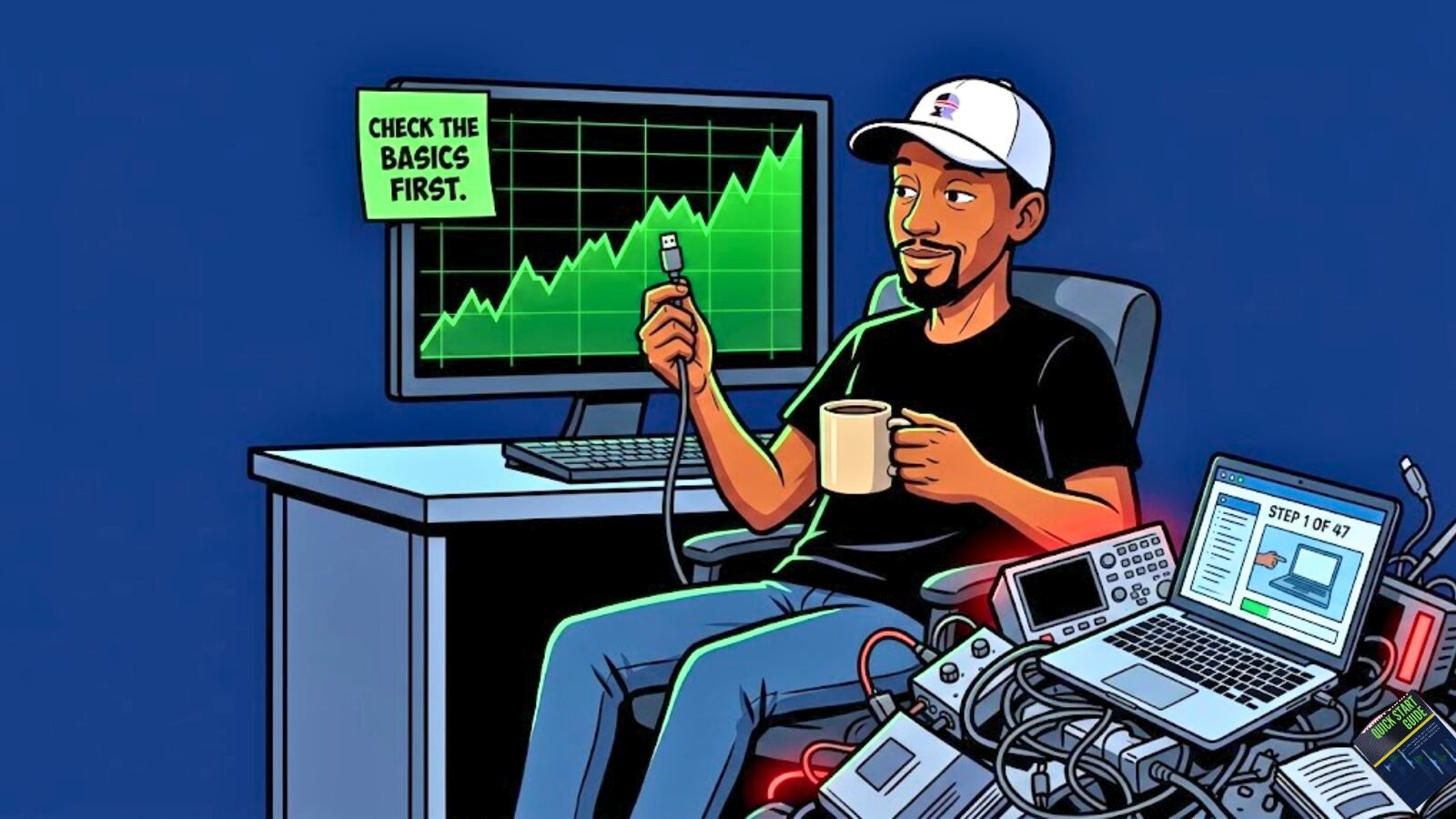
The audio issue got resolved this session through a principle borrowed directly from professional IT troubleshooting: always check the physical layer first.
Before assuming a software problem, a configuration issue, or a settings conflict, check the physical connections. Reseat the cables. Check the port. Verify the hardware is actually communicating before digging into the software stack. In this case, reseating the USB connection on the audio interface resolved a clipping issue that had been causing problems across multiple sessions.
That principle is worth carrying beyond technology.
In trading, the equivalent of the physical layer is the basics: is the plan being followed? Are the criteria actually being met before a trigger is taken? Is the documentation happening consistently? Before assuming that the strategy has a deeper problem, verify the fundamentals are intact. Most of the time, when something is not working in a trading operation, the answer is at the physical layer: a rule that has quietly drifted from its original criteria, a documentation habit that has gotten inconsistent, a pre-session routine that has been shortcut.
Check the physical layer first. The complex explanation is rarely the right one when the simple one has not been ruled out.
This applies to strategy troubleshooting as I’ve documented in my journal process: before concluding the system is broken, confirm the system is actually being applied as designed. That question alone resolves more apparent strategy problems than any technical adjustment ever has.
The Plan Worked Because It Was Followed, Not Because the Market Cooperated
Green session thanks to clean execution.
- One setup correctly skipped under active troubleshooting.
- Audio issue resolved with a documented solution that will hold up the next time the same problem appears.
- One trade taken on valid criteria.
Hindsight does not get to rewrite any of those decisions. The rule was followed at the time it needed to be followed, based on the information available at that moment. What the market did after the setup was skipped is interesting but not relevant to whether the decision was correct.
Discipline is not just about following the plan when it’s easy. It’s about following the plan no matter how good (or bad) the results may look in the rearview, or if the internal argument for bending the rule just this once is genuinely convincing.
The traders who build something durable are the ones who follow the plan on exactly those days. Not because the outcome will always validate the decision, but because the process only works if it is actually followed.
Accepting planned risk is the only way to win. Even when planned risk looks like a missed trade in the session log.
Trade it easy ✌🏾



